
A woman died on Friday night after a Tesla Model 3 crashed through the front of a house in Katy, Texas, in a wreck the driver told deputies happened while the car was operating on autopilot.
Whether autopilot, Full Self-Driving, or no driver-assistance feature at all was active in the Katy crash remains an open question for investigators.
Martha Avila, a 76-year-old resident, was standing in the front room of the home when the vehicle entered at high speed, according to the Harris County Sheriff’s Office.
Life Flight airlifted Avila to Memorial Hermann hospital, where she later died from her injuries.
The crash happened around 8 p.m. in the 21300 block of Rose Hollow Lane, in a residential neighbourhood in west Harris County, near the intersection of Rose Hollow Lane and Blooming Park Lane.
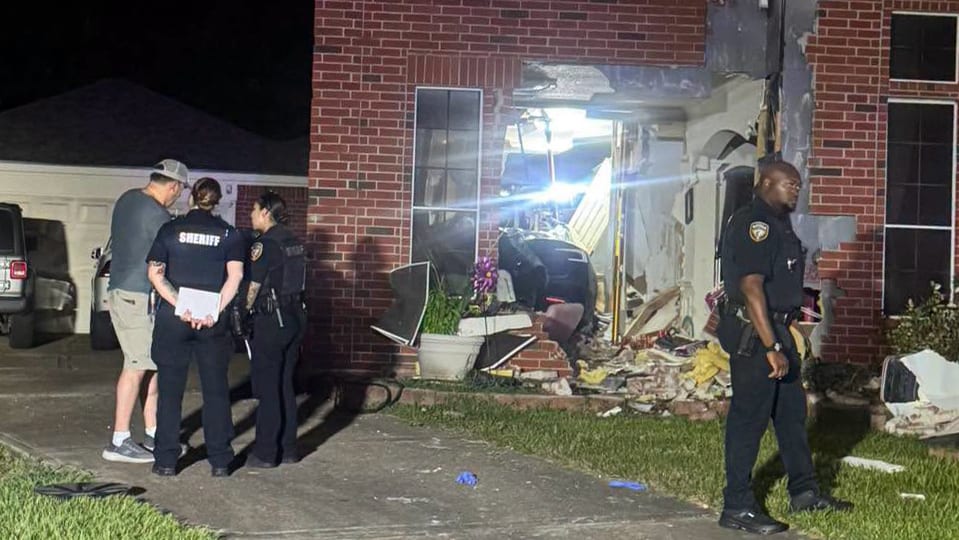
Investigators said the Model 3 was travelling eastbound when the driver failed to maintain a single lane, left the roadway and failed to make a right turn at the intersection before striking the house and coming to rest inside the front room.
Photographs released by the Harris County Precinct 5 Constable’s Office showed the car driven clean through the brick façade, with debris scattered across the lawn and emergency crews working at the scene after dark.
“He Had the Tesla on Auto Pilot”
The driver, identified by KHOU as a 44-year-old man named Michael Butler, was taken by ambulance to a nearby hospital with injuries.
According to the Precinct 5 Constable’s Office, headed by Constable Terry Allbritton, the driver “told deputies he had the Tesla on auto pilot” at the time of the crash.
Butler showed no signs of intoxication and has cooperated with officers throughout, the Sheriff’s Office said, and no charges had been filed as of Saturday afternoon.
Crucially, the account that the car was driving itself comes from the driver, and investigators have not confirmed that any automated system was engaged, let alone that one caused the crash.
Sgt. Alex Turman of the Sheriff’s Office said the agency is working with people familiar with Tesla vehicles and with the driver to determine “what role the driver’s control over the car played in this crash.”
The Harris County Sheriff’s Office Vehicular Crimes Division is leading the investigation, examining the vehicle’s automated systems, the driver’s actions, and the speed at which the car was travelling before impact.
Tesla markets two separate driver-assistance products — the older Autopilot system and the more advanced Full Self-Driving, now branded “Full Self-Driving (Supervised)” — and both require a fully attentive driver ready to intervene at any moment.
Neither is an autonomous system, and the company states that drivers remain responsible for the vehicle at all times.
Whether autopilot, Full Self-Driving, or no driver-assistance feature at all was active in the Katy crash remains an open question for investigators.
Tesla, which disbanded its media-relations team years ago, has not commented on the crash and does not typically respond to press inquiries.
A Pattern of Federal Scrutiny
The fatal wreck lands in the middle of an intensifying regulatory campaign against Tesla‘s automated-driving technology.
In October 2025, the National Highway Traffic Safety Administration opened a preliminary evaluation into roughly 2.88 million Tesla vehicles equipped with Full Self-Driving, after more than 50 reports of traffic-safety violations.
The agency said the software had “induced vehicle behaviour that violated traffic safety laws,” citing cars that ran red lights and drove against the proper direction of travel during lane changes.
Investigators were reviewing 58 such reports, including 14 crashes and 23 injuries, and a preliminary evaluation is the first step the regulator must take before it can seek a recall.
A separate and older inquiry has advanced further. NHTSA has escalated its reduced-visibility probe into 3.2 million Teslas to an engineering analysis, the stage that typically precedes a recall, after finding that Full Self-Driving struggled to detect and warn drivers in conditions such as fog and sun glare.
That probe was triggered in part by a crash in which a Tesla using the software struck and killed a pedestrian.
Not every investigation has gone against the company. Earlier this year, the regulator closed its inquiry into the Smart Summon feature across 2.6 million vehicles, though it stressed that the closure was not a finding that no defect existed.
US regulators have nonetheless scrutinised Tesla‘s driver-assistance systems for years, including a 2024 crash near Seattle in which a vehicle using Full Self-Driving struck and killed a motorcyclist.
Mounting Legal Exposure
In August 2025, a Miami federal jury returned a verdict of roughly $243 million in a 2019 Autopilot crash that killed 20-year-old Naibel Benavides Leon and gravely injured her boyfriend, finding the system defective.
In February 2026, a judge rejected Tesla’s bid to overturn that $243 million judgment, ruling that the evidence “more than supported” the jury’s decision and exhausting the company’s options at the trial-court level.
The case was significant because jurors held the manufacturer partly liable even though the driver was distracted, breaking through a long-standing defence that an inattentive driver alone is to blame.
Since that verdict, Tesla has quietly settled several additional Autopilot crash lawsuits rather than risk further jury decisions.
Robotaxi Ambitions at Stake
The Katy crash also arrives at a delicate moment for chief executive Elon Musk’s driverless ambitions.
Tesla launched a limited robotaxi pilot in Austin in June 2025, using Model Y vehicles overseen by a human safety monitor, and the rollout quickly drew regulator attention after videos showed cars driving on the wrong side of the road and braking erratically.
By mid 2025, the company had begun offering driverless employee rides in Austin without safety operators on board, a step toward removing the human monitor entirely.
Until now, Tesla‘s expansion of its robotaxi service with Model Y SUVs has been slower than expected, according to non-official trackers.