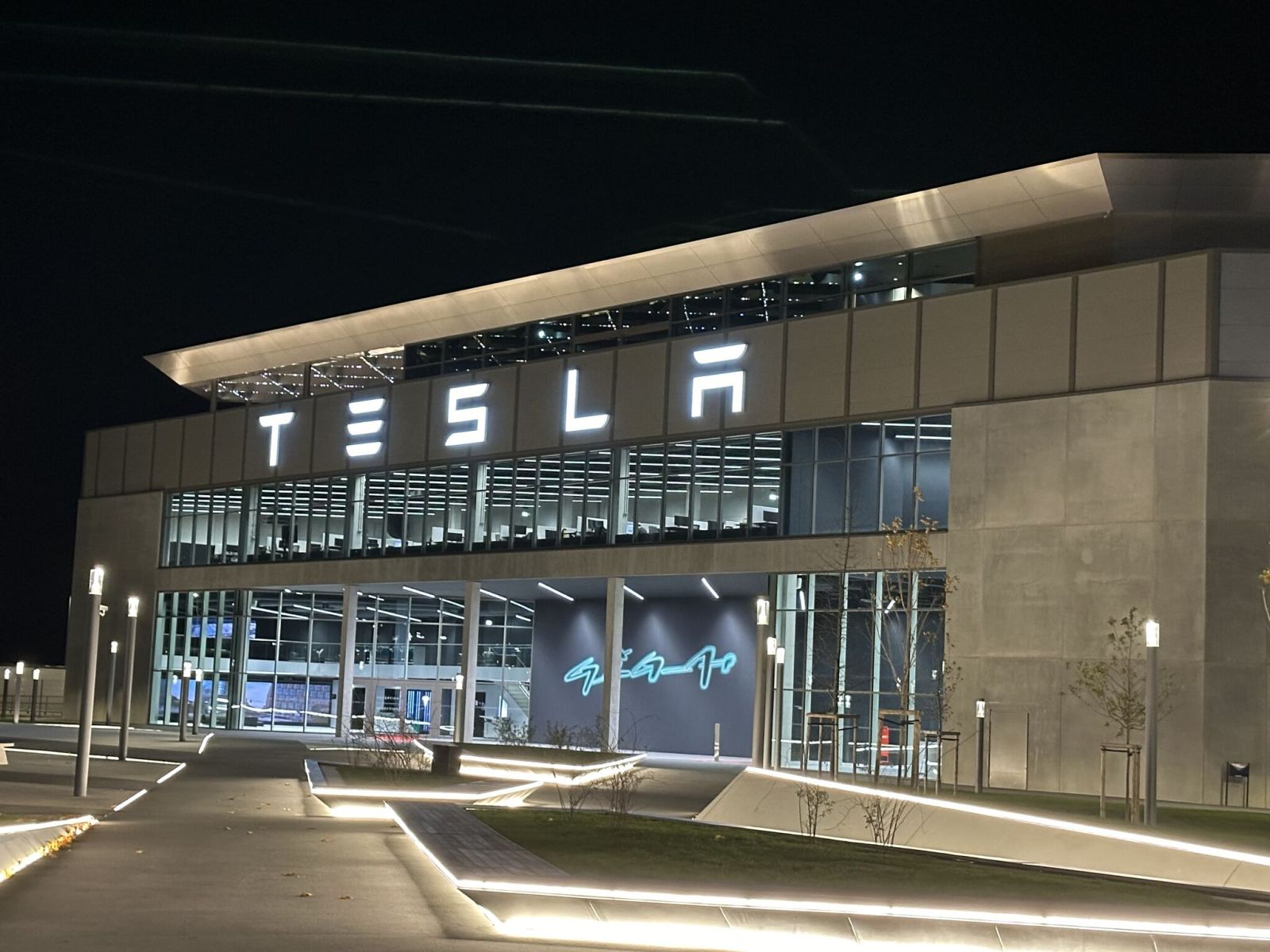

Tesla has scheduled mandatory special shifts at its Grünheide factory this month as the company races to lift weekly output to 7,500 vehicles by mid-October, according to an internal email seen by Handelsblatt.
“We have agreed with the works council on the following mandatory special shifts in September 2026,” the Giga Berlin Leadership Team wrote in the email to staff.
Three dates follow: a Friday night shift on September 18, a Saturday early shift on September 19 and a Friday night shift on September 25.
Each of the plant’s three shift groups — Blue, Red and Silver — is affected once.
Shifts cover “the entire vehicle production including all support functions,” the email states.
Drive Unit, Battery and Cell departments are exempt.
Plant director André Thierig had already thanked battery-cell production in June for contributing special shifts during the ramp-up.
Grünheide currently produces fewer than 6,500 Model Y units per week, according to information from the plant cited by Handelsblatt.
Closing the gap to 7,500 requires both faster cycle times and extra hours on the line.
From 5,000 to 7,500
Tesla’s European production ramp has accelerated sharply in 2026.
Thierig told Tesla Owners of Silicon Valley in June that the factory was producing about 5,000 cars a week and was supply-chain constrained at that rate, as EV reported.
Output was set to rise above 6,000 from July. By mid-summer the plant had pushed past that mark.
At a June works meeting, Thierig announced plans to cut cycle time — the interval within which a vehicle must pass through one station — from about 80 seconds through 60 to 45 seconds, and to raise weekly volume from 5,000 to 7,500 units.
Engineers have largely achieved the 45-second target, Handelsblatt reported, however volume has not followed.
Around 450 cars currently roll off the line per shift.
With two extra shifts in the week of September 14 and one in the following week, Tesla could reach 7,100 to 7,300 vehicles in its strongest week — still short of the 7,500 goal.
Automation has been a sticking point.
Many stations were upgraded and automated during the ramp, and much of the new equipment has not worked as intended, one employee told Handelsblatt.
When production falls behind schedule, management applies heavy pressure.
Everything is geared toward the mid-October target, the employee said.
Production Expansion
In 2025, Grünheide built about 202,000 vehicles and ran at 54% of the 375,000-unit annual capacity Tesla reports as installed at the site; the plant’s permit allows 500,000 a year.
Reaching a sustained 7,500-per-week rate would lift annualized output to about 390,000 — effectively maxing out the existing permit.
Thierig told Automobilwoche in June that the plant holds permission to expand to up to one million vehicles a year, though no decision has been made on which additional product would follow the Model Y at the site.
Handelsblatt reported that a union-affiliated works council member objected at the June works meeting that a production increase of about 50% was being matched by only around 20% more staff.
However, Thierig disagreed. “We’re doing all of that right.”
Tesla’s German subsidiary reported 2025 revenue of €7.1 billion, down from €7.7 billion, with net profit rising to €77.1 million on lower production costs.
European Demand
Surging European demand underpins the urgency.
Tesla’s German registrations surpassed the full-year 2025 total of 19,390 units by the end of May, reaching 21,089 in five months.
The plant’s home market gives an uneven picture of the demand behind the target.
Tesla’s German registrations surpassed the full-year 2025 total of 19,390 units by the end of May, reaching 21,089 in five months, and the second quarter’s 16,028 was roughly four times the year-earlier figure, as EV reported.
Registrations then fell to 367 in July, down 66.9% year on year and a 0.1% market share, the weakest month since the plant’s own 2025 changeover, before recovering to 3,034 in August, up 111% on a year earlier but 41% below May.
June to August combined, the three months since Thierig’s announcement, came to 11,169 registrations against 17,512 in March to May, a 36.2% decline, according to KBA data.
In the first eight months of 2026, Tesla registered 32,258 vehicles in the country**, up 182% on the same period of 2025 and 166% of last year’s total.**
The July trough follows Tesla’s practice of shipping Grünheide output to export markets early in each quarter before concentrating German registrations toward quarter-end, a pattern EV has documented in January and April.
In 2025, German sales fell 48% year over year amid the transition to the refreshed Model Y, rising competition and fallout from CEO Elon Musk’s political involvement.
Continent-wide, year-to-date registrations through April stood at 89,429 units, up 45.8% from the same period a year earlier, according to ACEA data.
Germany’s reinstated federal EV purchase incentive — a €3 billion program offering private buyers between €3,000 and €6,000 depending on household income and family size — has added further tailwind since applications opened in May.
Tesla raised Model Y prices by €1,000 ($1,170) across several key European markets in late April — a move widely read as confirmation that demand was outpacing supply.
To meet the surge, the company hired about 1,000 new employees by the end of June and converted approximately 500 temporary workers to permanent roles.
Grünheide employs around 11,000 people and exports to more than 30 markets.
Premium Splits and FlexTime
According to Handelsblatt, Tesla pays a 35% premium for special-shift hours — but not to everyone. Employees whose FlexTime accounts are in negative territory receive no premium.
Instead, the extra hours are offset against their accumulated minus hours, the internal email states.
Works council approval for the shifts came from a body whose composition changed after a March election.
A list led by works council chair Michaela Schmitz, known for proximity to management, won 41% of the vote. IG Metall took 31%.