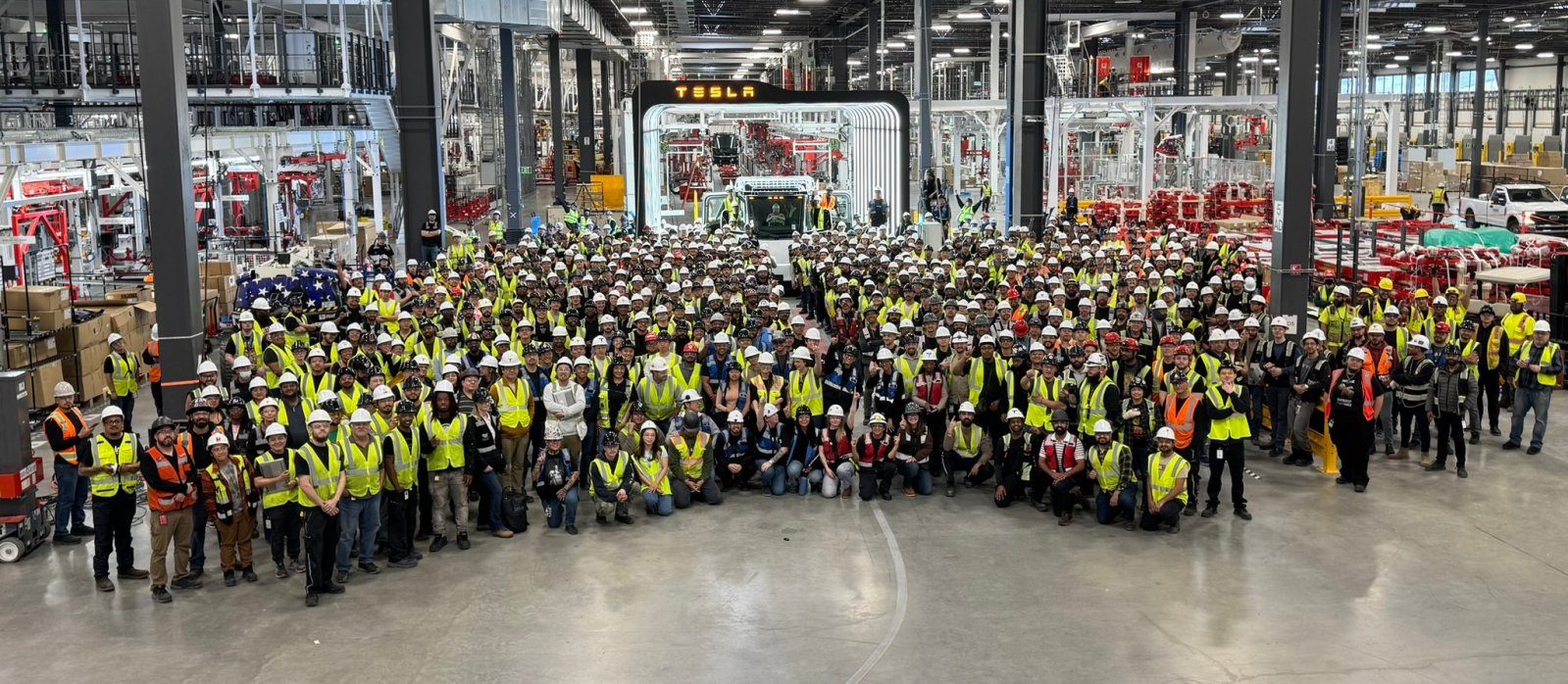

Tesla announced on Wednesday that the first Semi truck has rolled off its new high-volume production line, marking the transition from pilot builds to industrial-scale manufacturing at Gigafactory Nevada.
“First Semi off high volume line,” the company wrote in a post on X from its official Tesla Semi account.
The milestone comes just days after Tesla‘s first-quarter earnings call, during which CEO Elon Musk said the company had “just started production of Cybercab, and we’ll begin production of our Tesla Semi soon.”
The Semi is being built at a dedicated 1.7-million-square-foot factory adjacent to Gigafactory Nevada in Sparks.
The facility is designed for an annual capacity of 50,000 trucks, though Tesla has signalled that the ramp will be gradual.
Road to Volume Production
In its first-quarter shareholder update, Tesla still listed the Semi as being in “Pilot Production” at its Nevada facility — a status that has now changed with Wednesday’s announcement.
Musk warned in January that production of its new products would follow a stretched-out S curve. During the latest call, he reiterated the point.
“You should expect that initial production of Cybercab and Semi will be very slow, but then ramping up, and going exponential towards the end of the year and certainly next year,” Musk said.
The Tesla Semi was first unveiled in 2017 and originally promised for production in 2019 — a target that slipped repeatedly before Tesla finally delivered a handful of units to PepsiCo in late 2022.
Those early trucks were essentially hand-built on a pilot line.
As of March, Tesla had a few hundred Semis on the road with 13.5 million miles logged across commercial operations, with one truck reaching 440,000 miles.
Second-Generation Improvements
The truck now entering volume production is a significantly updated version compared to the original units delivered in 2022.
Tesla was spotted testing a redesigned Semi at its Fremont facility in February, featuring a Model Y-style light bar, improved efficiency, and increased payload capability.
Semi Program Head Dan Priestley told Jay Leno’s Garage that the truck has undergone “a lot of engineering improvements” since 2023, driven primarily by the need to prepare for high-volume manufacturing.
The second-generation Semi sheds roughly 1,000 pounds compared to its predecessor and achieves 1.7 kWh per mile — a 15% efficiency improvement — while maintaining a 500-mile range.
The truck delivers 800 kW of drive power and supports peak charging speeds of 1.2 MW.
The updated version incorporates several elements from the Cybertruck platform, including a 48-volt low-voltage system and a fully electric steering system derived from the pickup truck model, replacing the previous hydraulic-assisted setup.
The Semi is rated for a gross combination weight of 82,000 lb (37,195 kg) and a range of up to 500 miles (805 km) on a single charge.
Fleet Trials Building Demand
The high-volume production announcement comes amid a wave of commercial fleet trials and orders.
California-based freight brokerage AiLO Logistics recently launched a three-week operational pilot using the Semi on active freight lanes serving three customers.
DHL confirmed an order beyond “just a handful” of Tesla Semi trucks for 2026 delivery, after first testing the truck in 2024 in Livermore, California.
DHL Supply Chain reported energy consumption of 1.72 kWh per mile on a fully loaded 390-mile route.
ArcBest, another company that tested the vehicle, logged 4,494 miles over three weeks at 1.55 kWh per mile.
Those figures are broadly consistent with a prior cross-country test in which a first-generation Semi clocked 1.64 kWh per mile across 4,700 miles.
Uber Freight has also partnered with Tesla to deploy Semi trucks through its Dedicated EV Fleet Accelerator Program, designed to lower upfront costs for fleets purchasing the truck and route them through available charging infrastructure.
Charging Network
The truck can recover up to 70% of its range in about 30 minutes using Tesla‘s Megachargers — which the company is actively deploying as it prepares to ramp production.
Tesla confirmed in its first-quarter shareholder deck that it has deployed its first public Megacharger in Southern California.
Gigafactory New York is now producing V4 Supercharging cabinets, which Tesla says offer three times the power density and twice the number of stalls per cabinet compared to V3.
US fuel retailer Pilot Travel Centers has announced plans to install Tesla Semi chargers at travel centers along major US highways, with initial locations planned across California, Georgia, Nevada, New Mexico, and Texas.
Each site will feature four to eight charging stalls using Tesla‘s V4 cabinet technology, delivering up to 1.2 MW of power per stall.
Tesla is also preparing to launch the Semi in Europe, having hired a new head of Business Development for the EMEA region as it adapts the truck for European regulatory and freight transport requirements.
Broader Manufacturing Push
The Semi is part of a broader manufacturing ramp for Tesla in 2026.
The company said Cybercab, Semi, and Megapack 3 are all scheduled for volume production this year, with battery pack capacity remaining the limiting factor on ramping vehicle production, the company noted in the latest filing.
A key advantage of the Nevada location is vertical integration: the 4680 battery cells powering the Semi are manufactured in the same complex, eliminating the supply chain bottleneck that forced Tesla to deprioritize the truck for years.
Tesla previously guided full-year 2026 capital expenditures of more than $20 billion — a significant step up from approximately $8.5 billion in 2025 — with investments focused on factories for the Semi, Cybercab, and energy storage products.
During the latest earnings call, CFO Vaibhav Taneja raised that figure to more than $25 billion, with investments funding six new factories, AI infrastructure, and production ramps for the Semi, Cybercab, and Optimus humanoid robot.
The first quarter’s capital expenditures alone reached $2.5 billion, up 67% year over year.
Taneja confirmed the company expects free cash flow to turn negative for the remainder of the year as the spending accelerates.