RoboSense’s LiDAR sensors are now in mass production across nearly 70 vehicle models, with the Chinese supplier’s pipeline reaching nearly 180.
The company had achieved start of production on 69 vehicle models as of March 31, working with 17 automotive OEMs and Tier 1 suppliers — RoboSense said on Wednesday amid its Q1 2026 financial results.
The production footprint sits within a far larger pipeline of 177 vehicle models in design wins across 36 OEMs and Tier 1 suppliers as of the end of the first quarter.
RoboSense’s gap between the two figures — 177 design wins against 69 models in production — is due to a multi-year runway of contracted business still waiting to ramp.
A Widening Lead in China
RoboSense said it delivered more than 300,000 units of its solid-state E-platform products, including the E1 and E1R, as of April 15.
The company founded and led by Mark Qiu reported that its products were installed on 42.3% of LiDAR-equipped vehicles displayed at the Beijing Auto Show 2026.
RoboSense said it now serves more than 40 automotive brands worldwide across over 80 vehicle models, leading the industry in both model coverage and brand cooperation.
The company’s order backlog for ADAS exceeded 9 million units.
The BYD Anchor
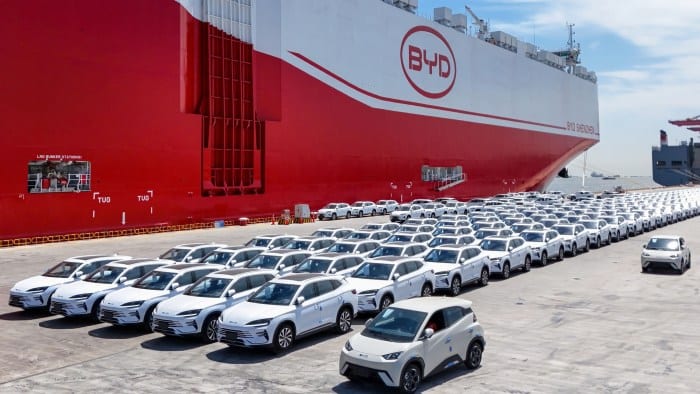
In March, RoboSense was named the exclusive LiDAR partner for all 11 new energy vehicles unveiled by BYD at its technology launch event in Shenzhen, as reported by EV.
The deal confirmed BYD as the unnamed leading Chinese EV maker behind up to 32 model design wins that RoboSense had disclosed during its second-quarter 2025 earnings call.
The eleven models span BYD‘s main brand alongside its premium Denza, luxury Yangwang and off-road Fang Cheng Bao sub-brands. RoboSense’s digital LiDAR was equipped exclusively across all configurable options.
BYD has since extended LiDAR as an option to entry-level models including the Seagull, its cheapest vehicle, in what RoboSense described as the “democratization of intelligent driving capabilities.”
New Chips Aim to Extend the Run
Last month, RoboSense launched “Eocene”, its self-developed SPAD-SoC digital architecture platform, alongside two new chips, Phoenix and Peacock.
The company plans to begin mass production of both chips in the second half of the year.
Phoenix supports 2,160 lines and has passed AEC-Q100 automotive-grade qualification, and a 4-megapixel LiDAR solution built on it has already secured design wins from leading automakers.
Peacock has commenced small-batch delivery, with large-scale production expected in the third quarter.
Volumes Surge as Earnings Improve
The expanding model count helped drive shipments sharply higher.
Total LiDAR shipments surged 204.1% to about 330,300 units in the quarter from 108,600 a year earlier.
Shipments of LiDAR for ADAS applications rose 49.7% to roughly 144,800 units.
Revenue climbed 39.9% to 458.8 million yuan from 327.8 million yuan, driven almost entirely by product sales.
The net loss narrowed 35.9% to 63.3 million yuan from 98.8 million yuan a year earlier. On a non-IFRS basis, the adjusted net loss shrank to 43.9 million yuan from 90.7 million yuan.
Gross margin slipped to 21.7% from 23.5%, which the company attributed to higher overheads from ramping its new EMX LiDAR products.