
Rivian and Volkswagen Group‘s joint venture is planning to enable real-time photorealistic 3D visualizations in future driver-assistance features — a step beyond the renderings most carmakers show today.
A new Palo Alto job listing shows the joint venture is seeking a Senior Manager to lead a software engineer’s team as the company develops a “fully integrated experience in our R1 and future vehicle lines.”
The JV says in the role summary that the candidate will “raise the bar for in-vehicle applications, such as real-time 3D rendering, and realize the next generation of self-driving visualizations, driver aids, and other 3D eye candy.”
The requirement for experience with game engines (with Unreal Engine cited as an example) suggests that the venture expects more than schematic overlays aiming for a next-gen 3D environment with materials, lighting, and dynamic scenes.
Rivian and Volkswagen entered a partnership late last year, according to which the German automaker agreed to invest $5.8 billion in the EV maker as it adopts Rivian‘s zonal architecture and software stack in its future electric vehicles.
The new job listing, first reported by X user Chris Hilbert, comes as Rivian’s founder and CEO RJ Scaringe opens the door to bring LiDAR back to the brand’s vehicles.
“Our view is that it’s definitely beneficial, and our approach to sensors has been that we need to rapidly build our foundation model as fast as possible,” Scaringe said earlier this week.
While noting that the price of LiDARs has been crashing over the last few years, the CEO said, “it’s a really great sensor that can do things that cameras can’t.”
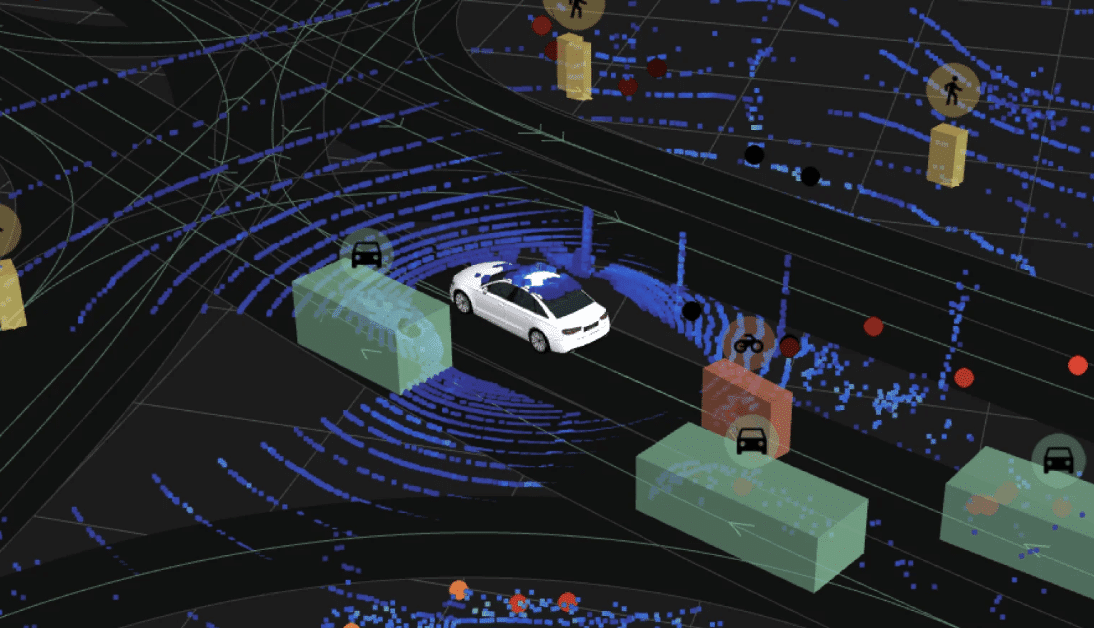
The Rivian-VW brief explicitly calls for game-engine expertise and photoreal materials/lighting, implying a synchronized scene-graph that is updated by the perception stack and rendered with higher fidelity than current production systems.
That would require tight coupling to the central compute/zonal controllers and strict latency bounds so the visuals track the world state in lock-step.
Tesla renders a dense, real-time driving scene — vehicles, pedestrians, curbs, road edges — when FSD (Supervised) is active.
It’s fast and informative, and it can expand to full-screen, but it’s deliberately stylized: flat shading and simplified geometry rather than cinematic rendering.
Lucid has been upgrading its optional Advanced Driver Assistance System (ADAS) DreamDrive Pro, adding features such as lane-change assist and 3D lane visualization.
A year ago, the EV maker announced that the UX 2.4 update was bringing improved capabilities, including new 3D lane visualization; Lucid Assistant, a new voice control system; an updated map design for improved legibility; and much more.
Rivian secured a $1 billion equity investment from Volkswagen Group, following the achievement of a gross profit milestone in the first quarter of the year, which was a condition for the investment to follow through.
After the second quarter earnings results a month ago, Rivian‘s CFO Claire McDonough noted that its Software and Services segment reported “another strong quarter” with $376 million of revenue and $129 million of gross profit.
“About half of the revenue within Software and Services was a result of the Software and Electrical Hardware joint venture we created with Volkswagen Group,” the CFO added back then.