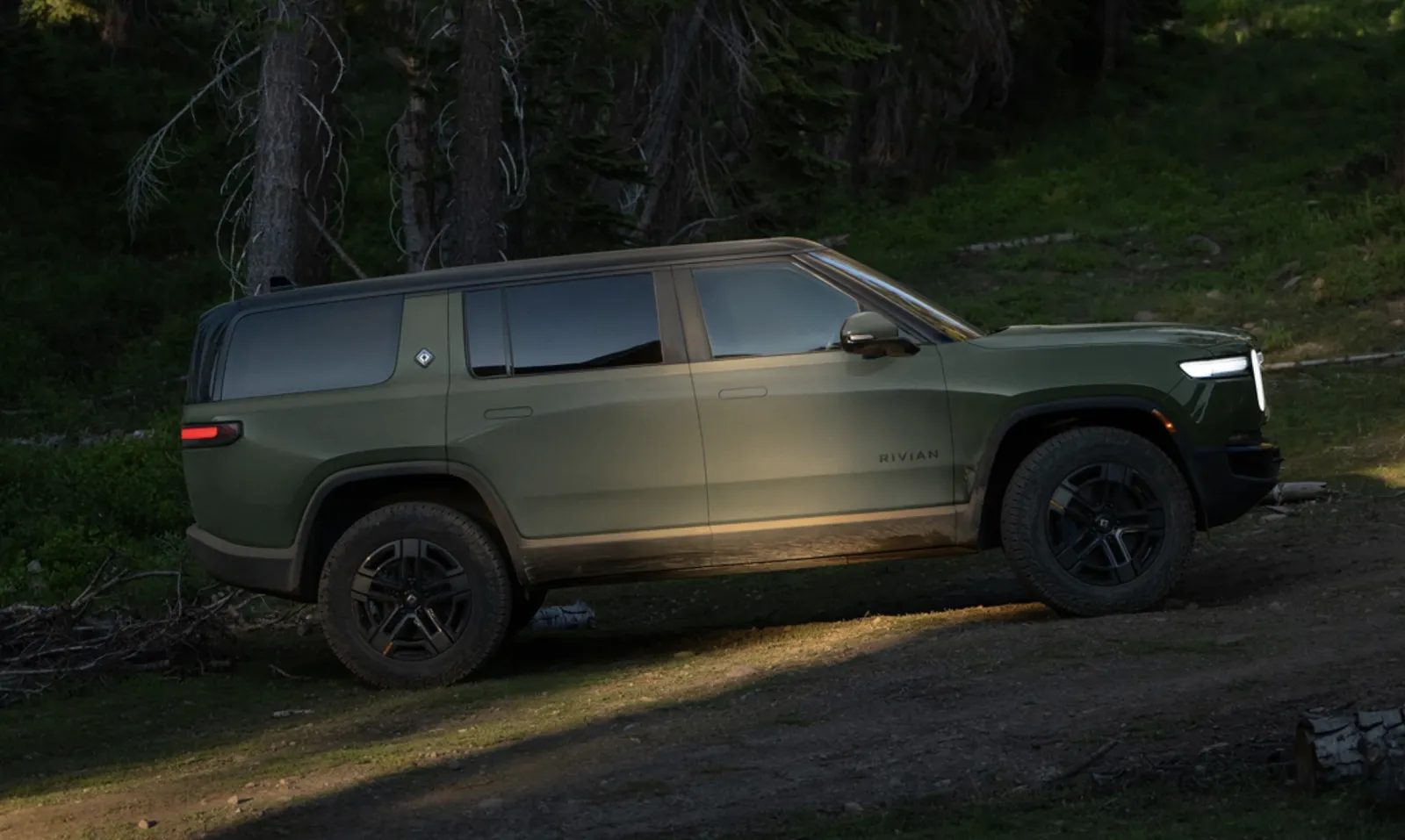

The Rivian R2 was the fourth most registered electric vehicle in Colorado last month, with 136 new registrations, behind two Tesla models and the Hyundai Ioniq 5.
The figures come from EValuateCO, a dashboard built by Atlas Public Policy with funding from the Colorado Energy Office, using data from the Colorado Department of Motor Vehicles.
They were first reported on X by the account ‘AlejandroEV66’ on Tuesday and verified by EV against the dashboard itself.
The Tesla Model Y led with 546 registrations, followed by the Model 3 at 228 and the Ioniq 5 at 175. The R2 came next, ahead of the Ford Mustang Mach-E and Kia EV9, both at 108.
Colorado recorded 2,976 new registrations of battery-electric and plug-in hybrid vehicles in the period, so the R2 accounted for about 4.6% of them. It reached roughly a quarter of the Model Y’s volume and about 60% of the Model 3’s.
The Rest of the Table
Honda Prologue 65, Subaru Trailseeker 62, Chevrolet Bolt 53, Toyota bZ Woodland 38, BMW i4 32, Hyundai Ioniq 9 31, Polestar 4 27, Tesla Model X 25 and Lexus NX 25.
Those fifteen models account for 1,659 registrations, or about 56% of the month’s total, which indicates a long tail of smaller volumes across the rest of the market.
The Dashboard
The dashboard’s most recent Department of Motor Vehicles snapshot is dated September 7, and the figures above are filtered to light-duty vehicles.
It reports 206,538 electric vehicles on Colorado roads, or 4.19% of the light-duty fleet, against 272,527 original registrations. Electric vehicles on the road grew 2.4% over three months.
That is a stock figure and it has kept rising while new sales fell. The two move independently and should not be read against each other.
Boulder County leads on both measures the dashboard reports.
Electric vehicles are 8.70% of the vehicles on its roads against 4.19% statewide, and 4.69% of its original registrations against 2.34% statewide. On either basis Boulder runs at roughly twice the state rate. Broomfield follows at 7.08% on the road, then Douglas at 6.53% and Denver at 6.37%.
The Tesla Model Y is the most common EV model in the state with 35,284 on the road, ahead of the Model 3 at 18,311, the Nissan Leaf at 12,788, the Ioniq 5 at 12,504 and the Nissan Ariya at 9,081.
A Harder Market Than It Looks
Colorado recorded the highest quarterly share of new electric vehicle sales any American state has posted, 32.4%, between July and September 2025. That is a measure of new sales rather than the fleet, and California remains far larger by vehicles on the road.
The incentives behind that have since been cut sharply.
The federal $7,500 clean vehicle credit expired for vehicles acquired after September 30, 2025. Colorado’s own Innovative Motor Vehicle Credit fell to $750 on January 1, 2026, from $3,500 in 2025 and $5,000 in 2023.
A buyer who qualified for the federal credit and took delivery on or before September 30, 2025 could claim $11,000 between the two.
Federal income, price, assembly and battery rules excluded many buyers even before the credit expired, and anyone buying later in 2025 had the state’s $3,500 alone.
The base state credit is now $750, with more available in the two cases below.
Vehicles with a manufacturer’s suggested retail price below $35,000 receive an additional $2,500, taking the state credit to $3,250. Vehicles above $80,000 receive nothing at all.
Those two thresholds place the R2 between Rivian’s own models. It starts above $35,000, so its buyers receive $750 rather than $3,250, and below $80,000, so they receive something.
Rivian’s R1S and R1T are frequently specified above the upper cap, which would leave those buyers with no state credit. Founder and CEO RJ Scaringe has previously cited $90,000 as the average selling price for the R1 models.
Colorado moved the other way on one programme.
Vehicle Exchange Colorado, a point-of-sale rebate for income-qualified residents who surrender an older or higher-emitting vehicle, rose on November 3, 2025 to $9,000 for a new electric vehicle from $6,000, and to $6,000 from $4,000 for a used one, explicitly to offset the lost federal credit.
It carries the same $80,000 price cap, must be approved before purchase, and requires a trade-in at least twelve model years old or one that has failed emissions.
The effect shows in the market. Quarterly market data from Experian, published as Colorado Auto Outlook, shows EV share of new light vehicle registrations running at 26.4% in the third quarter of 2025, falling to 12.6% in the fourth and to 9.0% in the first quarter of 2026. Across November and December it was 9.5%.
New retail light vehicle registrations fell 18.4% in the first quarter of 2026, with battery-electric registrations down 63.6% and plug-in hybrids down 72.5%. Combustion and hybrid volume fell about 2%, so the entire decline was electric. Conventional hybrids went the other way, taking 16.8% of the market against 12.4% a year earlier.
Denver Metro, the largest regional market, saw battery-electric share fall to 11.4% from 24.9%.
Tesla registrations in the state fell 35.8% in the quarter and Nissan’s fell 63.1%.
Context for the R2
Rivian opened R2 orders and began customer deliveries in June, and the model is the cheaper, smaller vehicle the company is relying on to reach volume.
It guided to 65,000 to 70,000 deliveries across its range this year after 22,559 in the first half, and expects to add a second shift at its Normal, Illinois plant by the end of this month.
Within that, management has pointed to 20,000 to 25,000 R2 deliveries.
There is no target to measure Colorado against. Rivian does not disclose model-level production or delivery figures for the R2, and it has published a sales projection for only one state.
A certification filing lodged on January 6, under California’s Advanced Clean Cars II pathway, put projected annual model-year sales at 25,000 R2 units, split between 5,000 in California and 20,000 across federal states.
That 20,000 is a single figure covering every state outside California.