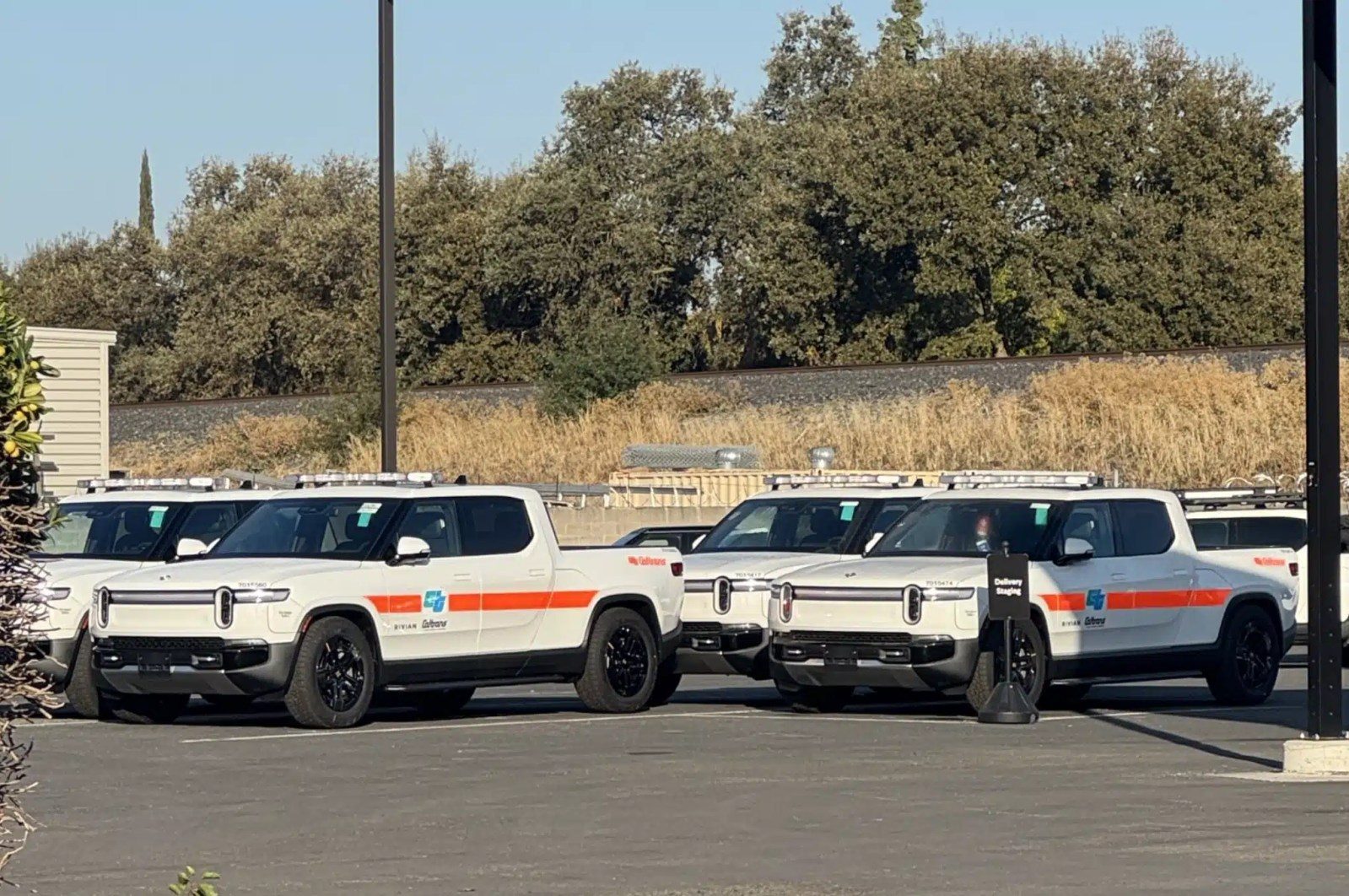

California’s Department of Transportation has recently ordered 524 additional Rivian vehicles, public procurement records show.
The second purchase phase lifts the agency’s total commitment to 977 units worth roughly $97.1 million, the largest known fleet relationship for the EV maker outside its Amazon van program.
The new order, placed between April and May, covers 201 R1S SUVs and 323 R1T pickups valued at a combined $52.7 million, according to data compiled from California procurement documents and first reported on X by Rivian owner and brand enthusiast Chris Hilbert.
Phase two exceeds the first on every dimension — 15.7% more vehicles and 19% more value — and average selling prices rose with it.
The new batch carries a blended average of $100,655 per vehicle, up 2.8% from $97,883 in the first phase, with the R1S averaging $102,124 and the R1T $99,741, per the records.
Unit prices in the second phase range from $97,928 to $102,588 for the R1S and from $95,903 to $100,563 for the R1T, against $95,593 to $99,633 and $93,268 to $97,308 respectively in the first — figures that likely reflect fleet upfitting and equipment, though the records do not break out configurations.
Caltrans placed its first order in June 2025: 138 R1S SUVs and 315 R1T pickups, a 453-unit batch worth $44.3 million that first surfaced through a forum sighting of a Caltrans-branded R1T in West Sacramento last September.
Rivian senior manager of fleet sales Seth Parks confirmed that order’s completion on January 1, writing on LinkedIn that the company had fulfilled the last of the 453 units, “all upfitted and delivered in just 200 days.”
“We are proud to serve Caltrans and the State of California,” Parks wrote at the time.
Neither Rivian nor Caltrans has issued a formal announcement for either phase — a pattern explained by the deal’s structure.
Every public milestone in the relationship has instead surfaced through sightings, procurement records and social media posts, from the first branded truck spotted at a service center to Friday’s pricing tables.
A Contract Built for Quiet Orders
Both purchases run through statewide contract 1-25-23-01J, an “Alternative Fuel Vehicles” agreement between Rivian LLC and California’s Department of General Services, according to the state’s eProcurement portal.
Reports from October last year of a roughly 600-unit total pointed in the right direction but understated the destination: the confirmed two-phase commitment now stands at 977 vehicles.
California law requires zero-emission vehicles to make up at least half of the state’s light-duty fleet purchases from fiscal year 2024-25, while Executive Order N-79-20 commits the state fleet to a full zero-emission transition.
The mandates that turn agencies like Caltrans, which operates one of the largest public fleets in the country, into recurring EV buyers.
Caltrans says nearly 10% of its light-duty fleet is already zero-emission, with 567 workplace charging ports operating at its facilities across the state.
Two-Thirds of Everything, Then Doubled
The Caltrans relationship now dwarfs the rest of Rivian‘s government business.
The company disclosed in contract documents last year that it had sold roughly 700 vehicles to government entities in three years through August 2025 — about 0.5% of total sales.
The new 524-unit order alone equals roughly three-quarters of that figure; the combined 977 units exceed it by nearly 40%.
The new order surpasses that entire projected annual government volume on its own.
Beyond California, Rivian disclosed agreements with Utah and Washington DC — whose transportation department also runs its vehicles — and said it “established a relationship with US Fleet Source to sell vehicles to the United States Federal GSA,” alongside smaller deployments ranging from the Palo Alto Police Department to the Contra Costa County Fire Department.
Public-sector access is widening in parallel.
Rivian secured a Sourcewell cooperative purchasing contract that opened its lineup to more than 50,000 government and public organizations, running to November 2029, and the company said in those documents that public fleet volume was “ramping” following the California award.
Chief Financial Officer Claire McDonough struck a more cautious note on the first-quarter earnings call, saying Rivian does not “anticipate significant volumes outside of Amazon in the near term” for fleet sales while remaining confident that “over the longer term, we will see more fleets electrify.”
The Caltrans cadence — 453 units delivered in 200 days, then a larger follow-on within five months — sits at the optimistic end of that framing.
From 399 Teslas to 977 Rivians
Beyond scale, the deal marks a generational shift in the agency’s EV purchasing.
Caltrans ordered 399 Tesla Model 3 sedans in 2022 in a purchase valued at over $18 million — roughly $45,000 per vehicle — citing the model’s safety ratings, range and operating costs as the best value for taxpayers.
Governor Gavin Newsom adopted a Rivian R1S as his official state vehicle in May 2025, replacing a Chevrolet Suburban, with the California Highway Patrol’s Dignitary Protection Section purchasing two of the company’s vehicles.
+The follow-on order lands as the company ramps its R2 mid-size SUV — with customer deliveries beginning June 9 — and as the R1 lineup, now in its fifth model year, leans increasingly on commercial and fleet demand to sustain volumes at the premium end.