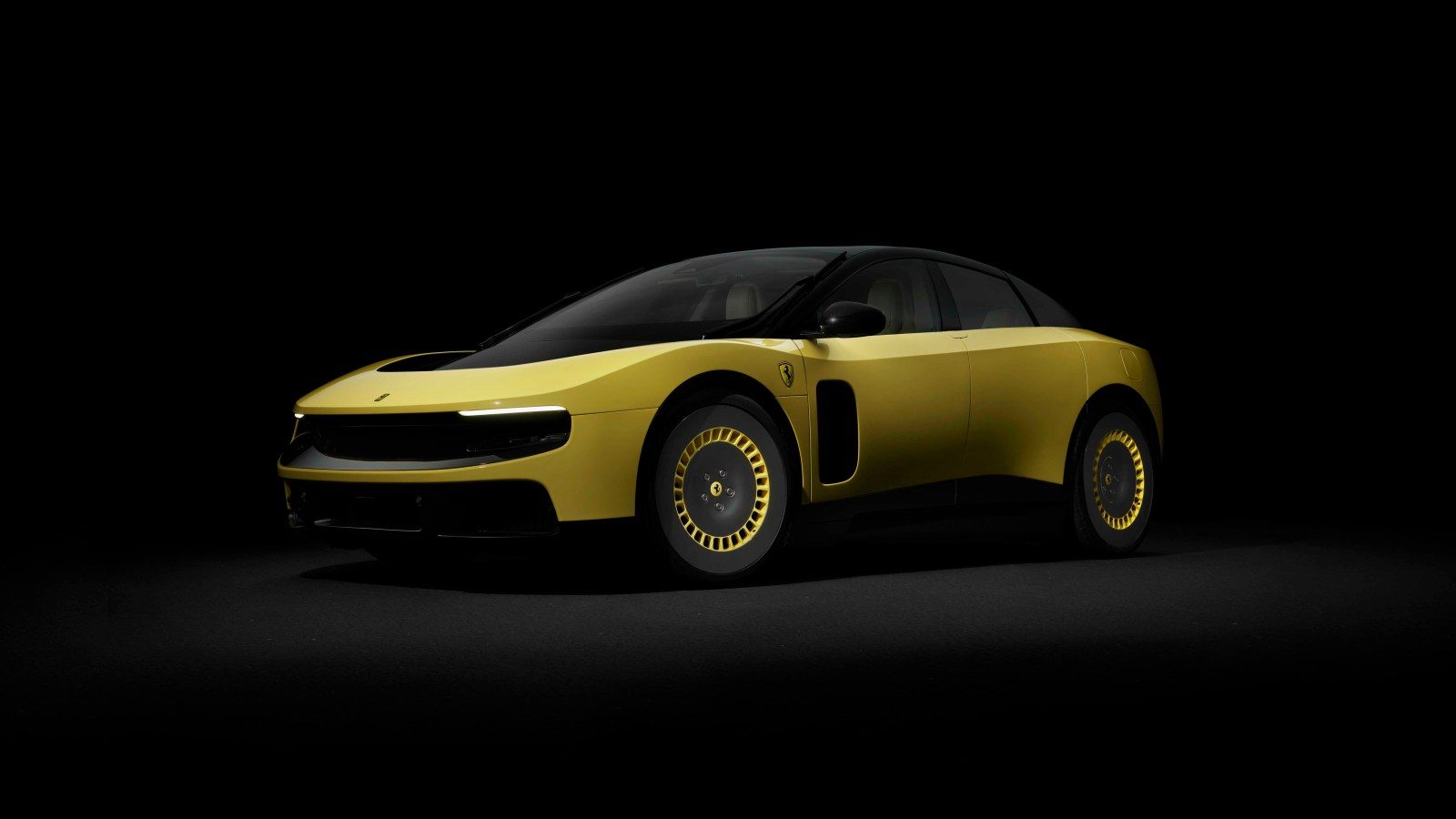

Milan-listed shares of Ferrari fell sharply on Tuesday, hours after the Italian carmaker unveiled the Luce — its first fully electric production model — at a global premiere in Rome.
The stock dropped more than 6% in early trading, as investors weighed the controversial design, a €550,000 price tag, and the broader question of whether Ferrari‘s brand equity translates into the EV era.
The decline extends a difficult stretch for the carmaker.
The stock is down roughly 25% from its 2025 peaks above €440, pressured by a luxury sector slowdown, weakening Chinese demand, and a Capital Markets Day update last October in which the company halved its 2030 electric vehicle ambitions — from 40% of the lineup down to 20%.
By then, Ferrari set a 2030 net revenue target of approximately €9 billion, which several analysts viewed as conservative.
As of press time, the carmaker’s shares were trading 6.2% lower at €290.80.
Luce EV
The Luce is Ferrari‘s first four-door, five-seat car, developed over five years with the design collective LoveFrom — led by former Apple chief design officer Sir Jony Ive and Marc Newson — working alongside Ferrari Design Director Flavio Manzoni.
The exterior, dominated by an S-duct front and a two-tone aerodynamic profile, has drawn a polarized reception, with several reviewers calling the design a clear break from Ferrari‘s traditional visual language.
At the reveal at the Vela di Calatrava complex in Rome, Ferrari executives framed the launch as a deliberate move rather than a response to industry pressure.
Executive Chairman John Elkann told an audience of more than 200 journalists that the Luce was “not a response to change” but a decision taken with clarity and courage to lead what comes next.
He described the launch as a chapter that turns Ferrari‘s vision into reality and reinforces the marque’s tradition of anticipating and shaping the future.
CEO Benedetto Vigna, in remarks at the premiere, called the Luce one of the most exciting projects Ferrari has ever undertaken — describing it as “the most versatile Ferrari ever produced.”
He also noted that the car is the result of more than 60 new patents and said Ferrari is “the first in the world to combine fully electric, hybrid and combustion engine architectures for sports cars.”
Speaking to CNBC after the launch, Vigna said the Luce would give drivers the same sensation as a traditional Ferrari, and argued that the sound of an electric powertrain was simply a different sound — “each engine has its own sound” — with the emotion delivered to the driver being what mattered.
Specs and Pricing
The Luce uses a quad-motor all-wheel-drive layout — one motor per wheel — producing more than 1,000 horsepower, mounted on a bespoke 800-volt architecture with a 122 kWh battery pack supplied by South Korean battery manufacturer SK On.
Ferrari designs and builds the main electric components, including the battery pack, in Maranello.
The car weighs more than 2.2 tonnes, making it heavier than any combustion-engined Ferrari currently in production.
Performance figures put the Luce at 2.5 seconds from 0 to 100 km/h and 6.8 seconds from 0 to 200 km/h, with a maximum speed of 310 km/h and a stated range of 530 km. WLTP consumption figures remain under homologation.
Pricing starts at €550,000 in Italy before options — placing the Luce well above Ferrari‘s typical entry point — with deliveries scheduled to begin in the fourth quarter of 2026.
Investor Concerns
Analysts pointed to a combination of “design hate” and the classic “travel and arrive” market dynamic to explain Tuesday’s share price reaction.
Michael Field, chief equity strategist at Morningstar, told CNBC in an email that many fans see the EV pivot as a dilution of a supercar brand built around classic design and combustion-engine power.
From an investment standpoint, Field added, many investors had feared the development of an EV model on the basis that the high research and development costs would put pressure on the brand to recoup them, with the potential to dilute returns.
Core investor concerns ahead of Tuesday’s session focused less on the technical specifications and more on whether Ferrari‘s identity — built on scarcity, the emotional pull of a combustion engine, and lightweight performance — can survive a silent, 2.2-tonne five-seater, even at ultra-premium pricing.
Ferrari‘s competitive set has moved in the opposite direction as Lamborghini has pushed its first full-electric model to 2029, Porsche has scaled back its BEV plans amid soft Taycan and electric Macan demand, and Maserati cancelled the BEV version of its MC20.
Ferrari has committed €4.7 billion to electrification through 2030, with BEVs expected to account for around one-fifth of sales by the end of the decade.
Roughly half of the carmaker’s current shipments are already hybrid.
The Luce was developed under the technological neutrality principle Ferrari outlined in 2022, under which the model sits alongside — rather than replacing — its combustion and hybrid powertrains.
Vigna underlined that point at the reveal, framing the Luce as the opening of an entirely new segment within Ferrari‘s range.
Ferrari‘s order book currently extends through the end of 2027.