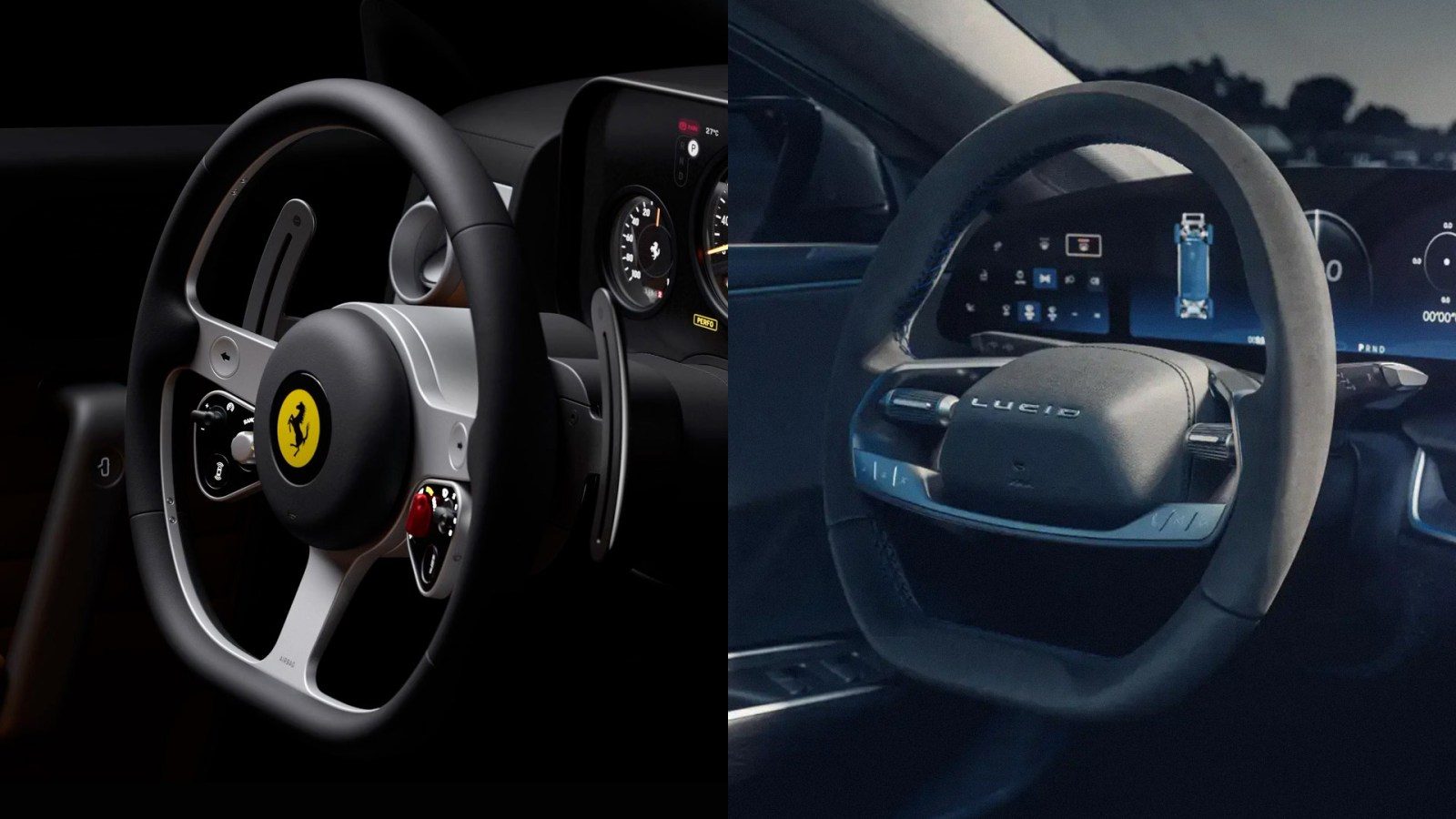

Ferrari has settled on a preliminary price of approximately €550,000 ($646,000) for its first fully EV model, according to a Bloomberg published on Tuesday citing people familiar with the matter.
Final pricing of the Ferrari luce is subject to variation of up to 10% before the vehicles reveal, which is scheduled for May 25 in Rome.
Production begins at Ferrari‘s Maranello E-Building in late 2026, with first deliveries expected by the final months of this year or early 2027, depending on allocation and market.
The price — roughly 2.6 times the price of Lucid‘s tri-motor flagship Air Sapphire — positions the Luce above Ferrari‘s Purosangue SUV ($450,000) and into hypercar territory.
On every measurable performance and efficiency metric, the $250,500 Lucid Air Sapphire — which started deliveries in late 2023 — outperforms the model of the Italian manufacturer despite costing 61% less.
The Direct Comparison
Both vehicles share several dimensions including a 116.5-inch wheelbase, a four-door luxury performance sedan configuration, and battery packs of similar capacity (122 kWh for the Luce, 118 kWh for the Sapphire).
However, nearly all the other specs differ.
The Air Sapphire’s tri-motor setup produces 1,234 horsepower, compared with the Luce’s quad-motor 1,113 hp — a 121-hp advantage for Lucid.
When comparing acceleration, the Sapphire reaches 60 mph in 1.89 seconds, versus the Luce’s Ferrari-quoted 0–62 mph (0–100 km/h) time of 2.5 seconds.
On equivalent metrics, the Sapphire is roughly 0.6 seconds faster.
For top speed, Lucid claims 205 mph for the Air Sapphire while Ferrari quotes 193 mph (310 km/h) for the Luce.
The Sapphire delivers 427 miles of EPA-rated range, compared with the Luce’s Ferrari-quoted 330 miles on the WLTP cycle — a European test standard typically 20% to 30% more generous than the US EPA figure.
Despite the larger battery, the Luce is 266 lbs lighter at approximately 5,070 lbs (2,300 kg), versus the Sapphire’s 5,336 lbs.
Both models support DC fast charging, though the Luce edges out on peak rate with 350 kW DC versus approximately 300 kW DC for the Sapphire. The Luce operates on an 880-volt architecture, while the Sapphire at 900V+.
The Sapphire carries five passengers while the Luce accommodates four, with Ferrari prioritising exclusivity over practicality.
Where Ferrari Differentiates
Designed by the former Apple Design Chief Jony Ive, the Luce’s cockpit prioritises a three-spoke aluminium steering wheel with analogue control modules — an E-Manettino dial for power and range modes, physical paddles for manual torque control, and mechanical dials for speed, battery and G-force readings.
Ferrari CEO Benedetto Vigna has positioned this “screen-light” philosophy as a deliberate rebuttal to the touchscreen-first interiors that Jony Ive’s own Apple work helped inspire across the industry.
The Air Sapphire, by contrast, centres on a 34-inch Lucid UX floating cockpit — a touchscreen-led layout common across premium EVs.
Second is exclusivity. Ferrari builds the Luce on allocation rather than production-capacity basis; the Air Sapphire is available to any qualifying customer who places a deposit.
Third is manufacturing provenance.
The Luce is assembled at Ferrari’s E-Building in Maranello, with “each of the main components” developed and produced in-house, according to the company.
The battery cells are supplied by SK On, a long-standing Ferrari hybrid battery partner on the SF90 Stradale and 296 GTB.
Ferrari has disclosed that the Luce includes a disconnectable front axle — allowing the car to operate as a rear-wheel-drive machine for “Ferrari driving feel” moments — and uses F1-derived Halbach array motor technology.
The Air Sapphire, by comparison, delivers performance through a twin motor rear-drive unit and a single motor front-drive unit, with torque vectoring via dual rear motors.
Ferrari’s Positioning Challenge
The Luce arrives at a difficult moment for high-performance EVs.
Reuters reported in mid last year that Ferrari had delayed a second, higher-volume EV from 2026 to at least 2028, with one source describing demand for high-performance electric sports cars as “non-existent.”
Ferrari has since revised its 2030 sales mix target to 40% combustion, 40% hybrid and 20% electric — down from an earlier plan that called for 40% EVs.
Competitors have been retreating from pure-EV strategies.
Lamborghini recently announced that its Lanzador EV has been pushed from 2028 to 2029 and may ultimately arrive as a plug-in hybrid rather than a fully electric vehicle, with CEO Stephan Winkelmann citing “close to zero” customer demand.
Aston Martin has delayed its electrification timeline amid weak customer interest, and Bugatti Rimac’s CEO has flagged waning demand for electric hypercars.
Ferrari CEO Benedetto Vigna has publicly committed to keeping the brand’s “value over volume” approach, targeting an average of four new models per year between 2026 and 2030 spanning internal combustion, hybrid, and electric powertrains.
The Luce’s pricing — and the spec comparisons that will follow its May 25 reveal — will be a decisive test of whether ultra-luxury brand value can sustain a price premium that performance data alone cannot justify.