
Chinese EV maker Nio registered just two vehicles in Israel during the first half of 2026, a 96.9% decline from 65 units in the same period a year earlier — according to data from the Israel Vehicle Importers Association (IVIA).
The premium brand recorded zero registrations for the second consecutive month in June — leaving it dead last among new energy vehicle (NEV) brands active in the market.
Monthly data compiled by EV shows the scale of the collapse.
Nio registered one vehicle in January, nothing in February, one unit in March, and then went completely dark across April, May, and June.
In the year-ago period, the brand had posted 44 registrations in January alone — its single strongest month since entering the country.
First Year
Nio officially launched in Israel in November 2024 through a partnership with Delek Motors, as exclusively reported by EV then and later confirmed by the brand.
Delek is one of the country’s largest vehicle distributors, representing brands such as Ford and BMW.
Delek had been importing Nio vehicles indirectly from Norway since 2023, before receiving the official brand concession in mid-2024.
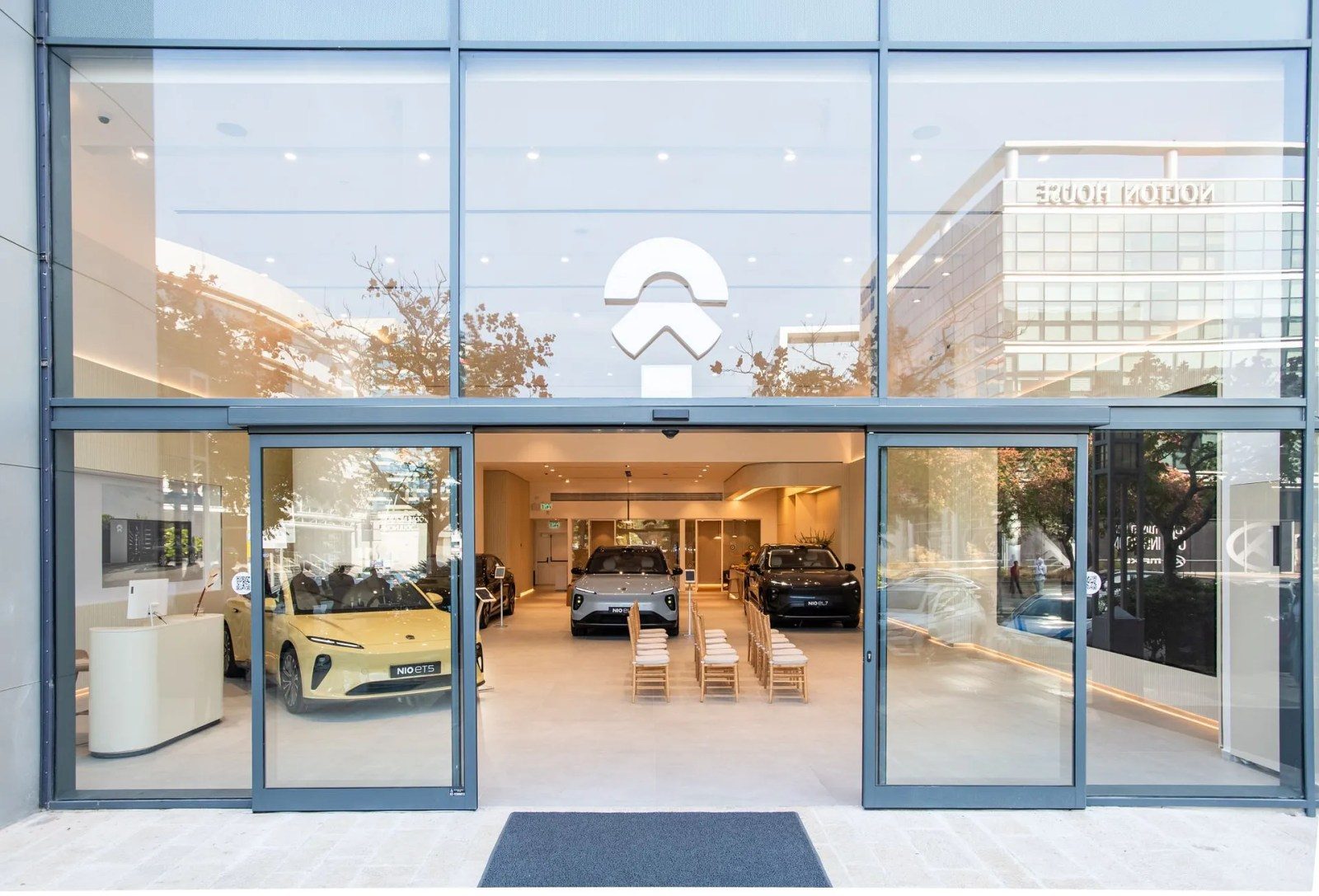
The first — and so far only — Nio House showroom opened in Herzliya, a city in the Tel Aviv metropolitan area.
At the time, the company said it planned to open two more locations “in the near future.”
More than a year and a half later, only the original showroom remains, according to Nio‘s Israeli website.
Nio registered 205 vehicles in Israel across 2025 — a modest total that nonetheless placed the country second only to Germany among its international markets at the time, as previously reported by EV.
Steep Decline
Monthly volumes were highly erratic throughout the year.
January 2025 saw 44 registrations, September hit a monthly record of 72, and October followed with 65. Five months recorded two or fewer units. November and December each posted zero.
The pattern deepened in 2026.
Nio ranked 61st out of 63 brands in Israel in the first quarter, registering just two vehicles — one in January and one in March — for a 96.8% year-over-year decline from its Q1 2025 total.
The second quarter brought no improvement: zero registrations in April, May, and June.
Pricing and Product Gaps
Nio currently lists three models on its Israeli website: the ET5 sedan starting at 255,000 ILS ($84,500), the EL6 SUV from 299,000 ILS ($99,000), and the flagship three-row EL8 from 594,900 ILS ($197,000).
All three sit on Nio‘s second-generation platform, released in 2022 and 2023. The new ES8, launched in China last year, has not been introduced overseas.
Pricing places the company at a steep disadvantage against the Chinese brands leading the market.
BYD and Omoda & Jaecoo sell a mix of battery-electric, hybrid, and plug-in hybrid vehicles at significantly lower price points.
XPeng‘s lineup also undercuts Nio considerably.
Even within the premium segment, Zeekr — which more than doubled its Israeli registrations in June — offers newer-generation models at competitive prices.
Delek Motors stated on its website that it had embarked on a project to deploy Nio‘s battery swap stations across Israel.
No station openings have been announced.
The battery swap network is a core pillar of Nio‘s value proposition in its home market, where the company operates more than 3,000 stations.
Internationally, however, the infrastructure has been slow to follow vehicle sales — a recurring pattern across Nio‘s expansion into the Middle East and beyond.
Israel’s June NEV sales
The shutout came as Chinese rivals posted record-breaking growth across Israel’s new energy vehicle (NEV) segment in June.
Omoda & Jaecoo topped the leaderboard with 3,742 NEV registrations, a 241% year-over-year increase driven by strong hybrid and plug-in hybrid demand.
Nio is a premium EV maker; it lacks the plug-in hybrid and hybrid offerings that have driven much of the growth for Chery Group and BYD in Israel.
The international-focused Omoda & Jaecoo brand alone registered 1,409 hybrid and 2,157 plug-in hybrid vehicles in June, dwarfing its 176 battery-electric sales.
Parent company Chery added another 2,619 units under its own badge, up 70%.
BYD ranked third among Chinese NEV brands in June with 2,266 registrations, a 219% surge that reflected growing traction for its plug-in hybrid lineup alongside its battery-electric models.
The Shenzhen-based automaker’s 1,845 PHEV units far outpaced its 421 pure-electric registrations.
Tesla followed with 1,312 pure-electric registrations, more than doubling its year-ago result with a 118% increase.
XPeng sold 798 fully electric vehicles during the month, up 41%, while Changan‘s Deepal sub-brand registered 234 units for a 72% gain.
Geely-backed Zeekr — a direct Nio competitor — posted 188 registrations, rising 127%, and Leapmotor recorded the sharpest percentage jump of the group at 533%, reaching 171 units as its Stellantis-backed distribution model gained ground.
Israel’s Auto Market
Official Israeli market data for June has not yet been published.
In May, passenger car registrations rose 13.4% compared with May 2025.
Since the beginning of the year, 143,983 new cars had been registered through May — an increase of 1% year-over-year.
Battery electric vehicles (BEV) accounted for an 11.3% market share with 16,216 deliveries in the January-to-May period.