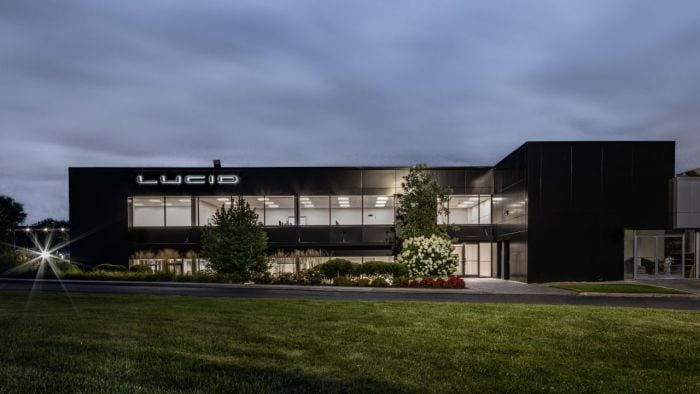
Lucid is pushing back its planned United Kingdom launch by another year, with the company’s European President Lawrence Hamilton now saying British buyers should expect the brand to arrive in early 2028.
Hamilton told The Independent that the UK remains a “prime place” for the EV maker.
However, he reaffirmed that right-hand drive models from the brand are likely to come only with the mid-size platform, for which production is expected to begin by year-end.
“It’s more likely to be the beginning of 2028 rather than 2027,” the European chief stated.
The revised timeline marks the third delay to Lucid‘s UK plans.
At the IAA Auto Show in Munich last September, then-interim CEO Marc Winterhoff told Auto Express that Lucid would enter the UK with a vehicle on its mid-size platform in late 2026.
In early April, however, Hamilton shifted the target to 2027 in an interview with AutoCar.
Hamilton framed the latest delay as a matter of sequencing, as Lucid is still expanding across continental Europe and does not want to overextend.
“In 2027, we’re going to focus on the markets that we’re already in,” he started, noting that the company’s “still got some markets to expand to in Europe – that’s part of the big plan.”
According to the European executive, the plans for expansion beyond its four markets — Germany, the Netherlands, Norway and Switzerland — are “well under way there, so we don’t want to bite off more than we can chew.”
The comments came on the same day that Winterhoff said — answering a question from EV at the Financial Times Future of the Car summit in London — that Lucid remains on track to enter “seven or eight” new European markets this year.
Winterhoff’s count would bring the total to 11 or 12 markets — and the upper end of that range could theoretically include the UK as an initial planning step, even if first vehicle deliveries would not follow until early 2028.
“And my general view is if you’re going to launch in a market, do it properly,” Hamilton concluded.
Lucid announced this week that it is closing its Oslo showroom and moving towards unifying its Norwegian footprint, after the brand failed to garner demand in the world’s most EV-friendly nation.
Three Mid-Size SUVs
Rather than arriving with the Air or Gravity, Lucid plans to make its UK debut with the Cosmos — the first model off its new mid-size platform, which was revealed at the company’s inaugural Investor Day on March 12.
Hamilton told The Independent that the first two mid-size models are already signed off, with a third still in the final design stage.
The Cosmos is a coupe-style crossover. The second — called Earth — takes a more rugged approach. A third unnamed model will have a boxier, more traditional SUV shape.
“The big focus has been on low weight, smaller batteries, optimal range, but fast charging speeds and a high efficiency drive train, which are very important factors to the more mainstream segment buyers,” the executive noted.
The Cosmos is built on an 800-volt architecture with Lucid’s next-generation Atlas drive unit, which the company says has 30% fewer parts and 37% lower manufacturing costs than the Zeus powertrain used in the Air and Gravity.
Lucid has said the Cosmos will start below $50,000 in the United States.
At the IAA last September, Winterhoff told Auto Express that it would translate to approximately £36,900 before VAT in the UK.
Efficiency as the Core Pitch
Hamilton positioned powertrain efficiency as the metric that will define Lucid’s competitiveness in the mainstream EV market, beyond the range advantage the brand has already demonstrated with the Air.
“We think we’ve solved the range problem because we can make a car that travels for maybe a thousand kilometres, which is more than most people ever need. So for that comfort blanket of range, we’ve demonstrated the technology’s there,” he said.
The executive noted that, once EV adoption is mainstream, consumer concerns will be on “how much it costs me to go from A to B.”
“If we have the most efficient powertrains, it’ll costs less to charge a Lucid than it does to charge another vehicle for the same kilometre distance,” he stated.
He pointed to the Cadillac Escalade IQ as a reference point, noting that while “it’s unfair to call that the competition,” a product like the Escalade “has the same range as the Gravity, but it has twice the size battery.”
“Literally it costs twice as much to travel the same distance because you need twice as many kilowatts to fill the battery,” he said.
To Hamilton, this is where Lucid‘s efficiency starts to come into play.
The company began as a battery technology business called Ativa in Silicon Valley in 2007 before pivoting to vehicle manufacturing.
Hamilton said Lucid intends to remain a premium brand but hinted that its engineering standards are set above what its pricing would suggest.
“I would say the way Lucid thinks in general is we set our engineering benchmarks for ride and handling dynamics performance much higher than we necessarily set commercial ones,” the Chief stated.
“This is where we create the advantage of saying, for example, for Volvo money you get Porsche performance – because we just want to make cars that beat Porsche or beat Lexus or whoever we set our engineering benchmark at,” he added.
PIF Backing and Long-Term Stability
Hamilton addressed the financial backing from Saudi Arabia’s Public Investment Fund, which has invested over $9 billion in Lucid since 2018 and currently holds approximately 56.9% of the company’s shares.
“PIF are involved with Lucid and they have been since before we went public – they’re one of our major shareholders and backers and continue to be so,” he said.
The executive flagged Saudi Arabia’s aim to create an industrial sector, after it had always been an oil-based economy.
“From that point of view, we don’t see them backing out. They’re not in it for the short term and they continue to provide fantastic support,” he guaranteed.
He recognized that Lucid needs “to raise money and generate results just like any organisation that’s been invested in and that’s what we’re working very closely with them to do,” adding that they “have that stability.”
“I guess that’s another fundamental point of difference between us and some of the other EV startups is we have a very solid and strategically aligned backup,” the executive concluded.
The comments come after Lucid reported first-quarter results last week showing a gross margin of negative 110.4% and a net loss of $1.03 billion.
At the same time, the EV maker announced the suspension of its full-year guidance pending a strategic review by incoming permanent CEO Silvio Napoli.
Lucid’s Tech
Hamilton confirmed Lucid‘s intention to expand its technology licensing efforts beyond the existing supply deal with Aston Martin.
“One hundred per cent we wish to share the technology,” he said. “With the mid-size car we have an even more efficient, smaller, lighter second generation drive unit coming.”
However, Hamilton flagged that the company cannot disclose any details about ongoing conversations with other OEMs.
On autonomous vehicles, Hamilton pointed to the Nuro-Uber robotaxi program, which has expanded from 20,000 to at least 35,000 vehicle commitments and recently secured key regulatory permits in California.
“We are quite focused now on the robotaxi business,” Hamilton said. “And I would say that is an example of sharing a technology with another sector. With Nuro and Uber, we have this three-part arrangement to essentially help put a robo-taxi fleet on the ground.”
He also highlighted the integration of Nvidia’s Level 4 autonomous hardware in future vehicles — including the mid-size platform already.
European Realities
The UK delay extends a pattern of shifting timelines across Lucid‘s European operations.
The company missed its January 2026 target for European Gravity deliveries without a public announcement — while telling EV last week that the first vehicle was delivered in the Netherlands in the final days of 2025.
Hamilton’s message on European policy was brief.
“The issue I would say is, and the learning from Norway, is just make your mind up and be consistent and stick to something because that removes the uncertainty,” he said. “I’m a great believer in electrification. I think it’s going to happen anyway.”
All Cosmos units destined for the UK will be manufactured at Lucid’s AMP-2 plant in King Abdullah Economic City, Saudi Arabia.
Production of the model is set to begin by year-end with what CFO Taoufiq Boussaid has described as a “slow ramp” through 2027.
Unlike its continental European markets, where Lucid launched with company-owned studios, the UK will use traditional dealer partnerships from the outset — a model the company has already begun deploying in Germany through its first European retail partner, Wackenhut.