
Michigan has not paid Lucid Motors any of the $6 million it pledged toward the EV maker’s Southfield engineering hub, and the company says it still intends to honor its commitments to the state.
“No funds have yet been disbursed to Lucid,” Michigan Economic Development Corporation spokeswoman Danielle Emerson told Crain’s Detroit Business in an email, adding that Lucid had signalled it still intends to meet its commitments to the state under the grant agreement.
Two rounds of layoffs this year have reached the Southfield site, even as the company holds to the job targets that secured the grant.
The Grant Scorecard
Michigan’s grant dates to early 2024.
The Michigan Strategic Fund board approved $6 million in performance-based support for Lucid on Feb. 27, 2024, tied to the creation of up to 262 jobs by mid-2027.
By the close of fiscal 2025, the company had created 259 of those jobs, all of them non-temporary, at an average salary of $142,421, according to the MEDC’s annual report released in March.
The build-out has trailed the headline figure, though.
Against a total projected investment of $10 million, Lucid had invested $1.6 million of its own capital as of the report, with the state still listing the project under “monitoring.”
A performance-based grant pays out only as milestones are met, which is why none of the money has moved despite the jobs already filled.
That structure shields Michigan from direct cost if Lucid stalls, but it also leaves the promised jobs riding on the company’s finances.
Two Footholds in the State
Lucid runs two operations in Michigan.
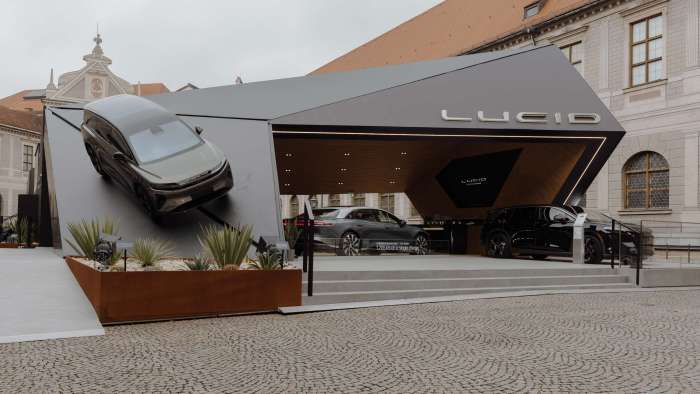
The older one is a studio and service center in Coldwater, in the state’s south near the Indiana border, which has handled deliveries and warranty work for Michigan owners since 2022.
For two years it was the only physical Lucid location in the state.
The second, and far larger bet, is the Southfield engineering center in metro Detroit, which moved Lucid from selling cars in Michigan to designing them there.
A $10 Million Bet on Detroit
Lucid opened the Southfield center in September 2024 as the third US employment hub in its network.
The Saudi-backed EV maker committed $10 million to the engineering and research operation, housed in one of the Travelers Towers at 26533 Evergreen Road.
Plans called for about 30,000 square feet of office space at the outset, with room to add another 50,000 to 75,000 square feet as the team grew.
The hub was the company’s first non-manufacturing base outside California, and its second research site after the 300,000-square-foot headquarters in Newark.
Manufacturing stayed in Arizona, at the Casa Grande plant known as AMP-1, alongside a second factory in Saudi Arabia.
Lucid scouted sites for more than a year and weighed Ohio and Texas before choosing the Detroit region, drawn by the state’s engineering workforce and its dense supplier base.
Michigan is home to roughly three-quarters of US automotive research and development, state officials said at the time.
What the Hub Builds
The Southfield teams were set up to work on hardware engineering, software and advanced driver-assistance systems, including autonomous-driving applications.
Their work was meant to support production of the three-row Gravity SUV and a coming mid-size model.
That mid-size car has since taken shape as the Cosmos, Lucid‘s first mass-market vehicle, a sub-$50,000 SUV the company still plans to launch later in 2026.
Before the office opened, Lucid had roughly 25 remote employees in Michigan, most of them in sales.
Headcount in Southfield has since climbed above 200.
Two Rounds of Cuts
The Southfield hub has now felt both of Lucid‘s 2026 reductions.
An initial round came in February, when the company cut about 12% of its US workforce.
That round reached Michigan, where a functional-safety specialist based in Southfield was let go barely six months after joining to work on autonomous-driving applications.
A memo from then-interim chief executive Marc Winterhoff had listed continued ADAS and software development among the company’s core focus areas, even as those teams absorbed losses.
The second round landed this week.
Lucid cut about 18% of its US workforce, roughly 1,500 people, and the reductions again touched Michigan.
A Lucid spokesperson called the cuts there “limited to a small number of Michigan-based employees” and repeated that the company expects continued growth in the state.
A Company in Retreat
The Michigan cuts are a small piece of a far larger contraction.
Lucid‘s latest layoff is the first major move by Silvio Napoli, who became chief executive on June 1 after Winterhoff served as interim CEO for more than a year, a stretch that began when founder Peter Rawlinson resigned in February 2025.
The company expects the cuts to deliver about $158 million in annualized savings and to cost roughly $32 million in severance.
Lucid also eliminated the role of chief operating officer and parted ways with Winterhoff, whose exit ended an eight-year association with the company.
The bulk of the reduction fell in Arizona, where a state filing covered 705 positions concentrated at Casa Grande, and where the company cut the plant’s second production shift.
That made the round the first of the year to reach Lucid‘s production workforce.
Lucid widened its Arizona base last year, acquiring select assets from bankrupt rival Nikola — more than 884,000 square feet across a Coolidge plant and a Phoenix product-development site — even as it now trims headcount across the map.
The financial backdrop is stark.
Lucid lost $2.7 billion in 2025 on revenue of $1.35 billion, with negative free cash flow of $3.8 billion.
Saudi Arabia’s Public Investment Fund, which owns more than half of the company, has funded the business through repeated capital raises.
Hiring has slowed to a trickle, with open roles down about 76% from a year earlier, and the company has suspended its full-year production forecast as it works down elevated inventory.
Abroad, Lucid is weighing a reduction of up to 40% in its European operation, where it registered just 35 vehicles in May.