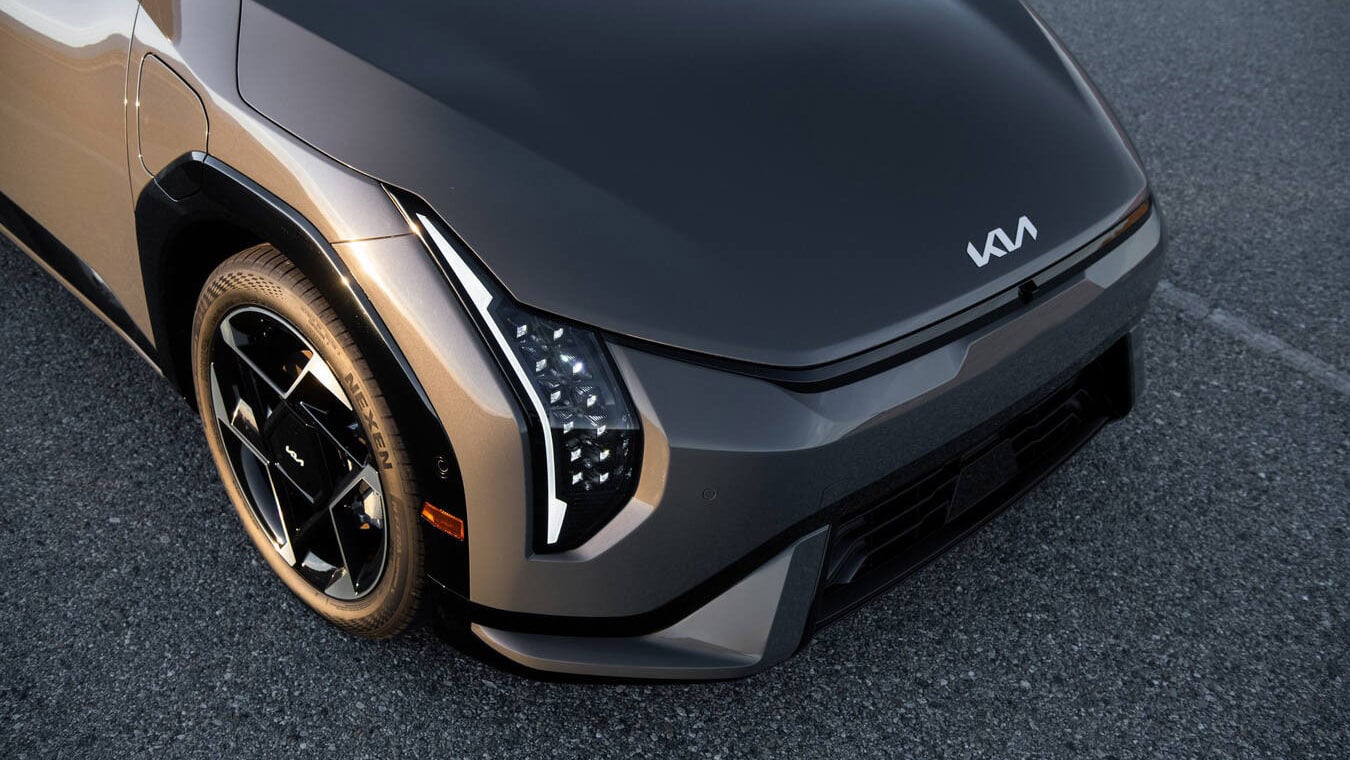
Kakao Mobility will build its Level 4 self-driving system on two Nvidia DRIVE AGX Thor chips, the chipmaker’s Hyperion reference architecture and its Halos safety system, with Kia‘s PV5 purpose-built vehicle (PBV) as the first platform, the South Korean ride-hailing company said Monday.
Kakao Mobility, an affiliate of internet group Kakao, signed a memorandum of understanding with Nvidia on autonomous driving at the Westin Seoul Parnas hotel in Seoul’s Gangnam district.
The signing took place on the sidelines of Nvidia AI Day Seoul, a two-day event that opened Monday at the neighboring COEX convention center.
The two companies aim to develop a Level 4 system that meets global standards by combining Kakao Mobility’s in-house autonomous driving AI models with Nvidia’s computing, sensing and safety technology, Kakao Mobility said.
Level 4 refers to vehicles that can drive themselves without human intervention within a defined area. The two companies expect the work to bring forward a “safe and scalable” Level 4 era in Korea and will keep open the possibility of entering global markets over the medium to long term, the release said.
The companies did not disclose financial terms, vehicle numbers or a timeline for commercial service.
Two Thor Chips
Kakao Mobility will fit two DRIVE AGX Thor systems-on-chip into a high-performance autonomous driving compute unit, which processes camera and sensor data in real time and supports AI-based driving decisions, the company said.
It will use Nvidia Hyperion, a sensor and compute reference architecture, to ensure compatibility and stability between the vehicle, its sensors and the compute unit.
Halos will be applied to develop and validate the software, with Kakao Mobility saying the system is designed to prevent system malfunctions.
Nvidia launched Halos at its GTC conference last March, describing it as “a comprehensive safety system bringing together NVIDIA’s lineup of automotive hardware and software safety solutions” with its research on autonomous vehicle safety.
The world’s most valuable company now calls Halos “the first full-stack, comprehensive safety system for robotics and autonomous vehicles.” In vehicles, “a safety monitor checks the driving model and holds a safe backup.”
In its own announcement of the agreement, Nvidia said the work combines Kakao Mobility’s driving software and “experience operating in Seoul’s Gangnam district” with Nvidia’s vehicle computing platform, and “aims to support future level 4 mobility services in Korea.”
The partnership is meant to improve the computing performance and stability of Kakao Mobility’s end-to-end driving AI, in which a single model handles everything from perception to driving decisions. The company said it will advance that technology in stages.
Kia PV5 Comes First
The Nvidia-based system will first go into Kia’s PBVs. Kakao Mobility and Kia signed a separate agreement at Kia’s headquarters in Seoul’s Yangjae district on July 16 to jointly develop and supply PBVs dedicated to autonomous services, Hyundai Motor Group said at the time.
Under that deal, Kia will supply PV5 electric vans fitted with a development kit for Kakao Mobility’s autonomous pilot projects this year. The kit connects external vehicle-control software to the vehicle’s interface so autonomous and remote-driving operators can control it more safely.
Kia plans to add production PBVs in phases based on the pilot results. The two companies will then use pilot data to co-develop a PBV optimized for commercial autonomous services. They also agreed to develop remote vehicle assistance, wireless charging and in-vehicle and external displays for driverless operation.
The van is Kia’s first dedicated PBV and was spotted testing in Michigan in February.
Late-Night Autonomous Rides
Kakao Mobility already runs late-night autonomous rides in Gangnam using its own technology. A trained “autonomous driving manager” rides along for safety, according to the company’s website.
It joined the Seoul city government’s Gangnam autonomous taxi program as a new operator on March 16 with two vehicles, which riders book through its Kakao T app, according to the city.
The service runs on weekdays from 10 p.m. to 5 a.m. across a zone of about 20.4 square kilometers (7.9 square miles). Since April 6, riders have paid a flat base fare of 4,800 to 6,700 won ($3.60 to $5.00), depending on the hour, the city said.
Kakao Mobility expanded its fleet in the program to six vehicles from two on August 20, adding software that slows its cars to 80% or less of the speed limit in school and other protection zones, the company said.
By the end of August, its vehicles had driven more than 13,000 kilometers (8,100 miles) and completed more than 2,000 rides with no accidents attributable to the company, it said at a briefing on September 9. Safety personnel still take over manually in alleys, construction zones and drunk-driving checkpoints, the company said.
The 235 users who rated the service from March 16 to August 31 gave it an average of 4.97 out of 5, and 97% gave the top score, the company said.
Kakao Mobility said it uses data from the service to train its AI models. At launch, it said the cars combined an “AI planner” with a rule-based method, trained on urban driving data collected since 2018 through its modular “AV-Kit” sensor rig.
Six Years of Pilots
Kakao Mobility received a temporary operation permit for autonomous vehicles from the Ministry of Land, Infrastructure and Transport in March 2020 and launched a free public service in Pangyo using its own technology in December 2021, according to its website.
Its earlier Gangnam late-night service, opened in September 2024, used vehicles from partner SWM. The company formed the KM Autonomous Driving Alliance with Korean startups including Autonomous A2Z, SWM and ThorDrive in 2021.
In September 2025, it signed a memorandum with Autonomous A2Z that set a goal of launching services with more than 100 of A2Z’s autonomous vehicles by 2030, Kakao said at the time.
A Shift Toward Physical AI
The Nvidia deal is part of Kakao Mobility’s push beyond taxi hailing. In January, it merged its future mobility and future business units into a new Physical AI division led by Kim, a former Waymo executive.
Ryu told employees in a March letter that the company aims to become a technology company leading the physical AI era, and to bring core software and hardware-control technology in-house after about five years of autonomous driving work through partnerships and investments.
Korea’s Level 4 Rules
South Korea began allowing the government to certify the performance of autonomous vehicles on March 20, 2025, under an amendment to its Autonomous Vehicles Act. Level 4 and higher vehicles had been restricted from sale and operation because no safety standards existed for them, the Ministry of Government Legislation said.
Under the system, manufacturers can sell certified autonomous vehicles, and buyers such as public agencies and passenger transport operators can run them after receiving conformity approval.
The transport ministry is also running a pilot in Gwangju covering 500.97 square kilometers (193.4 square miles) with 200 Hyundai-supplied vehicles, aiming for Level 4 driving based on end-to-end AI next year. Hyundai, Autonomous A2Z and RideFlux are among its participants, the ministry said in May.
Nvidia’s Korean Auto Ties
Kakao Mobility’s vehicle partner is already deepening its own Nvidia ties. Hyundai Motor Group and Kia said in March they would adopt DRIVE Hyperion as a unified architecture scaling from Level 2 to Level 4, with the partnership later extending to robotaxis built around Motional, Hyundai’s U.S. autonomous driving joint venture.
Nvidia CEO Jensen Huang visited Hyundai’s Seoul headquarters in June, saying a partnership that began in self-driving cars was expanding into robotaxis and autonomous mobility.
Hyperion has also been adopted for Level 4 programs by BYD, Geely, Nissan and Isuzu, Nvidia said at GTC in March, adding that Bolt, Grab and Lyft were also using it. Uber plans to launch a fleet of Hyperion-based autonomous vehicles running Halos across 28 cities on four continents by 2028, starting in Los Angeles and the San Francisco Bay Area in the first half of 2027.
Nvidia also teamed with Uber and Bolt on robotaxis in Europe.
Autonomous truck developer Einride said in September it would build its next system on Hyperion.
Hyundai Motor Group and Nvidia also said a year ago they would build an AI factory using 50,000 Nvidia Blackwell GPUs for autonomous driving, manufacturing and robotics, which they said would result in an investment of about $3 billion in Korea’s physical AI landscape.
In its AI Day roundup, Nvidia listed the Kakao Mobility agreement alongside work with Samsung Electronics and LG Electronics.