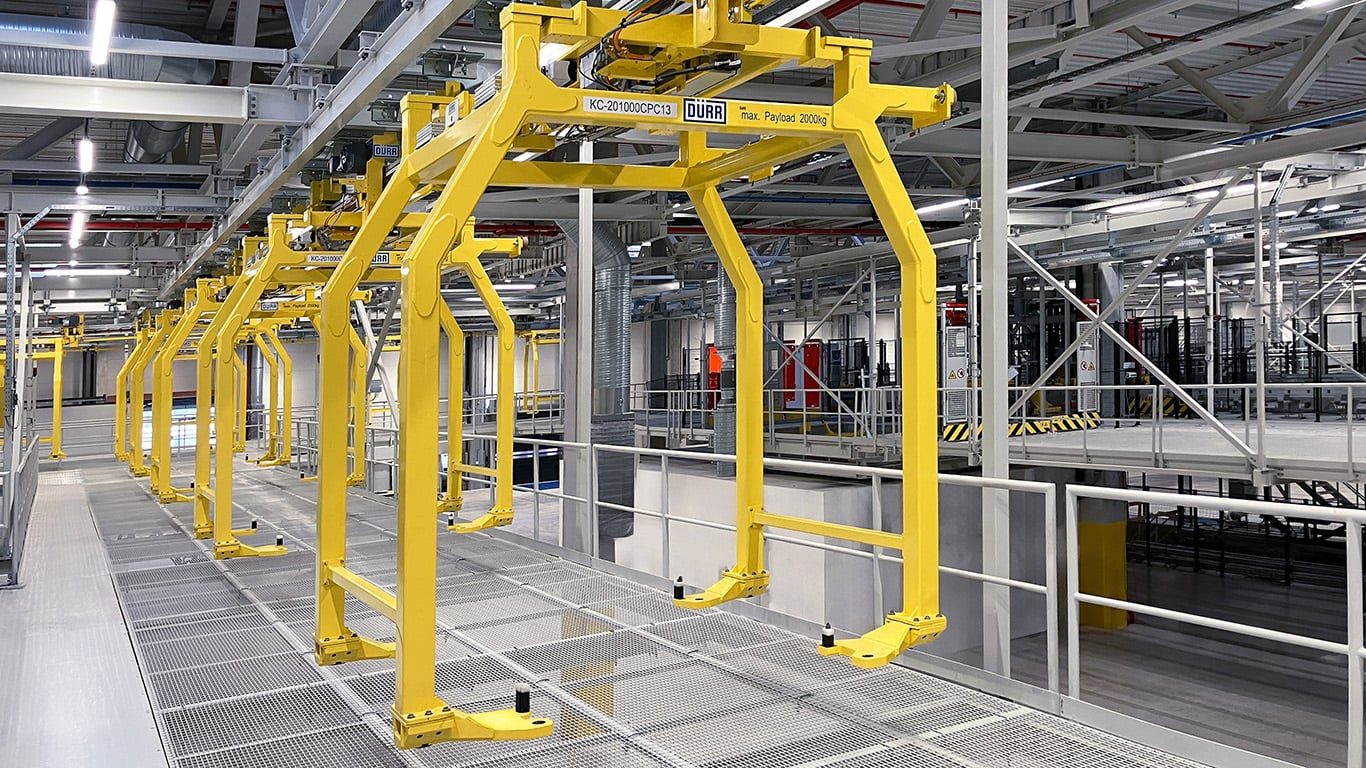

Dürr has begun installing the final assembly line at Volvo Cars’ plant near Košice, Slovakia, the carmaker’s first factory built only for electric cars, according to photographs the German plant-engineering group published.
The images show Dürr’s electric-monorail carriers, each rated for a 2,000 kg payload, suspended from the roof steel of a completed assembly hall with mezzanines, lighting and guard rails in place.
The scope covers conveyors, fluid filling and end-of-line testing, delivered as a single package under Dürr’s NEXT.assembly concept, for a plant with a maximum capacity of 250,000 cars a year and production scheduled to begin in 2027.
Volvo announced the Košice plant in July 2022 as a €1.2 billion investment for 250,000 electric cars a year, as EV reported, forming a European manufacturing triangle with Torslanda and Ghent.
Maximum annual capacity is 250,000 vehicles. Dürr announced the contract late last week.
Dürr already supplies vehicle-geometry and headlight-alignment equipment to every Volvo plant worldwide, and the Košice order extends that relationship into the assembly hall itself.
The contract does not cover the plant’s paint shop, body shop or battery lines, and Volvo has not named its paint-shop supplier for the site.
Component Supplier to Integrator
The German firm already supplies vehicle geometry and headlight alignment systems to every Volvo plant worldwide.
For Volvo, the arrangement reduces the need to coordinate between multiple technology suppliers while improving planning reliability across the assembly process, according to Dürr.
As the backbone of the assembly line, Dürr will supply more than three kilometers of conveyor technology to the Košice plant.
The system includes electric monorail systems, skillet platforms, and modular chain conveyors that transport car bodies and doors through all final assembly stations.
Filling systems built for future regulations
Volvo has used Dürr filling technology at several other facilities, including the Torslanda plant in Sweden — where the EX60 SUV’s production began in April — with special handling systems and five parallel consoles.
For Košice, the filling equipment goes further.
Dürr designed the systems to accommodate low-conductivity coolants and next-generation air-conditioning refrigerants that will be required under forthcoming European legislation.
Electric vehicles demand coolants with specific electrical insulation properties.
Future EU regulations are expected to phase in stricter requirements on refrigerant types used in automotive air conditioning.
Precision Inspection
End-of-line inspection at Košice will rely on two Dürr systems.
The x-wheel system measures and adjusts chassis geometry using the ‘x-3Dsurface’ non-contact sensor, which performs high-precision, area-based measurements compatible with any tire and body shape.
The driving axis determined during this process sets the alignment reference for the headlamps.
Dürr’s ‘x-light’ system then handles headlamp calibration.
Camera-based measurement technology inspects low beam, high beam, and fog lamp functions and adjusts them semi-automatically to meet both ECE and SAE standards.
Modern headlamp designs incorporate growing numbers of individual LED modules — a trend that has raised the complexity and precision requirements for light measurement, according to Dürr.
Košice in Volvo’s Strategy
Košice represents the first new European manufacturing site for Volvo Cars in about 60 years.
The Torslanda plant opened in 1964, and the Ghent factory in Belgium followed in 1965.
Together with Košice, the three European facilities will have combined annual output capacity of about 600,000 vehicles.
Slovakia is already home to four automakers — Volkswagen, Stellantis, Kia, and Jaguar Land Rover — giving the region an established automotive supply chain.
Košice will be the country’s fifth car plant.
Volvo has not publicly confirmed which model will launch first at the facility, though the company said in 2025 that a next-generation Volvo model would be the first vehicle built there.
Polestar has separately signed a memorandum of understanding to produce its upcoming Polestar 7 compact SUV at the site starting in 2028.
Broader Volvo Context
The assembly technology investment comes as Volvo works to rebuild sales momentum through its electric lineup.
Customer deliveries of the EX60 — the brand’s flagship mid-size electric SUV, built at Torslanda — started in Europe in July after demand exceeded internal forecasts.
Fully electric deliveries rose 14% globally in the second quarter, with BEV growth in Europe reaching 25%.
Parent company Geely has signaled plans to build more vehicles in Europe using Volvo’s existing plants, with founder Li Shufu warning of “very serious” overcapacity in the global auto industry.
Producing locally also helps the group avoid the EU’s elevated tariffs on Chinese-built electric vehicles.
Volvo has secured up to €119 million in Belgian government support for its Ghent plant and recently reversed a management reorganization put in place after losing its chief operating officer to Rivian.
The automaker has also enabled vehicle-to-load capability on the EX30 across EMEA markets as it broadens the feature set of its existing electric models.
Earlier this month, Volvo said it was choosing price over sales volume amid its weakest monthly result in years — a signal that the company is betting on margin discipline rather than aggressive discounting as new capacity comes online.