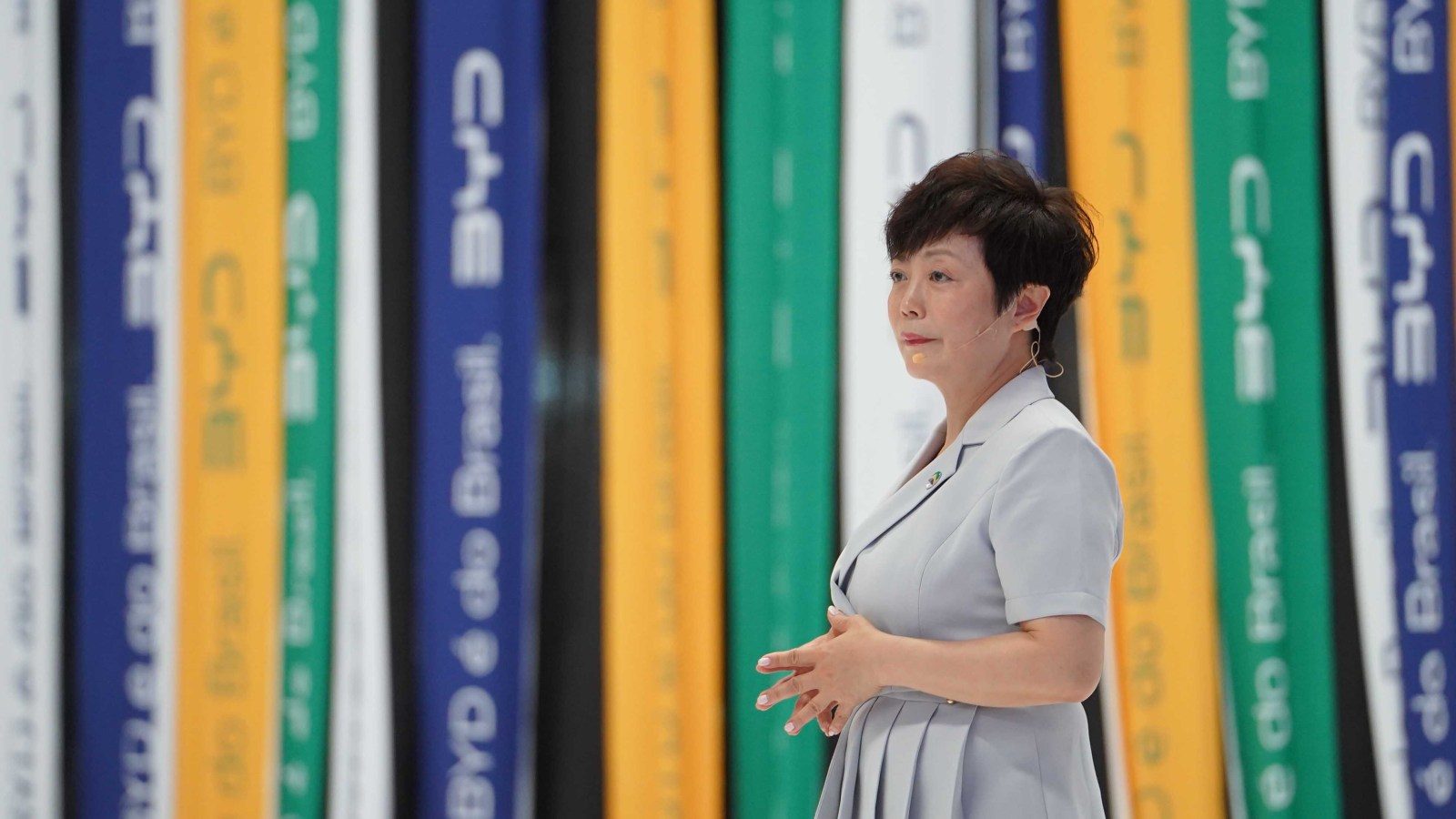

BYD is in talks with Stellantis and other European automakers about acquiring underutilized factories across the continent, the Executive VP Stella Li said on Wednesday.
Speaking with Bloomberg, Executive VP Stella Li said the world’s largest seller of electric vehicles is discussing potential deals to take on plants in countries including Italy.
Li made the remarks on the sidelines of the Financial Times’ Future of the Car conference in London, which EV attended.
“We are talking to not only Stellantis, we’re talking to other companies too,” Li told Bloomberg. “We are looking for any available plant in Europe because we do want to utilize this kind of spare capacity.”
According to the executive, BYD would prefer to operate the plants independently rather than through joint ventures — a position consistent with her earlier stance on potential manufacturing in Canada, where she told Bloomberg that a joint venture arrangement would not work for BYD.
Push for Local Production
The move would mark an escalation in the broader trend of Chinese automakers using local production to bypass the European Commission’s countervailing duties on Chinese-built EVs, imposed in October 2024.
The Commission concluded its anti-subsidy investigation after determining that China’s EV value chain benefits from unfair subsidization that threatens economic injury to EU producers. Individual duty rates vary by manufacturer.
BYD faces a 17% countervailing duty on top of the EU’s standard 10% import tariff, bringing its combined rate to 27%.
Geely faces 18.8%, while SAIC Motor — which owns the MG brand — was assigned the highest rate at 35.3%.
Combined with the base rate, Chinese EV makers face total tariffs of up to 45.3%.
Plug-in hybrid models are exempt from the countervailing tariff — a factor that has shaped BYD’s product strategy on the continent, where the company has been steadily expanding its PHEV lineup.
China has filed a formal complaint at the World Trade Organization seeking to overturn the duties.
Earlier this year, SAIC, BYD, and Geely challenged the measures before the Court of Justice of the European Union.
The Commission has since issued guidance allowing Chinese manufacturers to propose minimum import price agreements as an alternative to the duties, with negotiations ongoing.
The tariffs were prompted in part by the scale of Chinese government support for the EV industry.
BYD received 12.47 billion yuan ($1.8 billion) in government subsidies related to its daily operations in 2025, equivalent to 38.2% of net profit, its annual report showed.
Stripping out the subsidies entirely, the company’s adjusted net profit would be approximately 20.1 billion yuan — implying a roughly 50% decline from the prior year’s figures.
European Manufacturing Push
BYD already has two factories nearly ready to start production in Europe.
The company began trial production at its first European passenger car plant in Szeged, Hungary, in January — with series production expected in the second quarter.
A second factory in Turkey is not expected to begin operations until later this year.
The company has also considered both Portugal and Spain for a third European factory, under evaluation for their relatively low manufacturing costs and clean energy network.
Acquiring existing Stellantis plants — particularly in Italy — would represent a significant shift in BYD‘s European strategy, moving beyond greenfield investments to taking over established manufacturing infrastructure.
The move would also mark an escalation in the broader trend of Chinese automakers using local production to bypass the European Commission’s countervailing duties on Chinese-built EVs, imposed in October 2024.
Domestic Pressure
BYD‘s push to expand manufacturing in Europe comes as the company faces a prolonged price war in China that has eroded margins.
The automaker reported a 55% year-on-year decline in net profit in the first quarter of 2026 and has seen eight consecutive months of domestic sales declines.
The figures followed BYD’s first annual profit decline in four years for 2025, when net profit fell 19% to 32.6 billion yuan despite a record 4.6 million units sold.
BYD’s gross margin declined from 19.4% to 17.7%, which the company attributed to a shifting product mix toward lower-margin vehicles.
The price war has compressed average selling prices since BYD launched a 22-model price-cutting campaign with discounts of up to 34% in May 2025.
Chairman Wang Chuanfu warned that competition in China’s EV market had reached “fever pitch and is undergoing a brutal ‘knockout stage.'”
BYD also cut its workforce by approximately 100,000 employees in 2025, marking the first major headcount decline for China’s largest private-sector employer even as vehicle sales rose. The company’s year-end headcount stood at 869,600.
The company paid an average of approximately 147,000 yuan ($21,400) per employee in total compensation during 2025 — a labour cost advantage that several Western automaker executives have cited as a structural barrier to competition.
BYD has raised its overseas sales target to 1.5 million units for 2026, a 50% increase from the roughly 1.05 million vehicles it exported in 2025.
Overseas Surge
At the same time, overseas demand has surged.
BYD has raised its overseas sales target to 1.5 million units for 2026, a 50% increase from the roughly 1.05 million vehicles it exported in 2025.
The figure was increased from 1.3 million units set in January, with management flagging potential upside.
BYD has guided to full-year global sales of 5.0 to 5.5 million new energy vehicles. Overseas markets carry higher profit margins than the domestic market, making international expansion the most direct path to recovering profitability.
European Sales Momentum
The automaker’s European sales have reflected that momentum.
The figures rose 169.7% year-over-year to 50,646 units in the first quarter, lifting the company’s market share to 1.8% from 0.7%.
In Germany, Europe’s largest market, the Chinese automaker registered a record 4,705 vehicles in April — more than tripling from a year earlier.
In Spain, the company surpassed 40,000 cumulative registrations in March, marking three years since it expanded to the Iberian Peninsula.
BYD has also been stepping up hiring from rivals to bolster its premium Denza sub-brand in Europe, Bloomberg reported last month.
The upmarket brand, originally established as a joint venture with Mercedes-Benz and now 90% owned by BYD, officially launched on the continent in April and is expected to go on sale in the UK later this year.
The Denza brand made its European debut at the Milano Design Week in early April 2025, and was showcased at the Munich IAA Auto Show in September.
BYD is also preparing to bring its luxury Yangwang brand to Europe, which would make it the first Chinese automaker to enter the top-tier luxury segment on the continent. The launch timeline for Yangwang has not been disclosed.
Stellantis Deepens China Ties
The LPMI was launched in mid-2024 as a 51/49 Stellantis-led joint venture with exclusive rights for the sale and manufacturing of Leapmotor products outside Greater China.
Stellantis and Leapmotor are discussing the potential transfer of the Villaverde plant’s ownership to LPMI’s Spanish subsidiary.
Stellantis became Leapmotor‘s single largest shareholder in October 2023 with an approximately 21% stake, which has since been diluted to approximately 19%.
Earlier this month, it was also reported that state-owned Hongqi was in talks to produce cars in Spain through a Stellantis plant.
The negotiations are allegedly being held through Leapmotor, in which Hongqi’s parent company FAW Group also holds a stake.