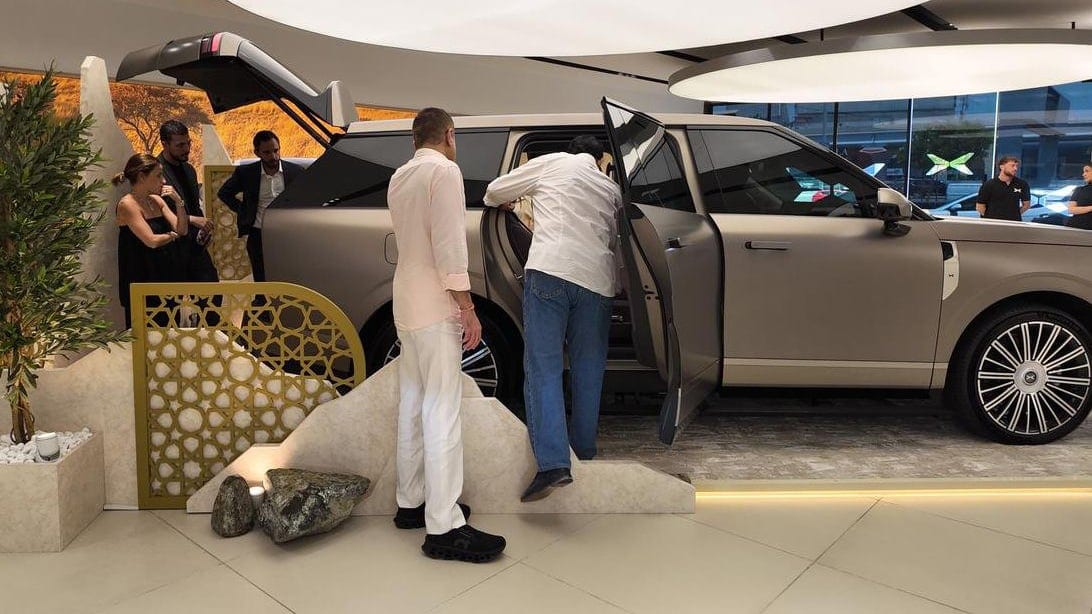

XPeng has delivered its 20,000th GX, the company said on Weibo on Monday, a little over three months after the full-size sport utility vehicle (SUV) went on sale.
The 20,000th owner is Bu Xinwen, General Manager of Bosch Huayu Steering Systems, the joint venture between Bosch and SAIC’s Huayu Automotive Systems that supplies the GX’s steer-by-wire system.
“From supplier to owner,” XPeng wrote, welcoming him to its owners’ community.
The GX launched on May 20 and recorded 284 units in that partial month.
Deliveries reached 6,739 in June and 7,140 in July, for a cumulative 14,163 by the end of July, according to figures published by the China Passenger Car Association.
That leaves at least 5,837 units in August by the time the milestone was announced — 81.8% of July’s figure, and a daily rate of roughly 195 against July’s 230.
August is the first month in which the GX has gone backwards.
The Backlog
XPeng took 24,863 firm orders in the model’s first 12 hours on sale, with more than 80% for the top Ultra Flagship trim.
Waiting times tell the same story. At launch, the battery-electric flagship carried a 26-to-30-week delivery window.
XPeng’s configurator now shows the extended-range 1585 AWD Max and Ultra SE trims at two to five weeks, the AWD Ultra at five to eight, and the AWD Ultra Flagship — the most expensive configuration — at seven to ten.
The compression suggests production has caught up with the surge.
The concentration of demand had pushed the all-electric Ultra Flagship wait to as long as 35 weeks in June, prompting XPeng to add moulds and production lines for key components.
September will be the first month that tests the underlying order rate rather than the queue.
The GX was XPeng’s second best-selling model in July at 7,140 wholesale units, behind only the Mona M03 at 10,357 — putting the company’s most expensive vehicle immediately behind its cheapest.
The GX lists from 279,800 to 359,800 yuan ($41,600 to $53,500) with a starting price of 269,800 yuan ($40,100) after the currently offered limited-time incentives.
The Gap It Has to Close
XPeng is targeting 550,000 to 600,000 global deliveries in 2026, growth of 28% to 40% on the 429,445 vehicles delivered in 2025.
July’s 38,027 sits about 36% below the roughly 59,000 a month needed to reach the low end of that range across the remaining months.
The GX is one of the levers meant to close it, alongside the Mona L03 and a record export push. Its own rate easing in August makes that arithmetic harder.
Overseas
The GX is sold in China, and offered for pre-order through XPeng’s UAE and Australia sites. Chairman He Xiaopeng said in June that overseas buyers had placed more than 1,000 blind orders.
Exports reached 124 units in July, up from two in June and 14 in May, accounting for 1.3% of XPeng’s record 9,700-unit export total for the month.
XPeng has said the GX will launch in Europe later this year.
The company assembles the G6, G9 and P7+ at Magna Steyr in Graz, Austria, from semi-knocked-down kits, and He has said a fourth model joins that line before year-end — without confirming whether it is the GX.
The Vehicle
The GX is a six-seat full-size SUV measuring 5,265 millimetres long on a 3,115-millimetre wheelbase, and the first model on XPeng’s SEPA 3.0 architecture.
It comes in two powertrains: a battery-electric version offering 750 kilometres of CLTC range on an 800-volt platform with 5C charging, and an extended-range version with a 1.5-litre turbocharged four-cylinder generator, 430 kilometres of electric range and about 1,585 kilometres combined.
Bosch announced on April 30 that Bosch Huayu would begin mass production of its new steer-by-wire system for XPeng, with the GX the first production model to carry it.
XPeng told its supply chain conference the GX would be the global production debut of that system, and the first time advanced by-wire chassis technology had been deployed at scale in a vehicle under 500,000 yuan.
The GX also underpins XPeng’s robotaxi programme.
The first mass-produced robotaxi came off the Guangzhou line in May on the same platform, running four in-house Turing chips for 3,000 TOPS. He completed the company’s first end-to-end robotaxi ride in Guangzhou in early July.
Manned pilot operations with safety drivers are planned for the second half of 2026, with driverless service targeted for early 2027.