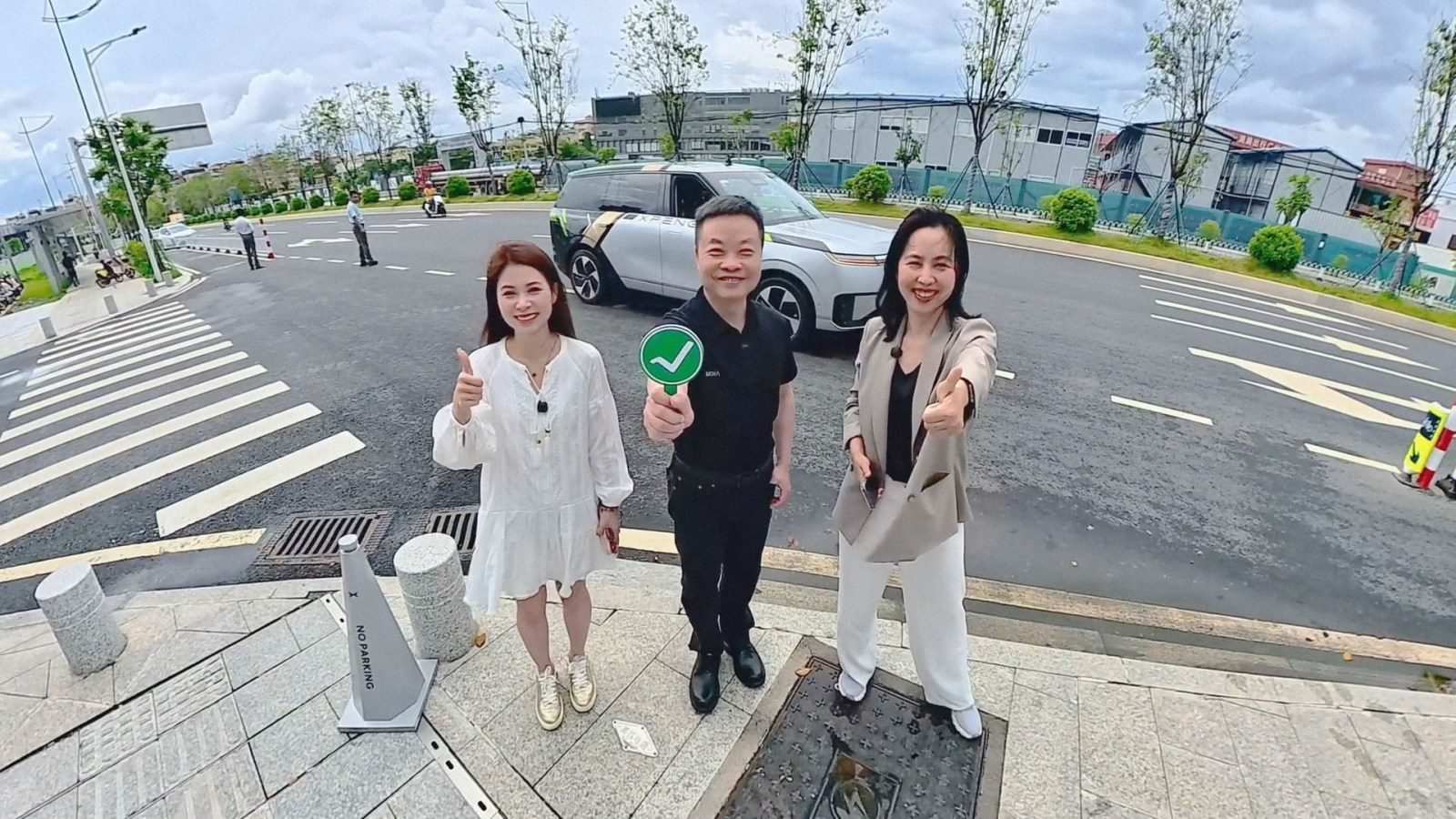

XPeng‘s founder and CEO He Xiaopeng announced on Thursday that he completed the company’s first end-to-end robotaxi ride in Guangzhou, marking the start of internal beta testing just eight months after the official unveiling of its robotaxi program.
He disclosed the milestone in a Weibo post, describing himself as “the very first user in our Robotaxi internal beta.”
The ride took place near XPeng‘s headquarters and covered the full service loop — from requesting a trip through the app to pickup and drop-off.
“This marks the first time we’ve successfully connected the entire journey end-to-end, from booking a ride in the app to getting picked up and completing the trip,” the Chief Executive wrote, noting that “sitting in the car at that moment, I couldn’t help but feel a little emotional.”
He Xiaopeng traced the program’s timeline in his post, laying out the sequence that brought XPeng from announcement to a working service in under a year.
“From announcing our Robotaxi initiative last November, to launching regular public-road testing in January, rolling the first production vehicles off the line in May, and now completing the full end-to-end workflow and opening internal testing today — it has taken just eight months,” He Xiaopeng wrote.
According to the founder, “that pace has exceeded even our own expectations.”
From Unveiling to Internal Testing
The robotaxi ride caps a development arc that began at XPeng‘s ‘AI Day’ in November 2025, when the company announced plans to launch three robotaxi models, each a 5-seater, a 6-seater, and a 7-seater.
They would be powered by a vision-only solution and four in-house Turing AI chips delivering up to 3,000 TOPS of compute power, the company said then.
The announcement came a day after Chinese media outlet 21世纪经济报道 reported that XPeng had scrapped a dedicated robotaxi model in favor of deploying Level 4 technology on existing production vehicles.
Sources at the time said the approach would allow the company to focus investment “toward software and algorithm talent, since hardware reuse is high.”
Reiterated Ambitions
XPeng reiterated its robotaxi ambitions during the company’s fourth-quarter 2025 earnings call in March, where management disclosed plans to begin manned pilot operations with safety drivers in the second half of 2026 and target fully driverless service by early 2027.
“By beginning of next year, hopefully, we can do without the safety driver on board,” He said on that call.
By then, the CEO said XPeng planned to “launch pilot passenger operations for our Robotaxi service to validate the technology, user experience, and the business model” in the second half of the year.
The earnings call also revealed that XPeng plans to invest 7 billion yuan ($1.0 billion) in physical AI-related R&D in 2026, up from 4.5 billion yuan allocated to AI in 2025 — a 56% year-on-year increase.
The company formally established its Robotaxi Business Unit on March 23, a tier-one organizational division operating across product definition, project integration, R&D testing, and daily operations.
On March 2, XPeng secured a Level 4 road testing permit for intelligent connected vehicles in Guangzhou, entering the phase of routine public road testing.
GX-Based Production Robotaxi
The vehicle He Xiaopeng rode on Thursday is built on the XPeng GX platform, which started robotaxi production in Guangzhou on May 18 — a milestone the company described as the first time a Chinese carmaker achieved mass production of a robotaxi through full-stack, in-house development.
The GX flagship six-seat SUV measures 5,265 mm long with a 3,115 mm wheelbase.
The robotaxi version operates without LiDAR sensors and without high-definition maps, relying instead on a pure computer-vision solution driven by XPeng‘s second-generation VLA 2.0 large model.
The system compresses decision-making latency to under 80 milliseconds and supports cross-city deployment without geographic-specific reengineering.
A core element of XPeng‘s commercial positioning is the production cost target of under 200,000 yuan ($28,000) per vehicle, according to Bernstein — enabled by the vision-only hardware approach and shared bill-of-materials with consumer models.
By comparison, Waymo‘s Jaguar I-Pace robotaxis are estimated to cost over $100,000 per unit.
For booking and dispatch, XPeng is partnering with Amap, Alibaba Group’s mapping platform with approximately 873 million monthly active users.
The company also plans to open its robotaxi SDK to additional global partners.
CEO’s Outlook on Autonomy
He Xiaopeng’s confidence in the robotaxi program aligns with increasingly bullish public remarks on autonomous driving timelines.
Speaking at the Xuanyuan Automotive Bluebook Forum in Guangzhou in May, the CEO said the probability of achieving Level 4 software capabilities by 2028 is “extremely high” and that an initial prototype of Level 5 full autonomy could emerge around 2030 — a timeline he once considered impossible in his lifetime.
He attributed the shift to a deeper understanding of the compounding effect of data-driven AI development, revealing that after restructuring XPeng‘s AI R&D framework, the evolution speed of the company’s autonomous driving technology improved roughly sixfold.
In his Weibo post on Thursday, the CEO thanked the robotaxi team before tempering expectations about the road ahead.
“Bringing Robotaxi to large-scale commercial deployment is a long-term journey,” He wrote. “Going forward, we’ll continue focusing on safety, user experience, and generalization, making sure every step is solid and reliable.”
He signaled that the internal beta is a precursor to broader access, adding that Guangzhou residents and visitors would hopefully be able to hail a ride through the app soon.