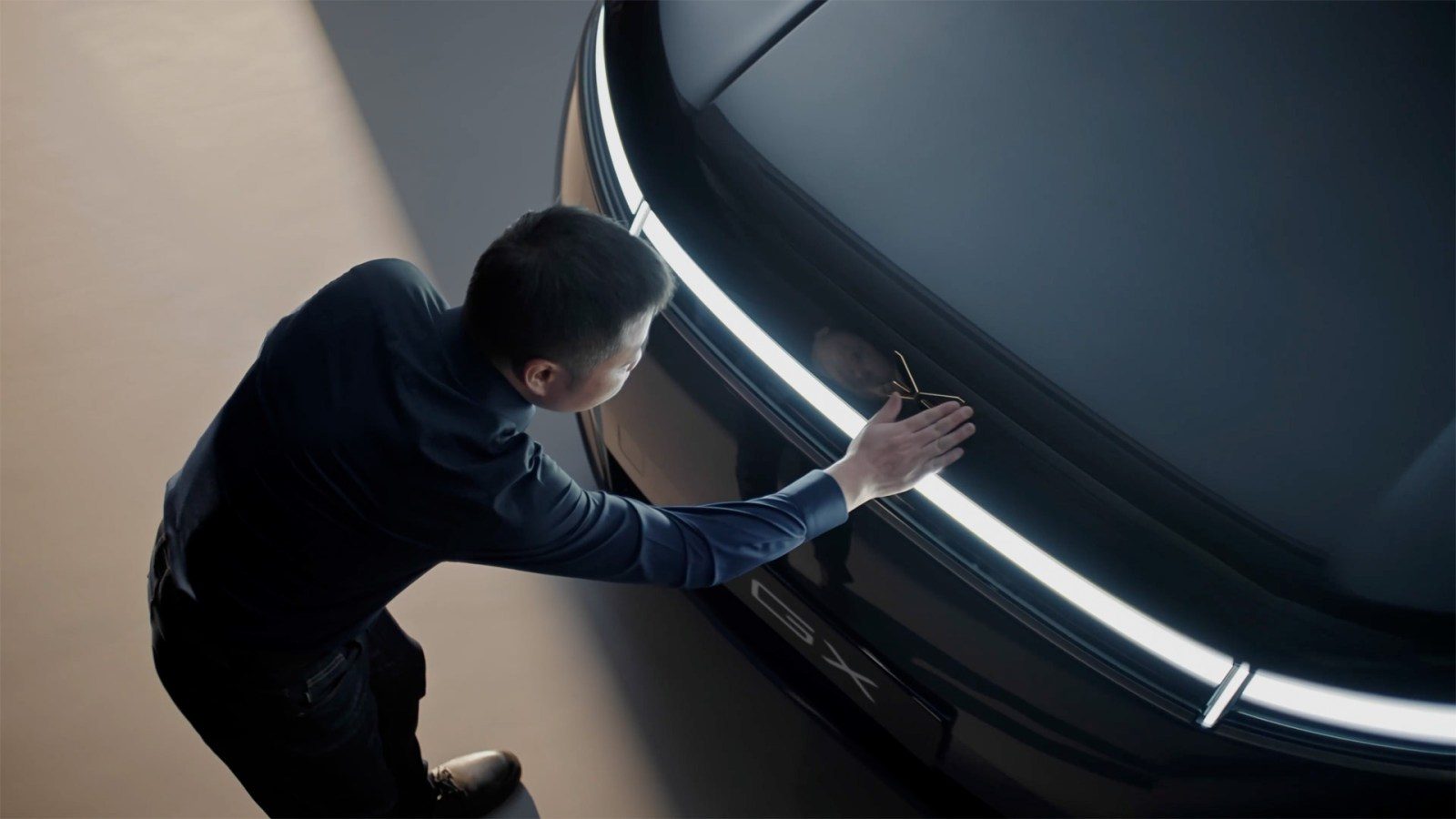

XPeng announced on Thursday that its newly launched GX flagship SUV secured 24,863 firm orders within its first 12 hours on sale — a result that founder and CEO He Xiaopeng admitted surpassed his own expectations.
Speaking in the morning after the model’s launch, He also revealed the Guangzhou-based automaker plans to enter the Middle East “as early as next month,” with additional markets to follow.
XPeng is also planning to bring the GX to Europe as early as October, marking the brand’s first entry into the continent’s premium large SUV segment.
The GX launched on Wednesday, priced between 279,800 and 359,800 yuan ($41,100–$52,900) before incentives.
The model is available in a pure electric version (BEV) — which rides on an 800V silicon carbide platform with up to 750 km of CLTC range and 5C ultra-fast charging — and as an extended-range electric vehicle (EREV), delivering over 1,585 km of combined range.
Early Demand
XPeng‘s flagship SUV debuted with a limited-time 10,000-yuan discount, bringing the effective range to 269,800–349,800 yuan for orders placed before June 30.
With that promotional pricing, the six-seat SUV nearly undercuts the Onvo L90’s starting price of 265,800 yuan with battery included, while sitting well below the Li Auto i8 and Tesla‘s six-seat Model Y L, both priced around 339,000 yuan.
Of the 24,863 orders collected in the first 12 hours, 80% were for flagship trims and more than half were for pure electric versions.
“To be honest, the data exceeded at least my expectations,” the CEO said, noting that “from what we’ve seen in our internal data, the numbers have been consistently very, very strong — and that was just the first night.”
XPeng‘s boss admitted that the company deliberately held off on publishing a sales battle report, a common marketing practice in China.
“There have been too many battle reports lately — from various other industries — and honestly, they’ve gotten to the point where even we don’t really trust battle reports anymore,” he said. “So I told the team: let’s not do it, let’s wait a day and release it.”
He Xiaopeng said he personally ordered two GX units — an EREV for Guangzhou and a BEV for Beijing — to replace two G9s.
The CEO joked that the flagship version had such strong demand that he was “thinking about whether I should maybe not go all-in on the flagship — I don’t want to compete with everyone for supply chain resources.”
He was candid about the difficulty of pricing in the current environment, however, notinh that “pricing is a really difficult question to answer because the industry has had a lot of great products recently.”
XPeng‘s Chief pointed to rising raw material costs as a persistent challenge, noting that much of the savings from technological innovation have been absorbed by supply chain partners.
“Most of the money earned from technological innovation has ended up being handed back to partners involved in memory, carbon chains, and other supply chains,” he said. “So the automobile industry is truly a very painful business.”
Despite those pressures, He noted that XPeng achieved a record-high gross margin in April.
The company has scheduled its first-quarter earnings report for May 28.
Domestic Pressure
China’s auto market has posted weak sales through the first four months of 2026, He Xiaopeng admitted, warning that the domestic market will face significant challenges in the second half of the year.
He argued that if Chinese automakers continue selling vehicles using the traditional business model, they risk falling into a pattern similar to the smartphone industry, where consumers become less willing to upgrade.
The real breakthrough, he said, will come from achieving Level 4 autonomous driving — increasing autonomous mileage coverage from around 50% to over 90%.
“The goal is to increase autonomous mileage coverage from around 50% to over 90%, so drivers rarely need to touch the steering wheel,” He said. “That day is coming soon.”
At the same time, XPeng has been facing steep declines in deliveries.
The automaker delivered 93,693 vehicles through the first four months of 2026, down from 129,053 in the same period last year.
XPeng targets 550,000 to 600,000 deliveries for the full year, which suggests that the brand would have to deliver an average of 57,000 units per month to achieve the goal.
International Push
According to the Chief Executive, XPeng‘s international push is about to shift gears.
The company’s overseas portfolio, currently centered around only two models, will “rapidly expand in the second half of this year and over the next two years into a very strong product matrix capable of competing globally,” he said.
XPeng‘s CEO emphasized that the company has designed its autonomous driving technologies and hardware-software stack from the ground up with globalization in mind.
“We basically avoid creating fragmented or isolated solutions — all of it is designed with globalization in mind,” He stated, adding that “only by truly designing both hardware and software from the ground up for global markets can a company build stronger global capabilities.”
He Xiaopeng, whose company is already present in over 60 markets worldwide, pointed towards 2027 for the results of its globalization push.
“I remain extremely confident about XPeng‘s overall globalization capabilities next year, including growth in sales and profits,” he said. “Since we are likely to enter the Middle East as early as next month, we will then gradually expand into different countries afterward.”
The comments come as XPeng accelerates overseas production infrastructure.
The company recently acquired a 90% stake in an Indonesian manufacturing entity under the Erajaya Group, deepening its localized production in Southeast Asia’s largest auto market.
In Europe, XPeng is preparing to launch the Mona L03 in July and has said the GX will follow in October — marking the brand’s first entry into the continent’s premium large SUV segment.
The company currently assembles the G6 and G9 SUVs at Magna Steyr’s Graz facility in Austria.
However, its Managing Director for the UK and Eastern Europe Elvis Cheng confessed last week that the plant’s capacity is insufficient to meet growing demand.
Cheng confirmed that XPeng is in early talks with Volkswagen about potential European manufacturing arrangements, though he pointed to compatibility challenges.
XPeng aims to double overseas sales from the 45,008 units delivered in 2025, with a broader target of 1 million annual overseas by 2030.