
XPeng registered only 24 vehicles in Australia throughout April, marking its weakest month of 2026 and bringing the year-to-date total to 200 units — according to data tracked by the Electric Vehicle Council.
The figures underscore the toll that a protracted legal dispute between the Chinese automaker and its local distributor, ‘TrueEV’, is taking on the brand’s ability to sell vehicles in one of the Asia-Pacific’s fastest-growing EV markets.
April’s 24-unit result represented a 41.5% decline from March and fell well below the brand’s January figure of 94 units, which had been its strongest month in 2026.
February came in at 41 registrations.
XPeng‘s Australian sales history is difficult to track, since the brand does not figure in the monthly reports of the Federal Chamber of Automotive Industries (FCAI).
Neither XPeng nor TrueEV has provided sales data to the Electric Vehicle Council either.
Dealer Conflict
XPeng entered Australia in late 2024 through TrueEV, a third-party distributor that was appointed as the brand’s sole importer, distributor and retailer under a five-year agreement signed in April of that year.
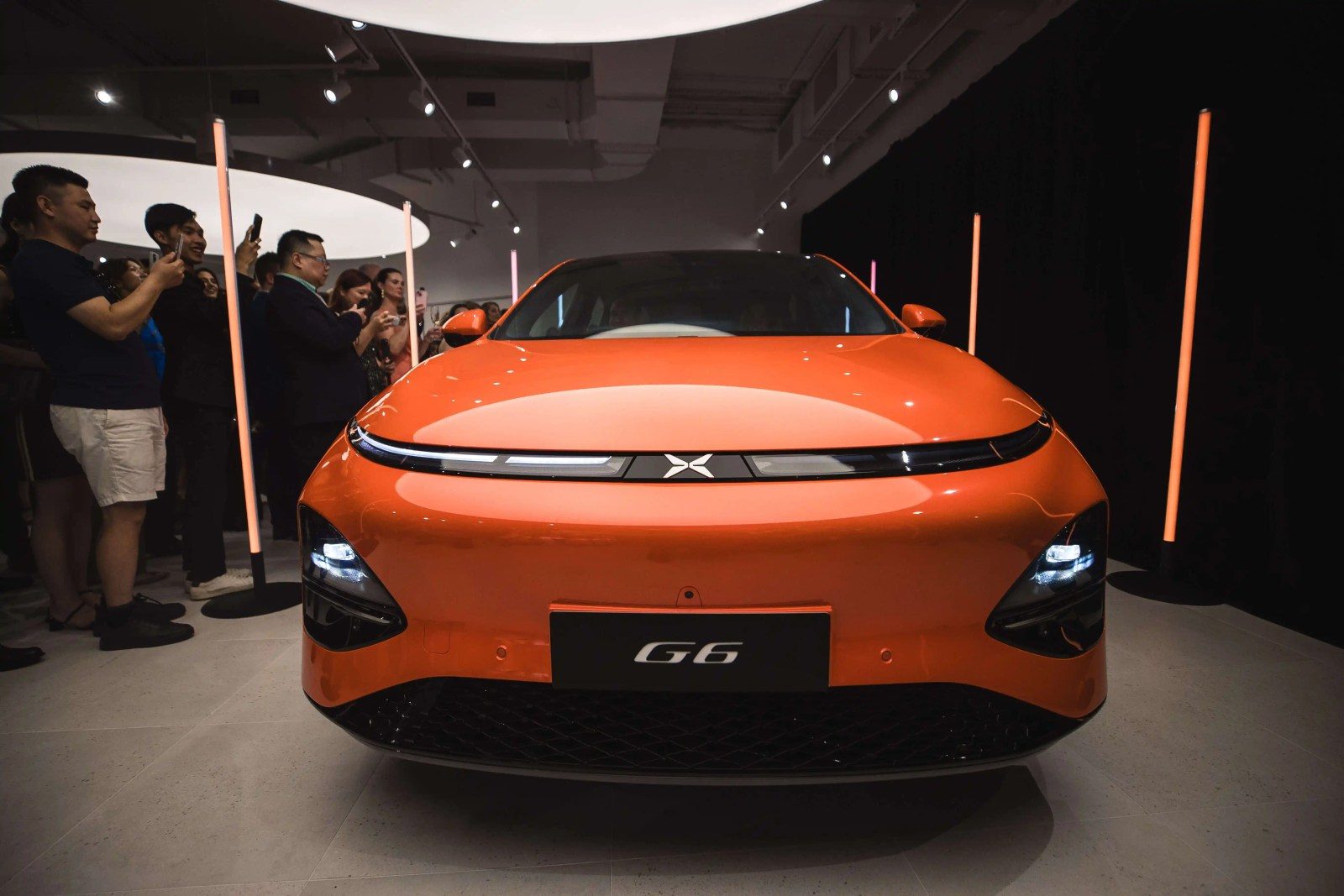
TrueEV began deliveries of the G6 mid-size SUV — XPeng‘s only model in the market — in August 2024 and claimed to have delivered over 2,000 units by the end of 2025.
However, the relationship between XPeng and TrueEV deteriorated rapidly.
In early March, TrueEV filed legal action in the Federal Court of Australia against three XPeng-related entities, alleging unconscionable conduct.
According to CarExpert, TrueEV claimed that XPeng relied on the distributor to establish its brand locally but then systematically undermined its operations from late 2024 onward, before issuing notice to terminate the exclusive distribution agreement.
Weeks later, TrueEV appointed an external receiver to manage the sale of 197 older-model G6 vehicles in its stock across multiple sites around the country.
The company denied reports that it had entered full administration.
Additionally, the trial is set for October 2026.
Renewed Launch
In early April, XPeng announced the formal establishment of ‘XPeng Motors Australia Pty Ltd.’, a factory-backed operation that would build an entirely new authorized dealer network across major cities.
These included New South Wales, Victoria, Queensland, South Australia and Western Australia.
The company appointed former GWM Australia chief operating officer Hidesuke Takesue to lead the new operation.
XPeng framed the move not as a transition from TrueEV but as a separate, parallel launch — describing it as “day one” for the brand in the country.
The result is an unusual situation in which both XPeng head office and TrueEV may coexist in the Australian market, at least temporarily.
XPeng has not confirmed when factory-backed sales will begin, whether certain models will be exclusive to official channels, or how existing customers will be supported during the transition.
Australian EV Market
According to the FCAI, electric vehicles accounted for 16.4% of all new vehicle sales in April 2026 — roughly one in every six cars sold — up from around 10% for much of 2025.
FCAI’s CEO Tony Weber attributed the EV surge to the increased supply of electric models to new incentives, combined with higher petrol prices.
Chinese-manufactured vehicles accounted for approximately 30% of all sales during April — a figure that includes not only BYD, Geely, MG and other Chinese brands but also some Tesla and Volvo models that are assembled in China.
The contrast between XPeng‘s struggles and the broader success of Chinese EV brands in Australia is stark.
In the battery electric vehicle (BEV) segment, BYD led all brands with 4,452 registrations, followed by Tesla at 1,225 and Kia at 1,324.
BYD also ranked second in the overall new vehicle market for the month with 7,702 total sales across all drivetrains, which also includes plug-in hybrids (PHEV) — trailing only Toyota.
Among Chinese EV brands, Zeekr posted 1,006 EV registrations in April for a year-to-date total of 2,838, while Geely recorded 1,202 units.
SAIC‘s MG registered 1,027 electric vehicles, while Chery Group‘s overseas-focused Omoda & Jaecoo brand added 692.
The numbers place XPeng at the very bottom of the EV brand rankings in Australia, behind Subaru (180), Chery (125), Skoda (97) and Leapmotor (143) — all of which are relatively minor players in the country’s electric vehicle segment.
The gap illustrates the cost of XPeng‘s distribution upheaval.
While rivals have been scaling up dealer networks and expanding model lineups — BYD now offers close to a dozen models in Australia, and Zeekr and Geely have both launched multiple vehicles — XPeng remains a one-model brand with an uncertain retail footprint.
Speaking with CarExpert on Monday, a spokesperson for the brand said it is “currently working through the local product roadmap now that XPeng ANZ is operating directly in Australia.”
The company expects to bring the updated version of the G6 and the X9 MPV to the market, with details to be provided during this quarter.
XPeng has set a 2026 target of 550,000 to 600,000 units and aims to double its overseas deliveries from the 45,008 units shipped outside China last year.