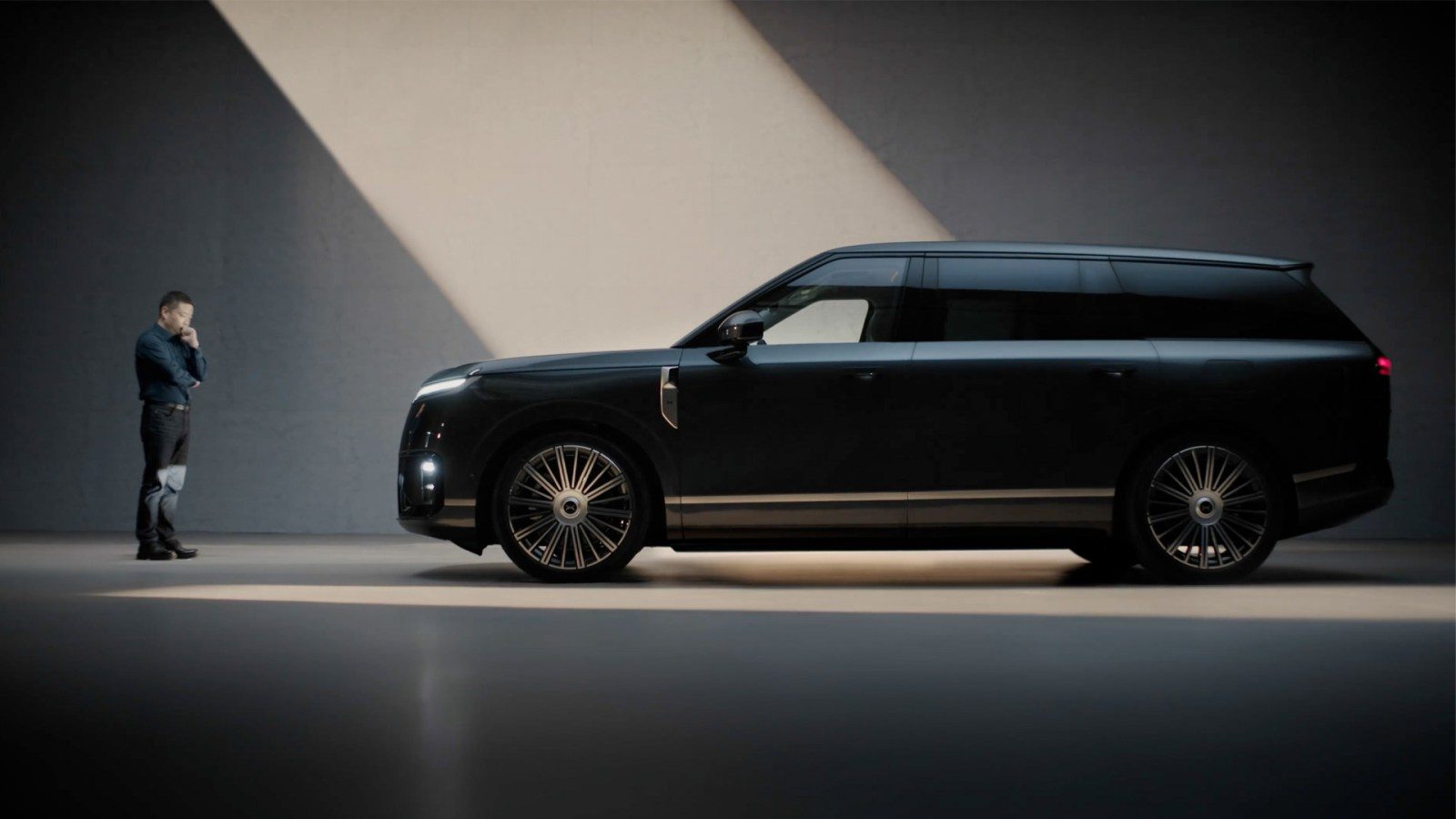

China’s auto industry is preparing for more than 20 new model launches at the 2026 Beijing Auto Show, which organizers are billing as the world’s largest auto fair when it opens next week.
The biennial event runs from April 24 to May 3 and alternates with the Shanghai Auto Show.
Several brands have begun unveiling new models and opening pre-sales ahead of the show, including the large SUVs Nio ES9, XPeng GX, Volvo EX90, Leapmotor D19, SAIC-Volkswagen ID.ERA 9X, Voyah Taishan, BMW iX3, Zeekr 9X, Lynk & Co 900, IM LS9, among others.
Facelifts of the Li Auto L9, the Onvo L90 and the Aito M9 are also debuting in the upcoming week.
The launches highlight how three-row six-seat SUVs have become the main battleground and technology showcase for Chinese automakers.
Speaking with media outlet Cailian Press, China Passenger Car Association (CPCA)’s secretary general Cui Dongshu said the new energy vehicle (NEV) is undergoing structural adjustments, as the entry-level segment has shrunk significantly and competition in the mid-to-high-end segment has intensified.
“High-end pure electric large three-row SUVs have a promising future and clear advantages,” Cui said.
He argued the Chinese auto market is shifting toward consumption upgrades and larger family needs, with demand moving toward higher-quality and more spacious vehicles.
The CPCA said earlier this month production and sales will continue a “slow recovery” through April, as the market emerges from what it described as the weakest opening quarter in over a decade — excluding the 2020 pandemic disruption.
Preliminary data from CPCA shows that retail sales in China’s passenger vehicle market reached 377,000 units between April 1 and April 12, down 20% year-on-year and 12% sequentially.
New energy vehicle retail sales reached 224,000 units over the same period, down 11% year-on-year but up 7% from March.
XPeng GX
XPeng opened pre-sales for its flagship six-seat GX on Wednesday, entering the premium large-SUV segment with the most expensive model in its lineup.
The GX has a pre-sale price of 399,800 yuan ($58,600) and is available in both battery electric (BEV) and extended-range (EREV) variants.
The launch price comes in below the 400,000-to-500,000-yuan range industry observers had estimated when the model was first unveiled in February.
The EREV pairs a 1.5-litre range extender with a dual-motor setup, delivering 430 km of electric range and 1,585 km combined on the CLTC cycle.
The BEV version uses an 800-volt silicon-carbide platform, supports 5C ultra-fast charging and offers up to 750 km of CLTC range.
XPeng‘s GX is built on an architecture targeting Level 4 autonomy, powered by three in-house Turing chips delivering 2,250 TOPS of effective computing power. The system is vision-only, with no LiDAR.
It measures 5,265 mm in length, 1,999 mm in width and 1,800 mm in height, with a 3,115 mm wheelbase.
The model is critical to XPeng’s bid to hit its 2026 delivery target of 550,000 to 600,000 vehicles, following a 34.1% year-on-year decline in January deliveries to 20,011 units — the steepest drop among major Chinese automakers.
The Guangzhou-based automaker delivered 62,682 vehicles in the first quarter, representing just 10.4% to 11.4% of its full-year guidance.
Leapmotor D19
Stellantis-backed Leapmotor officially launched its flagship D19 SUV on Thursday, following its debut in October 2025 and pre-orders opening the following month.
The D19 starts at 219,800 yuan ($32,220) and runs to 269,800 yuan ($39,550) for the top trim, and, like XPeng‘s recent launches, is offered as both BEV and EREV versions.
This reflects a broader trend: EV-focused companies are now adding hybrid-style range-extender options as demand for pure electric vehicles slows.
The D19 is the first model in Leapmotor‘s D series and measures 5,252 mm in length, 1,995 mm in width and 1,780 mm in height, with a wheelbase of 3,110 mm.
The EREV variant carries an 80.3 kWh CATL battery — what Leapmotor says is the largest ever installed in a range-extended vehicle — delivering up to 500 km of electric-only range on the CLTC cycle.
The EREV powertrain delivers 400 kW, accelerating from 0 to 100 km/h in under five seconds.
The BEV variant is built on a 1,000-volt high-voltage platform with a 115 kWh battery pack, delivering up to 720 km of range and a 0-100 km/h time of under four seconds.
The D19 is powered by dual Qualcomm Snapdragon 8797 chips with a total 1,280 TOPS of computing power, supporting a Vision-Language-Action large model.
Four new models — including the D19 — are expected to contribute about 60% of Leapmotor‘s sales in 2026, supporting a full-year target of 1 million deliveries.
Volvo EX90
Volvo unveiled the China-made EX90 at its 99th anniversary event on Wednesday, opening pre-sales for the fully electric flagship SUV at 539,900 yuan ($74,700).
The seven-seat, fully electric SUV had appeared on China’s Ministry of Industry and Information Technology (MIIT) catalogue earlier this year.
The EX90 is built on Volvo‘s SPA2 native luxury electric architecture and features a full 800-volt platform, the same underpinnings used on the — also debuted — ES90 sedan.
The SUV offers a maximum CLTC range of 756 km in a 2+3+2 seven-seat layout.
The model is available in Plus and Ultra dual-motor AWD variants, with the Ultra trim carrying higher-output motors.
The Plus variant pairs a 130 kW front motor with a 200 kW rear motor, while the Ultra variant upgrades to a 220 kW front motor and a 280 kW rear motor.
The model measures 5,037 mm in length, 1,964 mm in width and 1,742 mm in height, with a wheelbase of 2,985 mm.
The EX90 launch comes at a time when Volvo is trying to boost EV sales in China, as stronger competition and ongoing trade tensions created challenges for the Swedish-headquartered, Geely-owned brand.
In the first quarter, Volvo sold 28,330 vehicles overall in China, a 17% decline from a year ago.
Fully electric sales plunged 26% to just 451 units.
Electrified model sales in the region surged 116% to 7,604 units, driven by a 146% jump in plug-in hybrid deliveries, though fully electric sales fell 26% to 451 units.
Nio ES9
Nio pre-launched the ES9 at a technology event in Hangzhou, opening pre-sales for what it describes as the largest fully electric SUV currently on sale in China.
The Executive Luxury Edition starts at 528,000 yuan ($77,200) with the battery included, or 420,000 yuan ($61,400) under Nio‘s Battery as a Service scheme.
The vehicle is available in two other trims — the Executive Signature Edition and the Horizon Special Edition.
All three variants share a 520 kW dual-motor powertrain running on a 900-volt electrical architecture, paired with a 102 kWh CATL nickel-cobalt-manganese battery and up to 620 km of CLTC range.
The entry trim does not include the SkyRide active suspension system.
At 5,365 mm in length with a 3,250 mm wheelbase, the ES9 replaces the ES8 as Nio‘s flagship SUV.
The official launch is scheduled for late May, with customer deliveries beginning on June 1.
Founder and CEO William Li has described the ES9 as “the most important product of the year” for the brand.
Earlier this week, Li said orders from buyers outside the existing Nio community were running at more than 1.5 times the equivalent period after last year’s ES8 launch.
Bank of China International expects the ES9 to stabilise at monthly deliveries of 3,000 to 4,000 units, driving combined ES8 and ES9 sales above 10,000 units per month.
Price Comparison
All four models are six- or seven-seat configurations targeting the executive and family segments. However, pricing across the SUVs spans a wide range.
The Leapmotor D19 sits at the lower end, starting at 219,800 yuan ($32,220).
The XPeng GX follows at 399,800 yuan ($58,600) for both powertrain variants.
The Nio ES9 starts at 528,000 yuan ($77,200) with battery included, or 420,000 yuan ($61,400) under BaaS — the latter figure putting its entry point close to the GX on a cash-out basis.
The Volvo EX90 will compete in the same price segment.
The four models also differ on platform voltage: the Leapmotor D19 BEV runs at 1,000 volts, the Nio ES9 at 900 volts, and the XPeng GX and Volvo EX90 at 800 volts.
Other Models
Additional large SUVs are expected to draw attention during the show, including the Wey V9X — the first model built on Great Wall Motor‘s “Guiyuan S Platform” — which is scheduled to go on pre-sale on April 17.
Dongfeng and Huawei‘s jointly developed “Yijing” large six-seat SUV has completed extreme cold-weather testing and will debut in Beijing.
The “Huazhang S,” the first large six-seat SUV jointly developed by Wuling and Huawei, has already opened pre-sales.
Other competitors in the segment include the Zeekr 9X, Lynk & Co 900, IM LS9, Voyah Taishan and Geely‘s Galaxy M9.
The Zeekr 8X, unveiled earlier this month, will also be present at the show, according to Head of Interior Design Sérgio Loureiro da Silva.
“The Zeekr 8X, our newest family member, is here. On display at the Beijing Motor Show next month, see you there,” he wrote.
Additionally, Li Auto will launch an updated version of its L9, and Aito is scheduled to debut the refreshed M9.
Outside the large SUV segment, BYD will showcase its Sealion 08, a Denza D9 update, and a new Fangchengbao coupe SUV.
European Automakers
German legacy brands are lining up their own launches, including the Audi E7X, and the China-specific Mercedes-Benz S-Class facelift and BMW iX3 Long Wheelbase.
Developed specifically for the Chinese market, the BMW model is scheduled to enter the market in the second half of the year.
The iX3 Long Wheelbase is planned for availability in China and selected international markets, including Thailand, Malaysia, Indonesia, and India.
Volkswagen is also active on two other fronts through its Chinese joint ventures.
SAIC-Volkswagen will debut the ID.ERA 9X, while Volkswagen‘s partnership with XPeng produced the ID.UNYX 08 — the first model built on the jointly developed CEA platform.
Volkswagen officially launched the ID.UNYX 08 on Thursday, with pricing starting at 229,900 yuan ($33,700) and the top trim at 289,900 yuan ($42,500).
The public debut is scheduled to take place at the Auto Show.