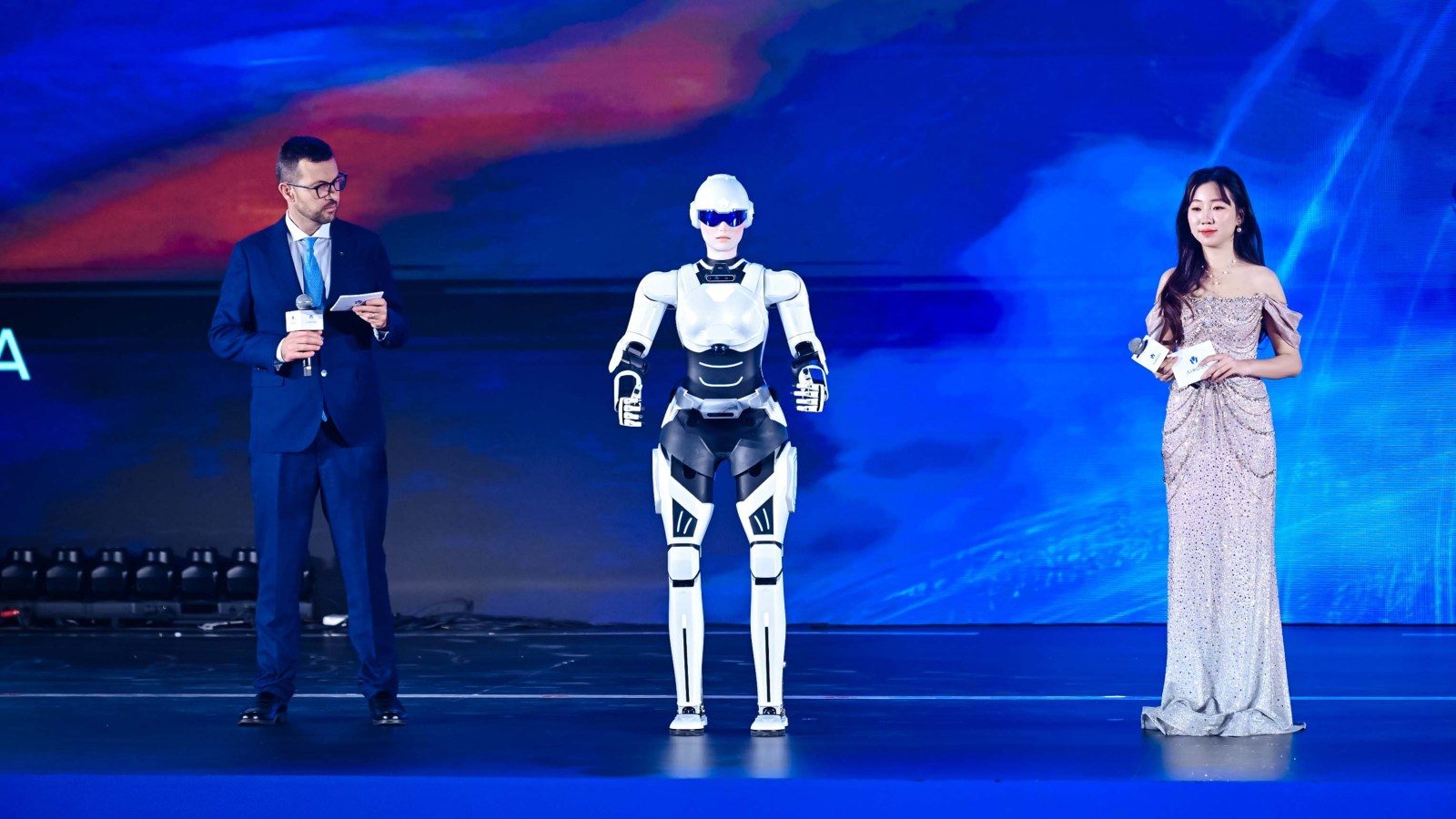

Chery Automobile Co.‘s robotics arm is preparing an initial public offering, the same day Unitree Robotics closed more than 460% above its offer price in Shanghai in the first listing by a humanoid robot maker on mainland China’s markets.
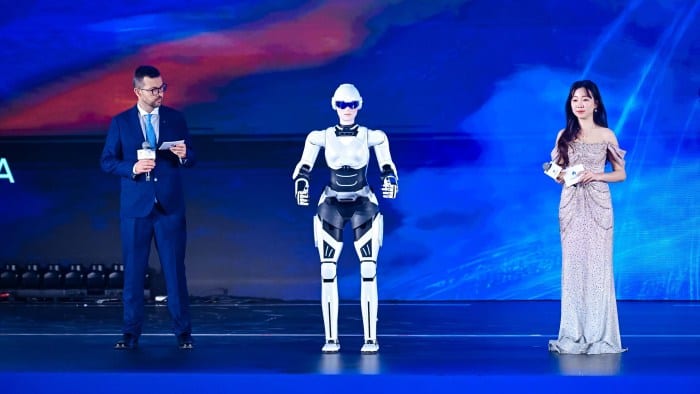
Aimoga Robotics is in discussions with several potential venues, Zhang Guibing, who leads the business and serves as president of Chery International, told Reuters at the World Robot Conference in Beijing.
“We’re making the relevant preparations now, and currently in discussions with several IPO locations,” Zhang said. He declined to specify timing or venue.
Unitree ended Wednesday at 845 yuan against an offer price of 150.8 yuan, valuing the Hangzhou-based company at about $51 billion.
The listing provides the first public-market pricing for a sector in which most significant participants remain private or held within larger companies.
Chery is the first automaker to state publicly that it intends to separate its robotics unit.
The Offering
Unitree sold 40.45 million new shares, or 10% of the enlarged capital, raising 6.1 billion yuan ($905 million) with no secondary component.
The offering was more than 8,000 times oversubscribed, a record for Shanghai’s STAR Market, with a lot-winning rate of 0.018%. Shares rose as much as 630% before paring gains.
DeepSeek invested about 140.8 million yuan as a strategic investor. Tencent Holdings Ltd. was already a shareholder. Senior management and core employees subscribed through two asset-management plans capped at 271.5 million yuan.
Pricing rose through the process.
An early prospectus implied about 42 billion yuan, Reuters reported a target of as much as 50 billion yuan in September, and the deal priced at 61 billion yuan.
Financials
Unitree reported 2025 revenue of 1.699 billion yuan at a 60.13% gross margin on core businesses, placing it among the few humanoid hardware makers operating profitably at scale.
The company shipped more than 5,500 humanoid robots last year, more than any manufacturer globally, and has sold over 33,000 quadrupeds cumulatively, holding more than 60% of that market.
Founder Wang Xingxing held about a third of the company before the offering through direct and indirect holdings. Post-listing accounts commonly put his stake nearer a fifth.
Overseas revenue exceeds 40%, with the US accounting for 13.3% of 2025 revenue. Washington has restricted foreign-made humanoid and quadruped robots; Unitree says current models hold US approvals though future ones could be barred.
The company guided to first-half 2026 revenue of 1.052 billion to 1.128 billion yuan, up 35.6% to 45.4%, with net income of 258 million to 306 million yuan.
Listed Companies
UBTech Robotics Corp. Ltd. has traded in Hong Kong since December 2023 and was the first publicly listed humanoid robotics company.
The Shenzhen-based firm spent more than 507 million yuan on research and development in 2025, produced its 1,000th Walker S2 at its Liuzhou plant and targets 5,000 units annually.
Dobot Corp. also trades in Hong Kong. No other pure-play humanoid manufacturer is publicly listed.
The Pipeline
AgiBot confirmed to Caixin on July 24 that it had begun a Hong Kong IPO process, the first of what the publication described as 30 to 50 Chinese embodied-AI startups to disclose listing plans.
The Shanghai-based company, founded by former Huawei Technologies Co. engineers, has appointed China International Capital Corp., CITIC Securities and Morgan Stanley as joint sponsors.
It is reported to be targeting HK$40 billion to HK$50 billion while selling 15% to 25%. Backers include Tencent, JD.com Inc., SAIC Motor Corp., HongShan, LG Electronics Inc., Mirae Asset and Hillhouse Investment.
AgiBot is pursuing a second route in parallel, having acquired a controlling stake in Shanghai-listed Swancor Advanced Materials Co. to secure a mainland platform without a direct offering.
Agility Robotics Inc. is going public through a special purpose acquisition company at about $2.5 billion, the only Western humanoid manufacturer with a live listing route. Deep Robotics and Leju Robotics are pursuing A-share listings.
Aimoga, incubated by Chery in January 2025, has delivered more than 3,000 robots globally, including 2,000 overseas, across more than 60 countries, and targets 10,000 next year.
The company’s humanoid sells on JD.com for 285,800 yuan and its quadruped for 15,800 yuan. It has deployed 110 police robots across Chinese cities for traffic management and crowd guidance.
Chery has separated units before. Bethel Automotive Safety Systems Co. listed in Shanghai in 2018 and robotics firm Efort Intelligent Equipment Co. was listed on the STAR Market in 2020.
Automakers Retaining Control
More than 20 major automakers have entered humanoid robotics. Almost none has moved to separate the business.
XPeng has moved in the opposite direction.
Founder and CEO He Xiaopeng announced on June 10 that he would assume the role of chief executive of the robotics division while continuing to lead the group, describing a shift from an intelligent car company to a physical AI company.
He compared the moment to the period before the G3, the company’s first mass-produced vehicle, in an internal letter reviewed by Reuters.
“The industry is becoming increasingly hot and competitive, and we have clearly seen the direction and timing of victory, but it still requires more arduous implementation,” he wrote.
XPeng has announced no plans to spin out or list the unit. Exposure to its IRON humanoid is available only through the listed parent.
IRON stands 1.73 meters and weighs about 70 kilograms, with more than 60 joints, 200 degrees of freedom, a humanoid spine, biomimetic muscles and dexterous hands with 22 degrees of freedom each.
It runs XPeng‘s Turing chips and the vision stack from its vehicles.
The company broke ground on a 110,000-square-meter production base in Guangzhou’s Tianhe District in February.
It targets mass production by the end of 2026 at more than 1,000 units a month, with commercial deployment in the first quarter of 2027 as sales assistants in Chinese showrooms.
Tesla has converted Model S and Model X capacity at Fremont to Optimus production without announcing a separation.
Hyundai Motor Co. owns Boston Dynamics outright and has retained it as an affiliate, with Atlas targeted for parts-sequencing deployment at Hyundai and Kia plants in the US around 2028.
Rivian has taken a different approach.
Its robotics spinoff Mind Robotics has raised $1.015 billion across three rounds — a $115 million seed, a $500 million Series A in March and $400 million in May led by Kleiner Perkins — and was valued at $3.4 billion, about 70% above its March mark.
Rivian is the major shareholder and founder RJ Scaringe is chairman. No listing has been announced.
BYD Co., Changan Automobile Co. and GAC Group are also developing humanoid products without disclosed separation plans.
Private Valuations
Figure AI Inc. carries a $39 billion valuation from its September 2025 round. Apptronik Inc. closed an extended $935 million Series A.
NEURA Robotics GmbH raised as much as $1.4 billion led by Tether Holdings Ltd., at a valuation reported around $7 billion though not consistently confirmed.
Galbot raised about 2.5 billion yuan in March and is generally described as the highest-valued unlisted Chinese humanoid company, a ranking that shifts with undisclosed private marks. Astribot, RobotEra, LimX Dynamics, Fourier Intelligence, 1X Technologies and Noetix Robotics remain active, several having closed nine-figure rounds within 12 months.
LimX has been linked to a Hong Kong listing.
K-Scale Labs shut down in November 2025 and Cartwheel Robotics closed in February.
Sanctuary AI pivoted to software in June, and Amazon.com Inc. acquired Fauna Robotics in March.
Forecasts
Morgan Stanley raised its estimate for Chinese humanoid shipments in June to 50,000 units this year from 28,000, and projects China’s market growing to $15 billion by 2030 from $2 billion.
Full-size humanoids will rise to about 70% of shipments by 2028 from roughly 30%, the bank said. It separately projects $25 trillion in annual global robot sales by 2050.
China’s Ministry of Industry and Information Technology and its state-asset regulator launched a 2026 initiative targeting more than 100 validated applications and “10,000-unit-scale deployment capability” by year-end.
Barron’s identified manufacturing rather than software as the binding constraint, noting the industry requires millions of low-cost components that current capacity cannot supply.
Zhang offered a longer timeline than Wednesday’s trading implied.
He compared China’s robotics industry to its electric-vehicle sector several years ago, with rapid entry, intensifying competition and consolidation ahead. “Competition, particularly on costs, is likely to be fierce,” he said.
Humanoid robots “could take about a decade to mature before seeing rapid adoption,” Zhang said.
Unresolved
AgiBot‘s valuation target appears in some market commentary at a figure ten times the reported HK$40 billion to HK$50 billion range.
Aimoga has not indicated whether it will pursue a mainland, Hong Kong or overseas venue. No automaker other than Chery has signaled an intention to separate its robotics operations.