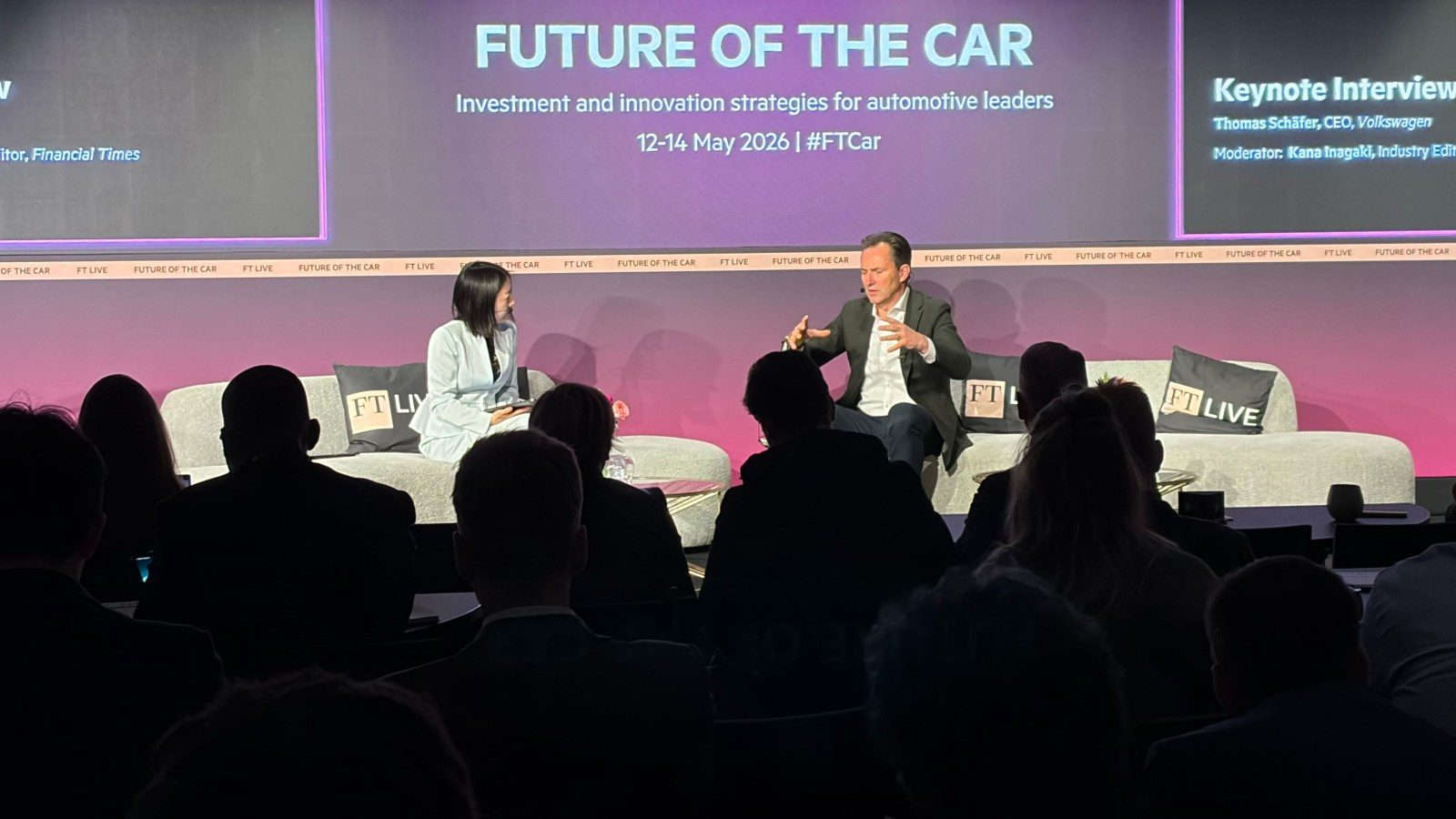

Volkswagen brand Chief Executive Officer Thomas Schäfer said on Wednesday that the German automaker’s $5.8 billion software joint venture with Rivian is “progressing really well” and that the partnership has “met all the deadlines.”
Schäfer made the remarks at the Financial Times Future of the Car summit in London, where EV was in attendance.
“The collaboration with Rivian on the software architecture is progressing really well,” Schäfer said.
“We have teams together in San Francisco that work with a focus for us on the ID.1.”
The ID.1 — Volkswagen‘s upcoming entry-level EV model — will be the first Volkswagen Group model in the Western world equipped with the zonal electrical architecture developed by Rivian and Volkswagen Group Technologies, the joint venture known as RV Tech.
“That will be the first vehicle with a Zonal Architecture in the Western world,” Schäfer said.
“In China, we will be launching it this year. With that vehicle, we go into the Western world.”
The ‘Comics and Personas’ Methodology
The most distinctive element of Schäfer’s London comments was his description of how the VW brand team approached the partnership with Rivian — a methodology he framed as deliberately different from the traditional automaker-supplier relationship.
“I must say that the collaboration is fantastic because we started it differently as a brand,” Schäfer said.
“Normally, you give them lists of functions and say: ‘Here, write the code. That’s what we want.'”
Instead, the VW team built three customer personas — for nurses, young people, and older drivers — and sketched comic-style storyboards depicting daily life scenarios for each persona.
“The team has sat down at the time and said, who is this car for? ID1 is for nurses, for young people, old people. They put out three personas, and they actually sketched comics on what the life of such a person looks like. What are they looking at? What kind of features do they need?,” Schäfer stated.
“That was given to the Rivian team, the software team, Rivian-VW Tech, and they loved it,” the CEO added.
Schäfer said the methodology resonated with the Rivian software team because it provided narrative context for the engineering work rather than abstract feature specifications.
“They absolutely love it because they all of a sudden made sense of what we are working on, why we are doing this, and how we get this right for the customer instead of 60 pages of anonymous functions that program us, SDV, whatever.”
The Defense of the Partnership
Schäfer’s framing arrives months after a sequence of Manager Magazin reports that described the JV as operationally stressed.
The German outlet reported in January that the partnership was falling short of expectations, with VW Group Chief Executive Officer Oliver Blume assembling an internal task force to address mounting delays across key vehicle programs.
Specific vehicle programs affected included Audi’s refreshed Q8 e-tron SUV and the successor to the electric A4 sedan, both delayed until 2028, and Porsche’s flagship K1 large SUV, which was reportedly postponed indefinitely.
The reports cited integration difficulties, a mismatch between Rivian’s EV-only software architecture and Volkswagen’s broader portfolio of combustion-powered vehicles, and tensions between Rivian’s standardised approach and demands from Audi and Porsche for brand-specific features.
The VW brand has positioned itself differently from the premium sub-brands within the Group.
While Audi and Porsche have reportedly pushed for maximum software customisation, the volume-focused VW brand has aligned more closely with Rivian’s standardised philosophy — which Schäfer’s “personas and comics” anecdote concretely illustrates.
“I must say the collaboration is working really well,” Schäfer said.
“We met all the deadlines. The winter test happened. Everything is on track.”
The Winter Testing Milestone
The winter testing Schäfer referenced was completed in late March, when RV Tech successfully validated its production-intent zonal architecture across reference vehicles from Volkswagen, Audi, and Scout brands during multi-month testing in Phoenix, Arizona and Arjeplog, Sweden.
The milestone unlocked a $1 billion equity investment from Volkswagen Group into Rivian, bringing VW’s total equity exposure to roughly $3 billion of the committed $5.8 billion across the JV’s life.
VW Group became Rivian’s largest shareholder on May 5 following the equity investment, displacing Amazon with a stake of approximately 15.9%.
Roughly $2.5 billion in VW commitments remain tied to future milestones, which could push the German automaker’s stake above 20% by 2027 if the JV continues to deliver.
Rivian’s Pushback
Rivian’s leadership has consistently defended the partnership against the Manager Magazin reporting.
Chief Financial Officer Claire McDonough told investors at the J.P. Morgan 2026 Global Leveraged Finance Conference in March that the relationship is “very strong” and that the JV had adapted Rivian‘s second-generation architecture for multiple Volkswagen Group brand programs in 13 months — “multiple times faster than they would have ever been able to do internally.”
Founder and CEO RJ Scaringe ruled out a Volkswagen takeover of Rivian in March and described the JV as “the largest software licensing deal in the history of the auto industry.”
“So now all future Volkswagens, Porsches, Audis, a bunch of brands that aren’t sold in the United States, Skoda, Seat, will use Rivian Electronics and Rivian Software as their core backbone,” Scaringe said.