
US manufacturing output rose 0.6% in April after an upwardly revised 0.1% gain in March, the Federal Reserve said on Friday.
Factory production advanced 1.3% on a year-over-year basis in April, while motor vehicle output increased 3.7%.
The data — published in the G.17 Industrial Production and Capacity Utilization report — showed US motor vehicle assemblies reached a seasonally adjusted annual rate of 10.69 million units in April, the highest monthly figure since mid-2025.
The reading marked a steady climb from the 9.58 million-unit trough recorded in November 2025.
For the first quarter of 2026, total assemblies averaged 10.33 million SAAR, up from 9.73 million in the fourth quarter of 2025.
Light trucks accounted for roughly 86% of total assemblies, running at 9.18 million units in April, while auto assemblies held steady at 1.27 million.
Combined auto and light-truck assemblies reached 10.45 million units, with the remaining volume coming from other vehicle categories.
Where EV Makers Stand
The G.17 data captures the full US auto production universe — both internal combustion and electric — but does not break out EV-specific assemblies.
Within the broader recovery, the three largest US-based EV makers each entered the second quarter with distinct production trajectories.
Tesla produced 408,386 vehicles globally in the first quarter of 2026 and delivered 358,023 — a gap of more than 50,000 units.
Nearly all of the excess sat in the Model 3 and Model Y category, where production of 394,611 outpaced deliveries of 341,893 by roughly 53,000 units.
Deliveries rose 6.3% from a year earlier, when the company was transitioning to the refreshed Model Y across all four factories.
Sequentially, deliveries fell 14.4% from the fourth quarter.
During the latest earnings call on April 22, Tesla said it is winding down Model S and Model X production at Fremont to retool the factory for Optimus humanoid robot manufacturing.
Additionally, the company said it is preparing more affordable trims of the Model 3 and Model Y and rolling out new Model Y variants in markets outside China.
Tesla did not break out US-specific production figures; however, management noted that demand was rebounding in North America and EMEA markets.
Management said the company reached its highest first-quarter order backlog in two years.
Tesla‘s raised its capital expenditure guidance to more than $25 billion, up sharply from roughly $8.5 billion spent in 2025 — as the company prepares to ramp up production of several products.
Cybercab and Semi production have officially started in late April, with volume output expected only later this year.
Rivian R2 Production Begins
Rivian produced 10,236 vehicles and delivered 10,365 in the first quarter — all R1 trucks, SUVs, and commercial vans built at its Normal, Illinois, plant.
Production was down 29.9% year-over-year, reflecting the factory retooling ahead of the R2 launch.
Deliveries, however, rose 20.0% from the first quarter of 2025, when the company was in the early stages of the same retooling.
The company reaffirmed its full-year delivery guidance of 62,000 to 67,000 vehicles — implying an average of roughly 17,200 to 18,900 per quarter over the remaining nine months.
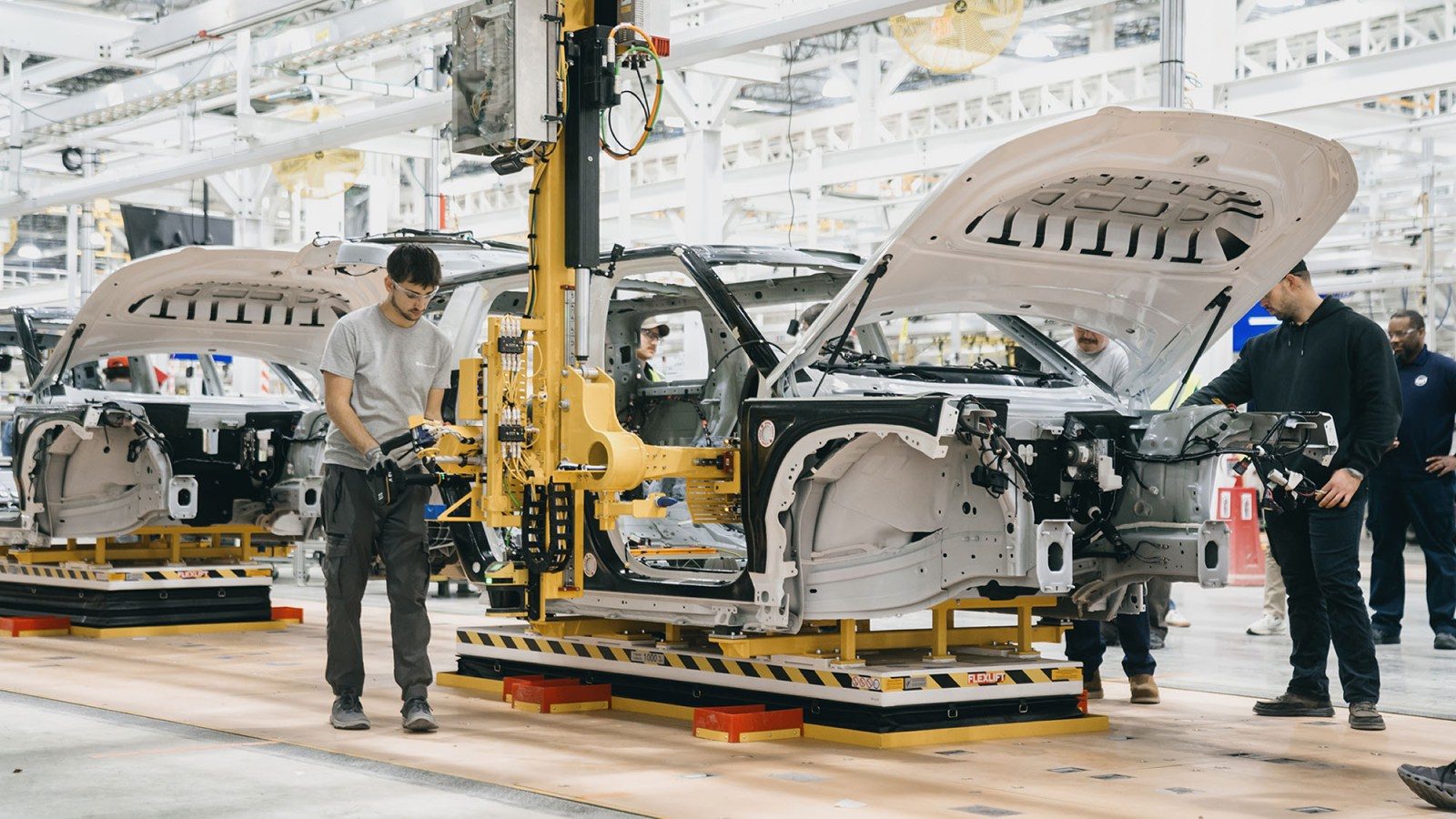
On April 22, the EV maker officially started volume, saleable production of the R2 at Normal — days after an EF-1 tornado damaged the roof and walls of the factory’s Building 2.
The first trim off the line is the Performance Launch Edition at $57,990, with customer deliveries beginning later this spring.
The plant’s annual capacity is being expanded from 150,000 to 215,000 vehicles. Rivian is already preparing to add a second shift to the R2 line.
Lucid’s Recall-Constrained Deliveries
Lucid produced 5,500 vehicles in the first quarter of 2026 — its strongest quarter since the company began manufacturing at its Casa Grande, Arizona, plant in 2021.
Deliveries came in at just 3,093 after a 29-day stop-sale on the Gravity SUV triggered by a recall of all 4,476 units built before mid-February.
The defect — improperly welded second-row seat belt anchor brackets by supplier Camaco — forced the company to either reinforce or replace the affected seats.
The production run brought Lucid‘s cumulative total to 47,977 vehicles.
In the first 17 days of the second quarter, the company built another 2,023 units, reaching the 50,000-vehicle milestone and surpassing half the output of the entire second quarter of 2025.
Lucid has guided for production of 25,000 to 27,000 vehicles in 2026, a 40% to 51% increase over its revised 2025 base of 17,840 units.
CFO Taoufiq Boussaid described the target as “conservative” at a Bank of America conference in March.
The Gravity SUV is expected to account for the majority of output this year.
Production of the Cosmos — Lucid‘s first mid-size model — is set to begin at its Saudi Arabian AMP-2 facility by year-end.