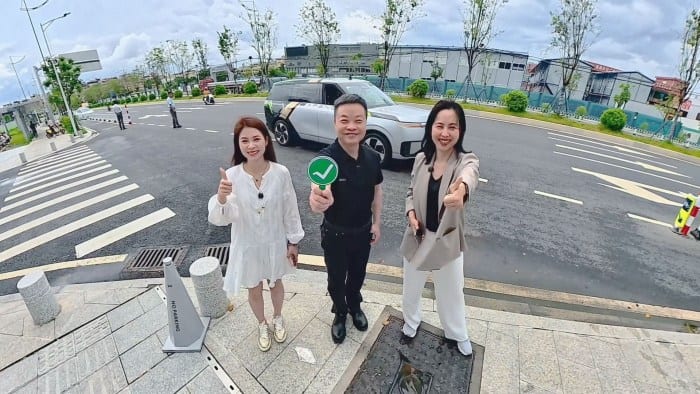

XPeng has once again placed itself alongside Tesla, saying the two will be the only carmakers offering rides in the Paris Auto Show’s official Autonomous Lab, the latest in more than a decade of public comparisons with the Elon Musk-led company.
“XPENG and Tesla will be the only two automakers taking part in the official experience, giving the public a first-hand opportunity to experience next-generation intelligent driving in real-world conditions,” XPeng said in a statement on Thursday announcing the European launch of its G9L SUV at the show.
The show’s organiser backs the claim, naming only Tesla and XPeng as the brands offering assisted-driving rides in a programme that runs from October 12 to 18.
The claim covers only that ride programme, not the show’s exhibitors or its conventional test drives.
The rides will use systems neither company is cleared to sell in France, and XPeng’s software is not yet available to any European customer.
What the Organiser Says
Visitors “will be able to board a vehicle equipped with a supervised, fully automatic driving system, level 2++, and drive on open roads,” the Mondial de l’Auto said on its website on September 30.
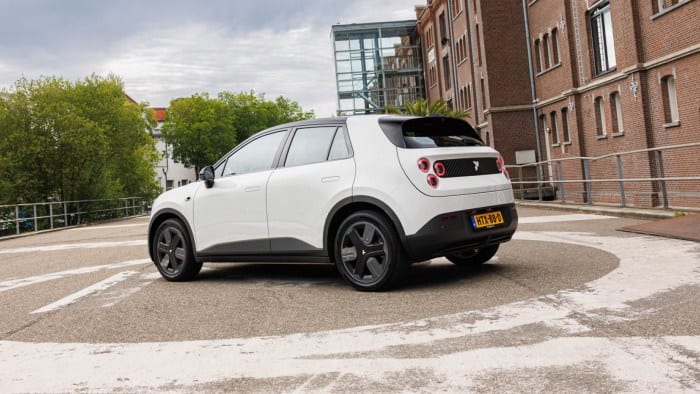
Tesla will provide six Model 3 sedans to demonstrate its FSD (Supervised) software, and XPeng two L03 SUV coupes running its Next Generation Pilot (NGP) system, according to the organiser.
The rides leave from a test centre at Gate H in Hall 7.1 and last about 25 minutes, with the route covering pedestrian detection, automatic braking, lane keeping, assisted lane changes and automated parking, the organiser said.
Consultancy Deloitte designed an explainer space for the programme and the agency La Squadra runs it, according to the organiser.
The same test centre offers conventional test drives from 21 brands, including BYD, Leapmotor, Lucid and Zeekr, but only Tesla and XPeng are listed for the assisted-driving rides.
XPeng described the Paris rides as its first large-scale overseas NGP test-ride experience.
The programme’s own page on the show’s website does not list participants, and neither the organiser nor Tesla has described Tesla and XPeng as the only two.
The two companies arrive with unequal fleets, with Tesla bringing six vehicles and a system already sold in several European countries, and XPeng two cars and software not yet on sale in Europe.
Rides Ahead of Approval
Tesla’s FSD (Supervised) is not authorised in France, where Transport Minister Philippe Tabarot has cited concerns over speeding and driver attention.
Tabarot said in early September that two Tesla vehicles would be handed to testing body UTAC, opening “a new phase: that of on-road trials.”
The organiser said FSD (Supervised) has covered more than 100 million kilometres in the seven European countries where it is authorised, a count that predates Croatia becoming the eighth on Tuesday, according to Tesla.
A decision on EU-wide recognition is scheduled for December, Germany’s Transport Ministry said on Tuesday.
XPeng plans to launch NGP in Europe in early 2027, Chief Executive Officer He Xiaopeng said in July.
Neither the organiser nor the two companies have said under what authorisation the rides will run on open French roads.
The organiser announced Tesla’s participation on September 30, saying the company would also display a Cybercab and its Optimus Gen 2 humanoid robot at a stand in Hall 7.1.
The Rest of the Release
XPeng will hold the global launch of the G9L in Paris, open European orders and announce prices, the company said.
The G9L will be XPeng’s fourth model built in Europe, after the G6, G9 and P7+ that contract manufacturer Magna Steyr assembles in Graz, Austria, though the release did not say where the new SUV would be made.
XPeng said it has delivered more than 100,000 vehicles outside China, including more than 60,000 in Europe, a regional figure it had not previously broken out.
It said it has delivered more than 6,000 vehicles in France “since entering the market two years ago,” although XPeng announced its arrival in France in May 2024, nearly two and a half years ago.
Overseas deliveries passed 20,000 in the second quarter for the first time, up 81% year on year, the company said in its quarterly results in August.
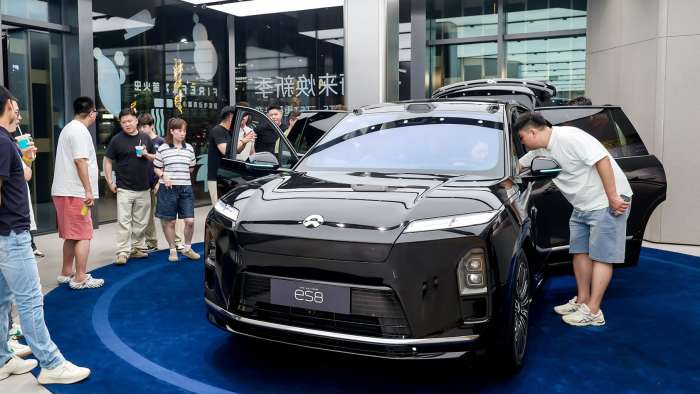
XPeng will present the G9L at a press conference on October 12, and its 1,000-square-metre stand in Hall 6 will show the G9L, L03, P7+, G6, G9 and X9, alongside its humanoid robots and flying cars, the company said.
The release came hours before XPeng reported third-quarter deliveries of 118,390, within its guidance.
He told Yicai on September 17 that XPeng might announce “several new cases” of overseas cooperation at the Paris show, as it discusses technology and chip deals with Volkswagen and other companies.
Volkswagen bought a 4.99% stake in XPeng for about $700 million in 2023 and licenses its technology, but the release does not mention the German group.
XPeng returns to Paris two years after giving the P7+ its world premiere at the 2024 show.
“Only Two” Is a Familiar Line
The Paris framing echoes a claim He has made before.
When Tesla rolled out FSD features in China in February 2025, He said XPeng and Tesla were the only two companies able to deliver intelligent driving without high-definition maps or LiDAR, and promised a comprehensive comparison of the two systems in the first half of 2025.
“A warm welcome!” He wrote on Weibo at the time.
XPeng has not published that comparison.
When XPeng announced its European NGP launch in July, both He and Xianming Liu, who leads its autonomous driving work, benchmarked the system only against Tesla’s FSD, without naming a Chinese rival.
Born From Tesla’s Patents
The comparisons go back to XPeng’s founding.
“One of the reasons Xpeng was founded was because Elon Musk made Tesla’s patents available,” He told Quartz in 2018, referring to Tesla’s decision in June 2014 to open its patents to other carmakers.
XPeng was founded the same year by former GAC executives Henry Xia and He Tao, with He as an early backer who became full-time Chairman in 2017.
In 2017, XPeng hired Junli Gu, who had set up Tesla’s machine-learning team and worked on Autopilot 2.0, as Vice President of R&D for autonomous driving.
In Court and on Twitter
Tesla sued former Autopilot engineer Guangzhi Cao in March 2019, alleging he uploaded copies of its Autopilot source code before joining XPeng.
“Inspired by and on a mission to beat Tesla, XMotors reportedly designed its vehicles around Tesla’s open-source patents and has transparently imitated Tesla’s design, technology, and even its business model,” Tesla said in the complaint, referring to XPeng’s US unit.
XMotors said at the time that it “fully respects any third-party’s intellectual property rights” and was “not aware of any alleged misconduct by Mr. Cao.”
Cao and Tesla settled in April 2021, with Cao making a payment to Tesla.
XMotors said Tesla “failed to find any substantive evidence” against it after more than two years of discovery.
Musk escalated the dispute in November 2020, a day after XPeng unveiled a LiDAR-based driving architecture.
“They have an old version of our software & don’t have our NN inference computer,” Musk wrote on Twitter, adding that “this was just an XPeng problem” and that other Chinese companies had not done the same.
He replied on WeChat the next morning that spreading rumours had never beaten a competitor.
“From next year, in China’s autonomous driving, you should be mentally prepared to be beaten until you don’t know which way is up,” He wrote. “As for the international market, we will meet.”
XPeng has since moved its newer models to a camera-based system without LiDAR, the approach Tesla uses.
The resemblance went beyond software, with Electrek reporting in May 2020 that XPeng’s website for the P7 sedan copied the design of Tesla’s.
By January 2025, XPeng Senior Designer Rafik Ferrag claimed the influence ran the other way, writing on Instagram the day Tesla launched the refreshed Model Y in China that the P7’s front light bar “is still being paid tribute to by various manufacturers such as Tesla.”
Benchmarking FSD
XPeng first claimed to have beaten Tesla on the road in April 2021, after a 3,600-kilometre test drive of its NGP system.
“NGP completely exceeded Tesla’s NoA regarding all the metrics in our tests,” XPeng Director Huang Xin said, citing internal figures of 0.71 driver takeovers per 100 kilometres against Tesla’s 1.03.
The tone softened as Tesla moved to end-to-end neural networks.
After testing FSD V12 in California in June 2024, He wrote that he believed 2025 would be the “ChatGPT moment” for fully autonomous driving.
A month later he said that year’s FSD and Tesla’s earlier software were “two completely different things in capability,” adding: “I greatly admire it.”
The name of the Mona M03 sedan was “a tribute to Tesla’s Model 3,” He said at its debut in July 2024.
In January 2025, Li Liyun, who then led XPeng’s autonomous driving team, praised FSD V13.2 after testing it in Los Angeles.
In April 2025, XPeng launched a global social media campaign called “Y Not,” a reference to the Model Y, promoting its G6 SUV.
President Brian Gu said in May 2025 that Chinese systems “actually did better than FSD in Chinese streets,” speaking at a Fortune forum in Kuala Lumpur.
In June 2025, the company said its P7+ top trim’s “energy replenishment efficiency far surpasses that of the refreshed 2025 Tesla Model Y.”
The Canteen Bet
He turned the rivalry into a public wager in December 2025, after about five hours in FSD V14.2 and a Tesla Robotaxi in Silicon Valley.
FSD had moved from “smooth L2” assisted driving to “a near-L4 reassuring stage,” He wrote on Weibo.
If XPeng’s VLA system matched in China, by August 30, 2026, what FSD V14.2 achieved in Silicon Valley, He said, he would build a Chinese-style canteen in Silicon Valley, and if not, Liu would run naked across the Golden Gate Bridge.
On XPeng’s fourth-quarter earnings call in March, He said VLA had “a particular advantage” over FSD on smaller roads, country roads and “uncharted territories.”
In May, He said VLA’s performance on narrow roads and in difficult situations was “clearly better than FSD.”
“I’m pretty confident I don’t need to run,” Liu told Electrek in June, adding that Tesla and XPeng were “just following the scaling law.”
He declared the bet won on August 27.
“Today, I want to say: Congratulations, the Silicon Valley canteen is coming!” he wrote.
The verdict rested on XPeng’s own testing, and no independent evaluation was published.
On Monday, Xinhua published its own test in Amsterdam of a pre-production L03 running NGP against FSD (Supervised) v14, in which XPeng cleared a narrow construction passage in one go while Tesla reversed twice.
German Tesla owner André Scheidler, who drove with Xinhua‘s correspondent, said the two systems were “already very comparable.”
XPeng’s NGP is not yet approved in the Netherlands.
Selling Against Tesla in Europe
XPeng has also matched Tesla on price and financing.
It copied Tesla’s seven-year low-interest financing in China in January, and the two launched matching 0% offers in Denmark in April.
He told the Financial Times at the L03’s Munich launch in July that XPeng was “not far from beating Model Y.”
“Globally, now of course Tesla is one of the competitors,” Head of International Development Alex Tang told CarExpertin July, calling Tesla a “tier one” player.
“We do have some markets where we outsell Tesla, frankly speaking, and some markets, of course, Tesla has more sales,” he said.
After the G9L’s China launch on September 17, He said FSD was “stunning in the US but not stunning in other countries,” and that XPeng might need only a small amount of local data to perform well abroad.
Musk’s Side
Musk has not named XPeng publicly since 2020.
On Tesla’s second-quarter call in July, he dismissed rival humanoid demonstrations as running on remote control and scripts, without naming any competitor.
XPeng’s IRON humanoid, which competes with Tesla’s Optimus, began coming off a new production line in September, and XPeng’s robotics unit raised more than $900 million in August.
Tesla will show Optimus Gen 2 in Paris, in a different hall from XPeng’s robots.