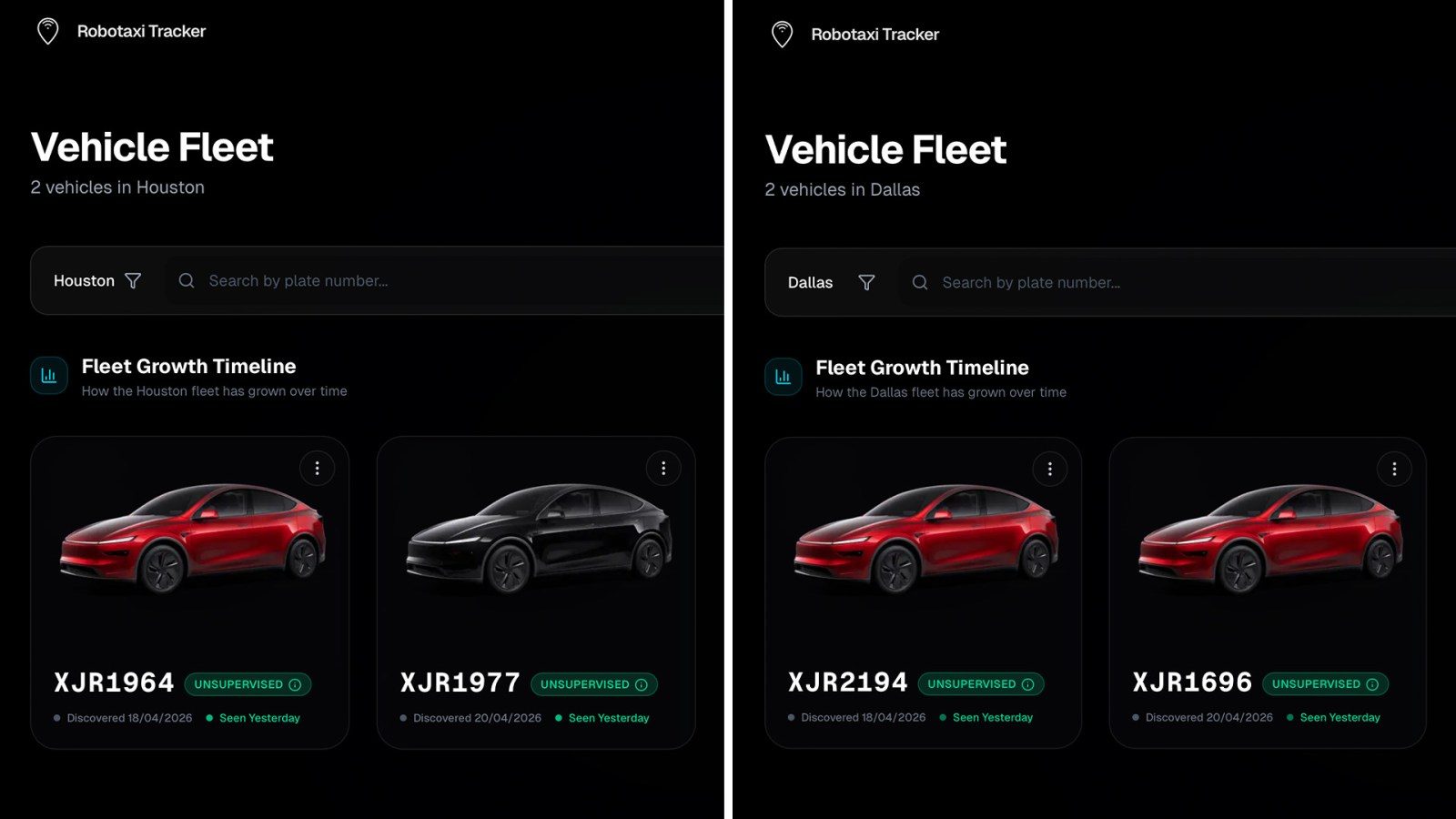

Tesla launched its unsupervised Robotaxi service in Dallas and Houston on Saturday.
However, crowdsourced data from the Robotaxi Tracker platform shows the company deployed just one vehicle in each city at launch.
The rollout expanded Tesla‘s ride-hailing service beyond Austin — where it first launched nine months ago with safety monitors inside the vehicles, before introducing unsupervised rides in Austin late last year.
“Robotaxi now rolling out in Dallas & Houston,” Tesla‘s official ‘robotaxi’ account posted on Saturday, alongside a 14-second video showing a Model Y driving with no human safety monitor in the front seats.
CEO Elon Musk reposted the video, writing: “Try Tesla Robotaxi in Dallas & Houston!”
As of Tuesday morning, Tesla had added a second vehicle in both Houston and Dallas. Both vehicles in each city are unsupervised.
For comparison, Tesla‘s Austin fleet currently shows 13 unsupervised vehicles active in the last 30 days.
The Bay Area fleet is much larger, with over 500 vehicles since launch.
However, rides there still require a safety driver behind the wheel due to stricter regulations in California.
Limited Availability
The service has been largely unavailable since Saturday.
Robotaxi Tracker data showed 0% to 2% availability in both cities over the first 24 hours, with only brief spikes during narrow windows on Sunday afternoon and evening before dropping back to zero.
Some riders have managed to hail rides during the brief windows of availability.
Three rides were logged in Dallas by Monday morning, with an average fare of $7.96 and an average trip of 3.5 miles.
Houston recorded five rides, with an average fare of $11.34 and an average trip of six miles.
At the same time, the geofenced areas are small.
The Dallas zone covers roughly 31 square miles, centred around Highland Park and parts of downtown.
Houston’s zone spans about 25 square miles in the northwest of the metropolitan area, covering the Jersey Village and Willowbrook neighbourhoods.
For context, the Houston metropolitan area covers over 10,000 square miles.
Comparison with Waymo
Alphabet’s Waymo launched in Dallas and Houston in late February — roughly two months before Tesla — as part of an expansion to ten US metropolitan areas.
The Robotaxi Tracker shows Waymo operating 16 Jaguar I-PACE vehicles in Dallas within a 48-square-mile geofence, and a single robotaxi in Houston within a 23-square-mile area.
While Waymo‘s Houston fleet is similarly small, its Dallas operation is significantly more established.
Co-CEO Tekedra Mawakana said at the time of the February launch that the four new cities were “critical to our plans, as we lay groundwork for service in 20+ cities.”
Waymo has since launched in Nashville on April 7, its 11th US city, and co-CEO Dmitri Dolgov said in March the company now operates “about 3,000 cars on the roads” delivering roughly 500,000 rides per week nationwide.
It is not unusual for robotaxi operators to start small in a new city before scaling up.
Waymo‘s own Houston deployment — a single vehicle — mirrors Tesla‘s approach.
Both companies are testing real-world conditions in new markets before committing larger fleets.
Expansion Timing
The launch came days before Tesla is scheduled to report first-quarter earnings results — set for Wednesday (April 22).
This is not the first time Tesla has announced Robotaxi news shortly before an earnings call.
In late January, the company said it had removed chase vehicles from unsupervised trips and that FSD was “100% unsupervised.”
The news came days before its fourth quarter earnings report, in which it reported its second consecutive year of declining revenue and profits.
The two launches are part of a seven-city expansion plan Tesla outlined in its fourth quarter 2025 shareholder update deck.
Tesla committed to launching its robotaxi service in Dallas, Houston, Phoenix, Miami, Orlando, Tampa, and Las Vegas within the first half of 2026.
Several vehicles have been spotted testing in many of these locations ahead of launch.
Musk described the timeline as “aggressive” on the earnings call.
The company’s track record on Robotaxi promises has drawn scepticism, as Musk had claimed in July that the service would cover half the US population by the end of 2025.
Later in the year, he said 500 vehicles would be operating in Austin and over 1,000 in the Bay Area by the end of 2025 — actual figures were roughly 42 and 130, most with safety monitors.
The company plans to begin volume production of the Cybercab — a purpose-built, two-seat autonomous vehicle with no steering wheel or pedals — later this year at Giga Texas.
Analysts Take
When Tesla reported its 2025 earnings results, Barclays analyst Dan Levy warned investors not to be overly optimistic on the Robotaxi service deployment.
“While pulling the safety monitor is a notable accomplishment, we caution against over-optimism in Tesla‘s robotaxi narrative, especially with questions on scaling still outstanding,” Levy wrote.
Wolfe Research analyst Emmanuel Rosner struck a similar note in February, writing that while the Robotaxi catalysts are real, “it’s difficult to have high confidence in the success of all of Tesla‘s initiatives, especially as timing can shift around.”
On Sunday, Morgan Stanley analyst Andrew Percoco published a note on the Dallas and Houston launches, describing the expansion as “a material evolution” in Tesla‘s Robotaxi strategy.
“In our view, this represents tangible progress at a time when the market was growing increasingly skeptical about Tesla‘s robotaxi expansion timeline,” Percoco wrote.
Morgan Stanley expects Tesla to operate 1,000 Robotaxi vehicles by the end of 2026 and reach one million by 2035.
The analyst framed the rollout as part of a broader feedback loop, as the company progresses in its Full-Self Driving (FSD) ambitions.
“We believe a successful robotaxi rollout has the potential to create a powerful flywheel across Tesla‘s ecosystem,” he stated. “Incremental unsupervised robotaxi miles driven improve the underlying autonomy model, which accelerates the path to personal unsupervised FSD.”
Ahead of its Wednesday earnings call, Tesla collected investor questions through the Say Technologies platform.
The most popular questions — based on the largest share of investor votes — all focus on how Tesla‘s autonomy programs are progressing.
Analysts regard developments in self-driving technology and broader autonomy initiatives as key determinants of Tesla‘s stock performance.
As of press time, the company’s stock was trading nearly flat at $394 during Tuesday’s pre-market session.
Tesla‘s shares closed 2% lower on Monday at $392.50, after briefly rising above $400 during the trading session.