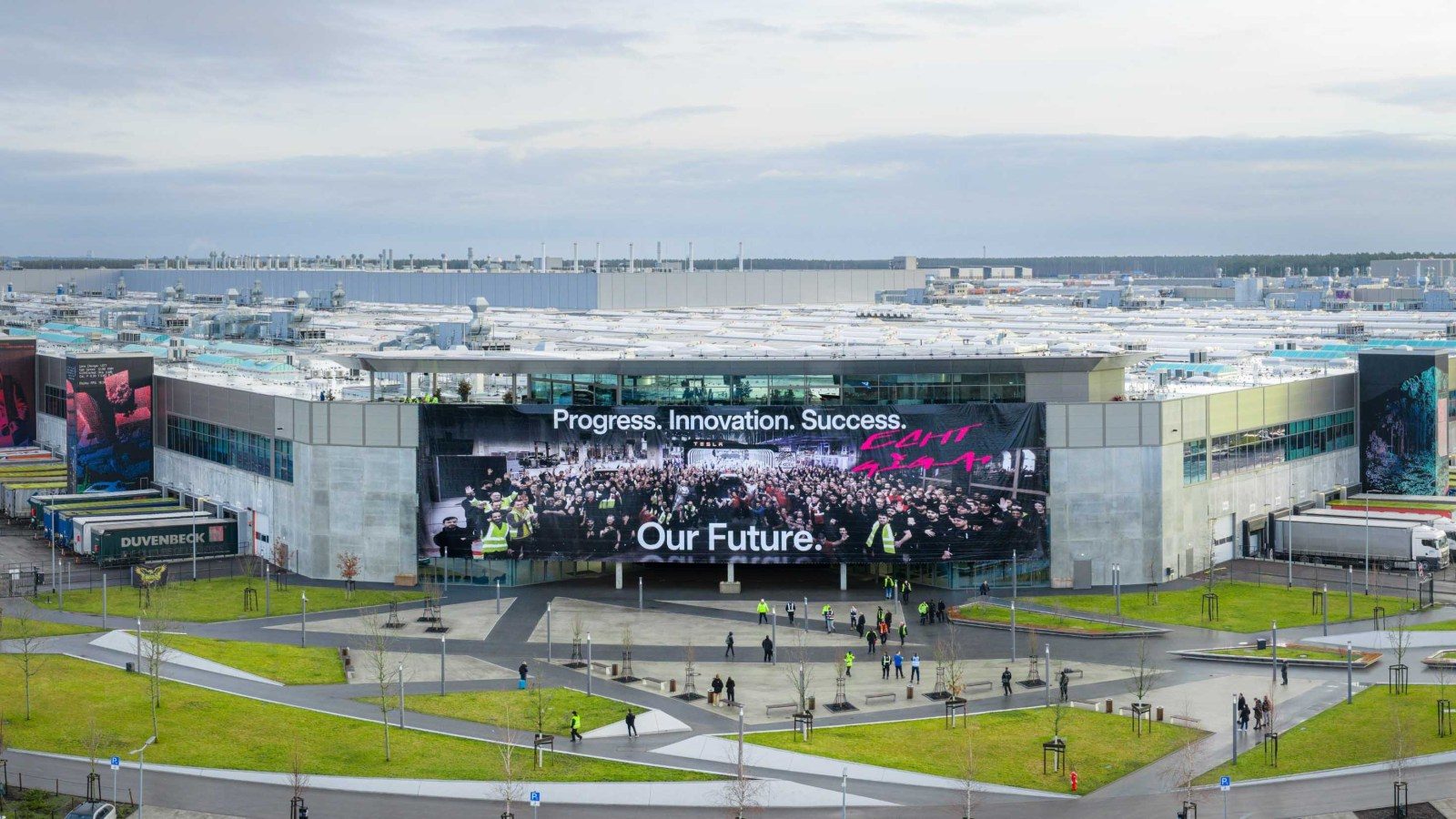

Tesla will invest nearly $250 million to expand battery cell production capacity at its Berlin-area Gigafactory, more than doubling the site’s previously planned cell output to 18 gigawatt-hours annually, the company said on Tuesday.
The additional investment increases the target annual cell production capacity at the Gruenheide plant southeast of Berlin from the 8 GWh figure announced late last year.
“The ramp-up of battery cell production will also be accompanied by a significant increase in labour demand,” Tesla said in a statement. “From battery cells to electric vehicles, everything is expected to be produced at a single location starting in 2027.”
The latest commitment pushes Tesla’s cumulative investment in Berlin cell manufacturing to approximately $1.45 billion, having brought total investments to nearly €1 billion ($1.2 billion) under last December’s announcement before Tuesday’s expansion.
A Reversal of the 2022 Cell Production Pause
Tesla’s revived push on European cell manufacturing reverses a three-year strategic pause.
CEO Elon Musk announced in 2020 that Gigafactory Berlin would become the world’s largest battery cell production facility, with an initial annual capacity of 100 GWh and plans to potentially expand to 200-250 GWh.
The company put those plans on hold in 2022 — the same year the Berlin vehicle factory opened — prioritising US cell manufacturing to access Inflation Reduction Act subsidies.
The original 8 GWh target announced in December 2025 represented a sharply reduced ambition.
Even with Tuesday’s expansion to 18 GWh, the planned cell output remains roughly 80% below Musk’s original 100 GWh vision and just 7-9% of the 200-250 GWh upper-bound target.
The 18 GWh figure would be roughly comparable to the 20 GWh starting capacity that Volkswagen subsidiary PowerCo is targeting at its new Salzgitter facility, with potential to expand to 40 GWh.
The Berlin Production Backdrop
The Berlin gigafactory currently employs over 11,500 staff and is Tesla’s only manufacturing facility in Europe.
The plant began Model Y production in March 2022 and has built more than 700,000 vehicles since opening, according to plant manager André Thierig.
Last month, Tesla announced it would add 1,000 new jobs at Gruenheide by the end of June to support a planned 20% increase in weekly Model Y output from the third quarter, alongside converting roughly 500 temporary workers to permanent contracts.
A separate hiring drive for “several hundred” battery cell production roles also began in April.
The cell production expansion announced Tuesday is expected to further intensify hiring demand at the site.
Berlin produced approximately 61,000 Model Ys in Q1 2026, according to a post by plant manager Thierig — roughly 65% of the factory’s stated 375,000-unit annual capacity.
Tesla’s European registrations have rebounded sharply in 2026 after a difficult 2025.
The Model Y was the second-best-selling vehicle in Europe in Q1 2026 with 51,468 registrations — trailing only the Renault Clio — and March registrations alone surged 117% year-on-year to 33,723 units.
Vertical Integration
Tesla’s renewed cell production push at Berlin centres on supply chain resilience and the broader cell-to-vehicle vertical integration strategy.
“The aim is to increase the vertical range of manufacture at the site: everything from battery cells to vehicles will be produced at a single location,” Tesla said in its December announcement.
“This is unique in Europe and also strengthens the resilience of our supply chains.”
The company acknowledged that European cell economics remain challenging.
“In international competition with China and the USA, it is currently hardly possible to produce cells economically in Europe,” Tesla said in its December statement, while indicating that “if the conditions are right, the entire battery value chain will also take place in Gruenheide in the future.”
The cell production target of 18 GWh would be sufficient to power roughly 200,000-225,000 vehicles annually.