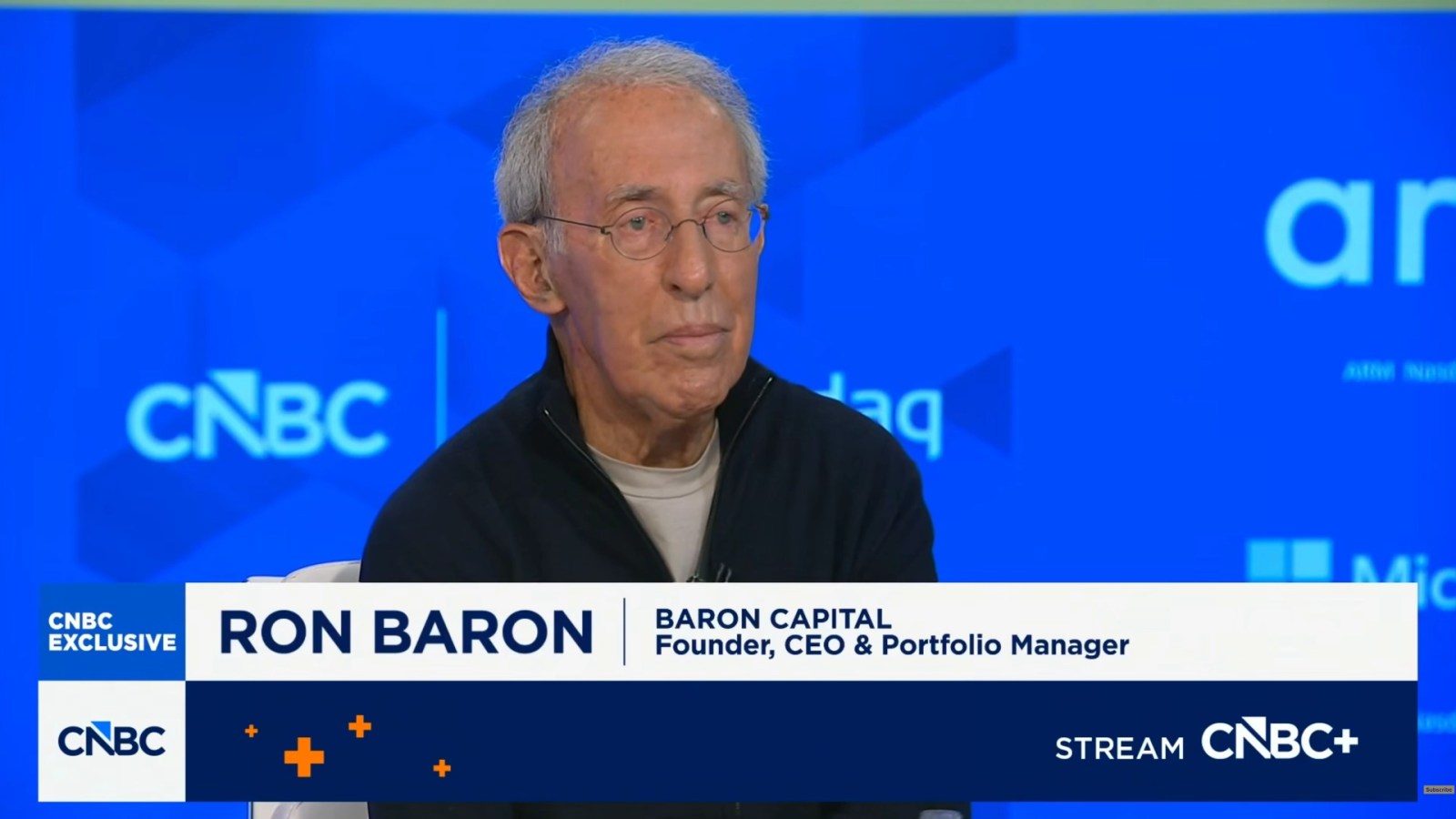

Billionaire investor Ron Baron reiterated his long-standing bullish outlook on Tesla, saying he expects to make five times the roughly $8 billion his firm has already earned from the automaker.
The founder, CEO, and portfolio manager of Baron Capital appeared on CNBC‘s Squawk Box ahead of SpaceX’s anticipated initial public offering — set to be the largest stock debut in US history.
The company confidentially filed its S-1 with the SEC in April and is targeting a valuation of approximately $1.75 trillion when it lists on the Nasdaq, reportedly as early as late June or July.
According to Baron, SpaceX will become the largest company on the planet, projecting a valuation of $10 trillion to $30 trillion over the next 10 to 15 years.
Shares in Elon Musk’s Companies
Baron previously told CNBC in November 2025 that he does not expect to sell his Tesla or SpaceX shares within his lifetime.
At the time, Baron Capital managed approximately $45 billion in assets, and Baron projected Tesla stock would reach $2,500 within a decade.
On Tuesday, he said the firm’s assets under management have grown to nearly $56 billion — a roughly $10 billion increase in six months — driven largely by the appreciation of its SpaceX position.
Baron said his firm has generated $61 billion in profits for its clients since 1992, when it managed just $100 million.
Of that total, he attributed roughly $20 billion to investments tied to Elon Musk’s companies.
Baron made clear on Tuesday that he sees both Tesla and SpaceX as generational investments — and that the bulk of the returns are still ahead.
“So of the $61 billion of profits, $20 billion has come from him,” Baron said of Musk’s companies. “And I think we can make five times that amount in 10 years.”
Baron on Tesla
Baron recounted his history with Tesla at length, describing how he first met Musk at the company’s 2010 IPO but waited four years before investing.
He noted that the stock tripled from $25 to $75 then, and doubled again before he committed capital.
“We invest $400 million between 2014 and 16, and make about $8 billion so far in profit,” Baron said. “And I think we can make five times that amount in 10 years.”
That projection implies Baron expects his firm’s Tesla position to generate an additional $32 billion in returns over the coming decade — on top of the $8 billion already realised.
For context, such a return would require Tesla‘s market capitalisation to grow roughly fivefold from its current level of approximately $1.6 trillion, implying a valuation in the range of $8 trillion.
Tesla‘s stock closed at $445 on Monday.
As of press time, the shares were trading around $425 on Tuesday’s trading session — down roughly 15% from their all-time high of $498.83 set in December.
Baron’s remarks come as Wall Street remains deeply divided on Tesla’s valuation.
Piper Sandler has a $500 price target on the stock, while JPMorgan sees it falling to $145 — a gap that reflects the market’s uncertainty over how quickly Tesla can monetize its autonomy and robotics ambitions.
The company’s Robotaxi service has recently expanded to Dallas and Houston in addition to Austin and the San Francisco Bay Area, though CEO Musk acknowledged during the earnings call that robotaxi revenue would not be “super material” this year.
Tesla‘s Full Self-Driving software recently began rolling out to customers in the Netherlands — the first market in Europe — and the company is pursuing EU-wide approval through the European Commission’s Article 39 process.
Musk is also expected to join President Trump’s delegation to China this week, where FSD regulatory approval remains a key commercial objective.
Baron on SpaceX
Baron has been one of the largest buyers in SpaceX’s twice-yearly tender offers — a process through which employee shareholders can sell portions of their stock to outside investors.
He described the mechanism as central to how his firm built its position in the company.
“Every single employee is a shareholder in SpaceX,” Baron explained. “I say, Becky, you are this fantastic engineer. You’re making $250,000 a year, but you’re now worth $5 million. Don’t you think it’d be a smart thing to sell some of that stock a little bit?”
Baron said his firm has invested approximately $1.7 billion in SpaceX since 2017, and that position is now worth roughly $15 billion at current private-market prices.
On the IPO itself, Baron said he does not know the exact listing price but suggested it could debut between $1.5 trillion and $1.75 trillion.
“This is going to become the largest company on the planet,” the billionaire highlighted. “I think that the company over the next 10 or 15 years is going to be worth $10 trillion, $20 trillion, $30 trillion. And that could be very low.”
SpaceX’s anticipated IPO would make it one of the most valuable publicly traded companies on day one, slotting in behind only Nvidia, Alphabet, Apple, Microsoft, and Amazon.
The company reportedly plans to raise as much as $75 billion, with approximately 30 percent of the offering allocated to retail investors — roughly three times the typical proportion for mega-cap IPOs.
Baron said the company’s reusable rocket technology — pioneered with the Falcon 9 — is the foundation for everything that followed, including the Starlink satellite internet constellation and the in-development Starship vehicle.
He pointed to space-based data centers as a significant emerging opportunity, noting that terrestrial data center construction faces growing political and environmental opposition due to electricity consumption and water usage.
“You don’t need this cooling in space, number one, as long as you have giant radiators. And then electricity, which is a huge cost. You don’t need that either because you’re using the sun,” Baron noted. “So basically, you’re getting free electricity and free cooling once you get into space.”