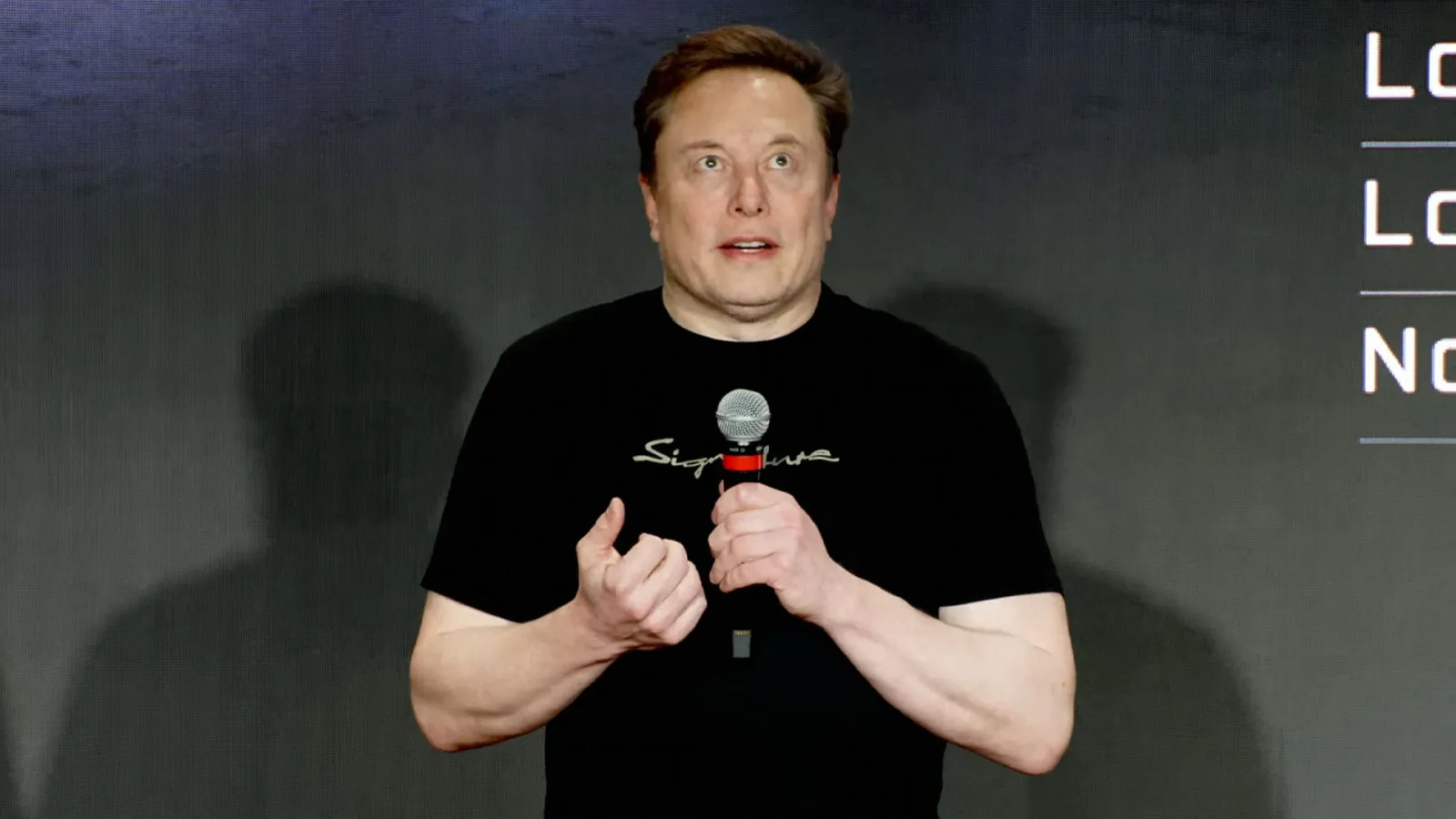
Elon Musk said on Wednesday that delaying approval of Tesla‘s Full Self-Driving software in France would cost lives, responding within hours to a French cabinet minister who had set out the government’s case against authorising the system.
“Delaying the approval of FSD in France will cost lives,” the chief executive wrote on X at 12:24 p.m. Eastern time, replying to a post carrying the minister’s remarks.
Musk was replying to a video statement from Transport Minister Philippe Tabarot, who said the safety trade-offs were not yet sufficient to authorise the system as it currently stands.
Tabarot went further, saying that “this system is not a self-driving system” — a direct challenge to the name under which the software is sold.
Roughly five hours separated the post from Tesla‘s second-quarter earnings call, scheduled for 5:30 p.m. Eastern time.
What France objected to
Tabarot gave two reasons.
The minister said the software allows a vehicle to travel at 70 kilometres per hour where the limit is 50 if surrounding traffic is moving at that pace, without the driver requesting it, and that a vehicle can in some cases exceed the limit by as much as 50.0%.
Driver monitoring was the second reason mentioned
According to the minister, the system does not guarantee an optimal level of driver attention in urban settings or during complex manoeuvres such as lane changes, intersections and roundabouts.
France’s vehicle approval authority had previously told owners the system does not fully comply with United Nations Regulation 171 because it permits system-initiated manoeuvres in urban environments.
Technical discussions continue with the Netherlands, other European states and the company, the minister said, adding that a ministry representative travelled to the Netherlands last week.
Tabarot described the two as examples rather than a complete list, saying there were several concerns and that he would not go into overly technical detail.
A familiar argument
The lives-at-stake framing has appeared before in Tesla‘s dealings with European regulators, and has already drawn scrutiny.
The company has recently presented regulators with safety material including a self-published claim that the software could have saved 32,000 lives.
Musk described European requirements in March as an extreme regulatory burden that stifles innovation.
Reuters published internal regulator correspondence in May showing sustained scepticism among several national authorities toward the company’s safety claims and rollout strategy.
An industrial argument
Tabarot paired the refusal with a statement of domestic ambition.
France will convene its autonomous vehicle ecosystem this autumn, the minister said, to present measures intended to accelerate deployment and set a direction for the coming years.
He pointed to the country’s carmakers, suppliers and engineers working in artificial intelligence, saying France has real cards to play and is ready to play them, though never at the expense of road safety.
That framing places the decision within an industrial strategy as well as a regulatory one. France is targeting type approval for fully autonomous vehicles by 2027 and co-leads a European test-site initiative spanning 18 countries, with a strategic roadmap expected in the autumn.
The arithmetic Musk is arguing against
Five member states have authorised the software since April: the Netherlands, Lithuania, Estonia, Denmark and Belgium.
European customers have driven more than 50 million kilometres on it in roughly three months, as recently reported by EV.
Bloc-wide recognition requires a qualified majority at the Technical Committee on Motor Vehicles, meaning at least 15 of 27 member states representing 65.0% of the population.
Germany, France and Italy together carry enough weight to determine the outcome, and none has approved nationally. Germany’s assessment remains under review.
The committee met on June 30 without voting. Next opportunity for a decision falls in early October.
Besides France, Sweden’s Transport Administration also wrote to the committee on April 30, recommending it vote against the proposed introduction unless the feature allowing vehicles to exceed posted limits is removed.
Tabarot said several other European countries share France’s reservations, without naming them.
Previous Comments from Musk
Musk has commented on the software repeatedly through the past six weeks, mostly to mark releases.
He announced version 14.3.4 on June 11, carried in firmware 2026.14.6.10.
On June 29 he amplified the first rollout to older Hardware 3 vehicles, alongside a post from Elluswamy saying the build was reaching early-access customers and would widen over the following weeks based on feedback.
Elluswamy described that build as distilling the driving behaviour from the Hardware 4 series into both the camera and compute configuration of the older computer.
Musk said recently that upcoming releases would remember parking preferences so a vehicle reaches the right location at a home, office or school drop-off, and that destination parking is by far the biggest reason drivers now intervene.
Critical safety interventions are extremely rare, he added in the same post.
A different register appeared on June 22, when Musk disputed the involvement of the software in a fatal crash.
Replying to another user, he said the account made no sense because the system drives slowly through neighbourhood streets while the incident had been a high-speed crash.
Speed features in both that response and in the French objection, though in opposite directions. Musk cited the system’s slowness to rule out its involvement in a crash, while Tabarot cited its willingness to exceed limits as grounds for refusing authorisation.
The commercial stake
France has become one of the company’s strongest European markets during a regional recovery.
Registrations reached 9,569 units in March, up 203.0% year on year and within three units of the all-time monthly record of 9,572 set in December 2023. First-quarter registrations totalled 13,945, a rise of 108.0%.
May brought 5,446 units and June roughly 7,474, an increase of 105.0% implied by the 104.99% figure reported by industry body PFA.
Registrations cluster at the end of each quarter because vehicles ship in batches, a pattern the company has itself flagged.
Around 260,000 vehicles in France are eligible for the software. Outright purchase was withdrawn across most of Europe on May 21 in favour of a subscription at €99 a month, having previously cost €7,500.
The company extended its ride-along programme in France through September 30, allowing residents to experience the system from the passenger seat without individual vehicle certification.