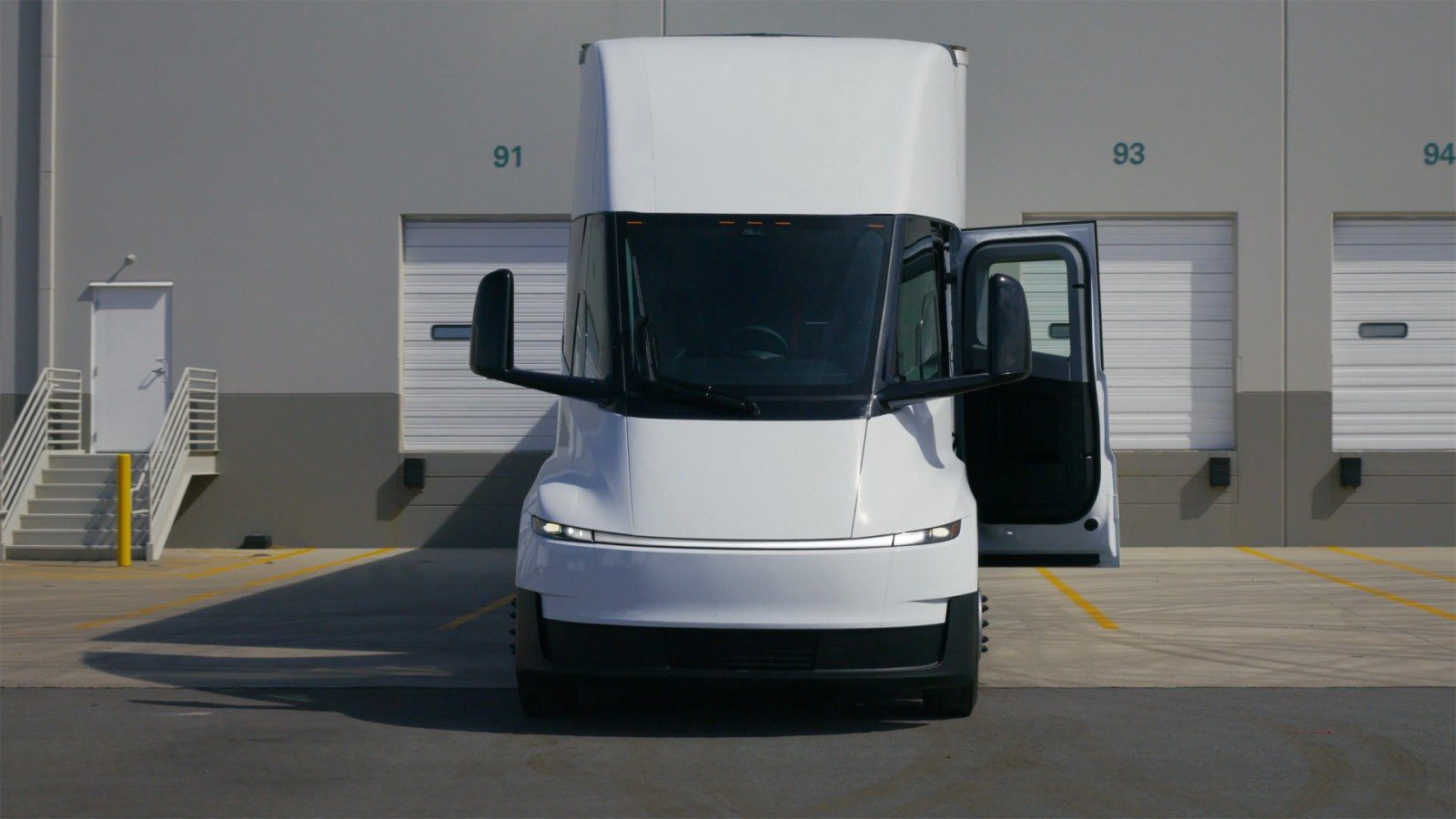

California-based freight brokerage and asset-based carrier AiLO Logistics has launched a three-week operational pilot using the Tesla Semi truck.
The vehicle is deployed on active freight lanes serving three customers to evaluate real-world performance in energy efficiency, route reliability, and driver experience.
“Sustainability is built into how we operate at AiLO, not just what we talk about,” Chief Revenue Officer Nick Cook stated. “Putting the Tesla Semi to work on live freight lanes is a direct extension of that commitment. We look forward to seeing what the data shows.”
The Tesla Semi is rated for a gross combination weight of 82,000 lb. (37,195 kg) and a range of up to 500 miles (805 km) on a single charge.
Other Pilots
Late last year, DHL confirmed an order beyond “just a handful” of Tesla Semi trucks for 2026 delivery, after first testing the truck two years ago.
The company first included a Tesla Semi in its fleet in 2024, with a pilot in Livermore, California, where the truck covered more than 3,000 miles of regular routes.
The firm revealed late last year that the trial was “successful” and the truck is now circulating in Central California, as part of its fleet.
“Our pilot of the Tesla Semi exceeded expectations, proving its ability to efficiently haul a typical DHL freight over long distances on a single charge,” President of Transportation at DHL Supply Chain NA Jim Monkmeyer stated.
According to the company, the truck is travellng approximately 100 miles per day, requires charging about once per week, and offers a range of up to 500 miles fully loaded.
DHL Supply Chain reported energy consumption of 1.72 kWh per mile on a fully loaded 390-mile (628 km) route, while ArcBest — another company that tested the vehicle — logged 4,494 miles (7,232 km) over three weeks at 1.55 kWh per mile.
Both cited reduced fuel costs and emissions compared to diesel trucks.
Those figures are broadly consistent with a prior cross-country test in which a first-generation Tesla Semi clocked 1.64 kWh per mile across 4,700 miles.
Tesla has said it has a few hundred Semis on the road with 13.5 million miles logged.
Second-Gen Semi
Tesla was spotted testing a redesigned Semi at its Fremont facility in February, featuring a Model Y-style light bar, improved efficiency, and increased payload.
In a recent episode of Jay Leno’s Garage, Semi Program Head Dan Priestley said that the truck has undergone “a lot of engineering improvements” since 2023, driven primarily by the need to prepare for high-volume manufacturing.
The second-generation truck sheds roughly 1,000 pounds compared to its predecessor and achieves 1.7 kWh per mile, a 15% efficiency improvement, while maintaining a 500-mile range.
The truck delivers 800 kW of drive power and supports peak charging speeds of 1.2 MW.
The updated version incorporates several elements from the Cybertruck platform, including a 48-volt low-voltage system and the same type of lithium-ion battery cells used in its batteries.
It also replaces the previous hydraulic-assisted steering with a fully electric steering system derived from the pick-up truck model.
Production Ramp
In its first-quarter shareholder update, Tesla listed the Semi as being in “Pilot Production” at its Nevada facility.
The company said it expects volume production of both the Cybercab and the Semi this year, with both programs described as on schedule.
In the same filing, Tesla noted that battery pack capacity remains the limiting factor on ramping vehicle production.
During the earnings call that followed Wednesday’s earnings report, CEO Elon Musk highlighted that Tesla has “just started production of Cybercab, and we’ll begin production of our Tesla Semi soon.”
Management has not provided a more detailed schedule; however, Musk warned that production will start slowly before ramping up to exponential volumes — a note he had previously shared regarding production of the company’s autonomous products.
“Now, I should say, whenever you have a new product with a completely new supply chain, new everything, it’s always a stretched-out S curve,” he said. “So you should expect that initial production of Cybercab and Semi will be very slow, but then ramping up, and going exponential towards the end of the year and certainly next year.”
Charging
The truck can recover up to 70% of its range in about 30 minutes using Tesla‘s Megachargers — which the company is currently deploying, as it prepares to ramp production of the model.
DHL Go Green VP Stephan Schablinski recently told Fox News that Tesla “is also rolling out a nationwide mega charging network across North America.”
The information was confirmed by Tesla in its first-quarter shareholder deck published this Wednesday, where it announced that it has deployed its first public Megacharger in Southern California.
Gigafactory New York is now producing V4 Supercharging cabinets, which Tesla says offer three times the power density and twice the number of stalls per cabinet compared to V3.
US fuel retailer Pilot Travel Centers previously announced plans to install Tesla Semi chargers at travel centers along major US highways, further building out the long-haul charging corridor.