
Rivian‘s release notes for software 2026.31, the update that brings its rebuilt operating system to the R1T and R1S, were published on Thursday by the software-focused platform Rivian Roamer.
The company has not begun distributing the update.
Rivian Roamer records the notes as preliminary and warns they may change before reaching vehicles, a caveat Rivian’s own text repeats.
It delivers a commitment Software Chief Wassym Bensaid first made in February and repeated in May, and first-generation R1s are included.
What Changes
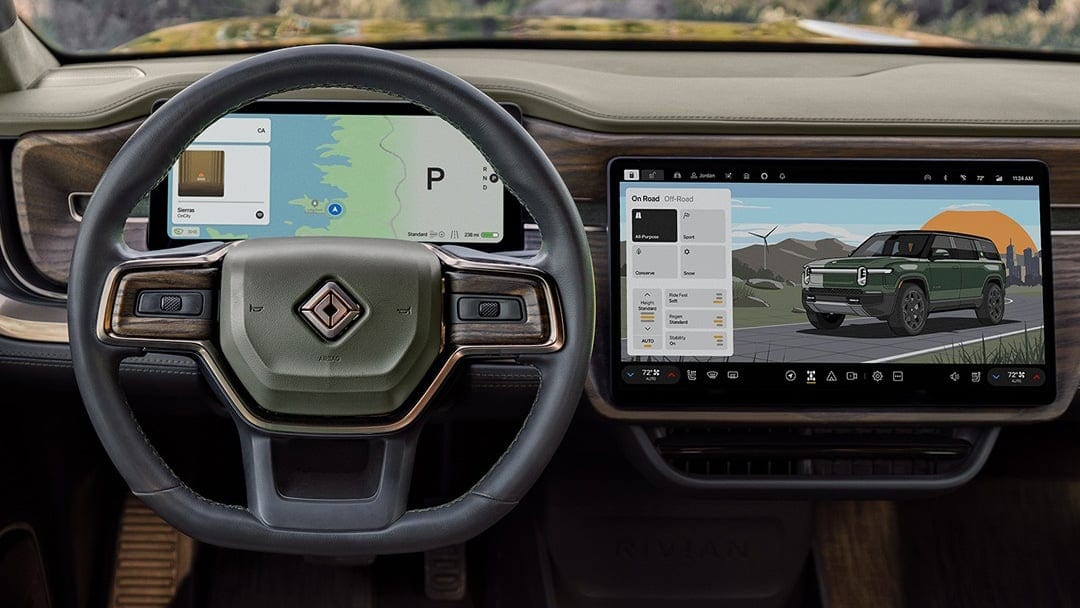
RivianOS 2 unifies navigation, media, energy and quick controls into a single interface.
The notes describe a new vertical status bar displaying key vehicle information and giving easier access to frequently used controls and Settings.
Quick controls and the media player can be moved to either side of the centre display, so a driver need not reach across it.
A trip panel arrives on the driver display, showing real-time information on the current drive in the manner of the existing trip gauge in Drive modes. Interface elements adapt within apps, and the Settings app is rebuilt with universal search and context awareness.
The media player gets dynamic hues and a list view built for podcasts and audiobooks. Apple Music, Spotify, TuneIn and TIDAL all already run on the R1; what changes is the player around them.
A Weather app arrives with current conditions, air quality and a ten-day forecast, plus destination weather inside navigation. The owner’s guide is redesigned with synonym search and popular queries.
Why Gen 1 Inclusion Is the Story
The two generations of R1 are not close relatives underneath.
First-generation vehicles run a domain-based electrical architecture with 17 separate electronic control units. Second-generation cars consolidated to a seven-ECU zonal layout and added dual Nvidia Drive AGX Orin processors, delivering roughly ten times the processing power.
Porting a ground-up operating system across both is a substantial engineering commitment, and owners had assumed for months that pre-2024 hardware would be left on the old stack.
Bensaid settled it on August 19. “We rebuilt the R1 experience from the ground up, faster and more intuitive,” he wrote on X. “Rivian OS 2 arrives on R1 Gen 1 and Gen 2 with the 2026.31 OTA update.”
EV reported the confirmation at the time.
That is the strategic point chief executive RJ Scaringe has made repeatedly, arguing that the company set out to build a single operating system rather than inherit decades of electronic control unit sprawl.
The notes bear it out.
They contain a Gen 1-specific item — updated top-of-charge current thresholds to improve 12V battery management — and a Gen 2-specific fix for a rare fault that locked the doors when a digital key was left inside the vehicle. A single release addressing both by name is the evidence.
What Rivian has not detailed is which features run on which generation.
The R2 carries a further 200 sparse TOPS of edge AI compute dedicated to the cabin. Gen 1 R1s do not, and the company has not said whether the interface arrives whole or reduced.
Bensaid’s framing during a Reddit session in May was that the goal is a core operating system giving a unified brand experience irrespective of the hardware — language that suggests adapting the software layer to each tier rather than shipping identical feature sets.
Waze, With Three Caveats
The most visible addition is crowd-sourced reporting. Navigation gains Google Maps and Waze user reports on police presence and speed cameras along a route.
Bensaid announced it separately on August 21. “Real-time alerts from Waze are coming to R1 and R2 in-vehicle navigation, starting with speed cameras and police reports in the 2026.31 OTA update,” he wrote. “More data and alerts to follow.” He attached a screenshot of the in-map alert card.
Three qualifications matter.
This first release covers police and cameras only.
The alerts appear as native cards inside Rivian‘s own navigation rather than as a separate Waze app. And the company has not said whether drivers can submit reports or only receive them.
It also extends an existing relationship rather than starting one. Rivian integrated Google Maps routing, live traffic, incident data and satellite imagery through the 2025.22 update last July, with Bensaid calling that collaboration “really just the beginning.” Waze has been owned by Alphabet since 2013, when Google bought the Israeli company for more than $1 billion.
The pattern is deliberate.
Rivian supports neither Apple CarPlay nor Android Auto, and both its chief executive and its software chief have defended that on the same podcast a year apart.
Scaringe told The Verge‘s Decoder in October 2025 that CarPlay “feels the same in every car” and that customers would appreciate a seamless digital experience in the fullness of time.
Bensaid appeared on the show in May and put a number on it. He told Decoder that more than 70% of customers requested CarPlay when the R1T and R1S launched around five years ago, and that a recent internal survey put the figure below 25%.
“The challenge with screen mirroring solutions is that they take over every single pixel in the car,” Bensaid said, adding that deep artificial intelligence integration would eventually render the debate “completely obsolete.”
Absorbing individual Google services into an in-house interface, rather than surrendering the screen to Google’s automotive platform, is the same approach Tesla takes.
Radio Stays on the R1
The notes omit iHeartRadio, which appears in the R2’s equivalent list. That is a hardware difference rather than a missing feature.
The R2 ships with no AM or FM tuner at all — Rivian removed the receiver and antenna and pre-loaded iHeartRadio in their place.
The R1 retains a physical FM and HD radio tuner. No Rivian has ever offered AM.
The company told the tracker RivianTrackr that FM accounted for single-digit listening share on the R1, its stated justification for dropping the tuner on the $44,990 R2.
The Weather app is described in the notes as part of the Connect+ experience — Rivian‘s paid connectivity tier, at $14.99 a month or $149.99 a year, with a 60-day trial on new vehicles.
Rivian Assistant and in-car streaming sit behind the same subscription.
The Assistant Question
The notes say Rivian Assistant now recognises spoken punctuation and handles more weather questions — forecasts for a specific day or time, conditions on arrival at the next stop, and air quality — more accurately.
Those are incremental gains on the R1, where the Assistant shipped in the 2026.15 update in May, to both generations, after what Bensaid described as two years of work.
Nothing in the notes suggests the more capable edge version running on the R2’s dedicated silicon is coming to the R1.
The traffic may run the other way.
A screenshot Bensaid posted alongside the Waze announcement appeared to show the Rivian Assistant icon in the R2’s left side rail.
The Assistant has been available on R1 but absent from the R2 since launch, and Bensaid did not say whether it arrives there in 2026.31.
The Fixes That Matter
Several entries are more consequential than they read.
Improved low-voltage fault recovery, with controlled retry and shutdown behaviour, should mean fewer immobilised vehicles after a 12V failure.
For LFP packs, state-of-energy now persists after a vehicle reset, which addresses inaccurate range readings on the chemistry hardest to estimate.
Climate settings now persist across drive cycles, a long-standing complaint. A bug that defaulted the driver’s seat to heat rather than vent above 38°C is fixed, as is a fault causing media to resume on approach and then pause again seconds later once the driver closed the door.
Two Energy app fixes correct incorrect overnight session durations and a charging graph that displayed stale data after connecting to a charger.
Cadence and What Is Absent
Rivian has shipped four R1 feature releases so far in 2026 — 2026.03 in January, 2026.07 in April, 2026.15 in May and 2026.23 in August.
The pace may reflect engineering shifted toward the port.
Universal Hands-Free 2.0 — adding stop light and stop sign response, automatic lane changes on surface streets, Auto Park and on-ramp-to-off-ramp routing — does not appear in these notes either.
The R2 has received Launch Mode, Pet Comfort, Gear Guard and garage-door pairing since its first major update, delivered under a commitment Bensaid made in June to ship deferred features monthly through the summer.