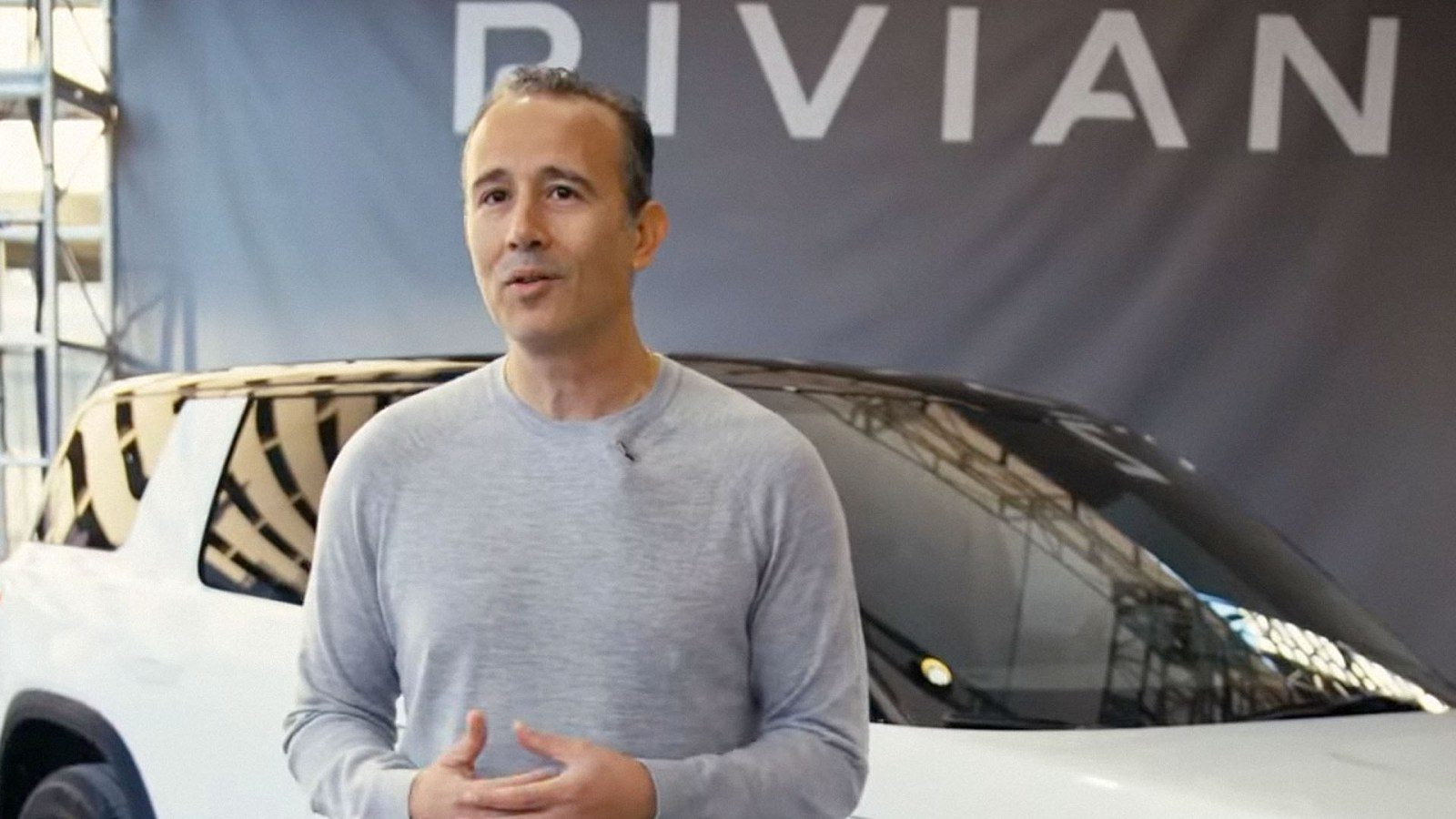

Rivian‘s Chief Software Officer Wassym Bensaid said on Thursday that the company’s next-generation operating system will debut on the R2 at launch — before rolling out to existing R1 vehicles “later this year.”
The move is part of the Irvine-based EV maker’s broader effort to unify its software architecture across its vehicle lineup.
The information was provided during a Reddit AMA session in the r/RivianR2 subreddit, where Bensaid answered questions about the software platform, update reliability, and the feature roadmap.
Some of the questions highlighted issues that have drawn increasing scrutiny from the R1 community — as Rivian prepares to welcome a larger, less technically forgiving R2 customer base.
Software version 2026.15, which is currently rolling out, is only the third public software release of the year. Rivian pushed 11 over-the-air updates in 2025.
One OS Across Platforms
Reddit user ‘ghostleader3201’ asked whether “R2 and R1 will share any common software stacks” or whether Rivian‘s team would “have to maintain different versions of Rivian‘s OS for different vehicles.”
“Our goal is to create a core software Operating System that provides a unified brand experience irrespective of the hardware that may differ between vehicle platforms,” Bensaid wrote.
The executive added that “RivianOS 2.0 will be introduced on R2 vehicles at launch, and will come to R1 vehicles later this year.”
The R2 runs on a ground-up redesign of the operating system, replacing the R1’s horizontal navigation bar with a vertical sidebar and introducing multi-panel layering.
The question of whether Rivian could sustain two parallel software stacks had been a recurring concern in the owner community — particularly as the R2 introduces a different infotainment architecture and more powerful onboard compute.
The same architecture also underpins the $5.8 billion software joint venture between Rivian and Volkswagen Group, where Bensaid serves as co-CEO alongside Volkswagen‘s Carsten Helbing.
VW brand CEO Thomas Schäfer said last week that the partnership is “progressing really well” and has “met all the deadlines.”
The Scalable Systems Platform developed through the venture is expected to be deployed across Volkswagen, Audi, and Scout Motors vehicles, starting with the VW ID.1 in 2027.
Bensaid has previously described the ambition behind the joint venture’s software as building “the Android of cars” — a reference operating system that other automakers could license.
Rivian Assistant
Bensaid called the Rivian Assistant the feature his team is most excited about when asked what upcoming capabilities the software team was looking forward to.
“Hands down, it’s Rivian Assistant,” the Software Chief highlighted. “We just started rolling it out to vehicles, and seeing everyone in the community use it has been incredibly rewarding for the team.”
He noted that “the real excitement is about what’s next — we are completely focused on continually adding more features and taking it to the next level to completely redefine the in-cabin experience.”
The assistant — an AI-powered voice system that replaces Amazon’s Alexa — began rolling out to Gen 1 and Gen 2 R1 vehicles this month via update 2026.15.
It was first unveiled at Rivian‘s Autonomy and AI Day in December, where Bensaid promised it for “early 2026.”
The feature did not ship in the February update (2026.03) or the April update (2026.07).
CEO RJ Scaringe confirmed on the first-quarter earnings call in late April that it would arrive “in the coming weeks.”
The R2 version of the assistant will feature substantially more powerful onboard AI hardware, including 200 Sparse TOPS of Edge AI compute and the ability to run a local large language model directly within the vehicle.
Apple and Google Integration
User ‘takaiguchi’ asked about the timeline for Apple integration — specifically group text messages through the assistant and iCloud calendar syncing.
Bensaid acknowledged the limitations and said the team is working on both.
“For group messaging, standard Bluetooth protocols don’t natively support this. We are making progress and working with Google/Apple on officially supported solution to bring group texting to our vehicles,” he wrote.
The assistant launched with integration with Google Calendar only.
“As for iCloud Calendar, we don’t have a definitive timeline to share with you yet but we have this on our roadmap,” Bensaid wrote.
However, he added that “expanding ecosystem options for our iOS users is a major priority for the software team.”
Text messaging integration has been one of the most requested features in the Rivian owner community.
Rivian has said that Google integration — which would enable texting — is in development but has not given a public timeline.
The company does not support Apple CarPlay or Android Auto, as it prefers to develop its own in-house infotainment.
On media apps, Bensaid confirmed that the R2 will launch with iHeart Digital Radio, with Amazon Music “coming soon” and YouTube Music following after that.
He said Rivian would “continue to expand our media portfolio on R1 and R2” but noted that “any integration meets our security and privacy standards and seamlessly integrates into our user interface.”
Update Reliability Under Scrutiny
The slowdown in update cadence and a rocky deployment earlier this year drew pointed questions from the community.
User ‘Accomplished_Ear2304’ raised concerns about updates “breaking things and introducing new bugs,” noting that “the April update had to be stopped mid roll out because of bugs.”
The user warned that “the R1 community up until now has been much smaller and tends to skew to early adopters willing to work through this. The same can’t be said the audience that the R2 is geared towards.”
Rivian was forced to halt the 2026.07 update in April after it wiped saved navigation contact addresses and elevation records for some Gen 1 owners.
The deployment was resumed days later.
Bensaid responded by describing the company’s testing and deployment process.
“Quality is something we take very seriously. That’s why each OTA goes through multiple internal testing rounds, and we deploy OTAs in deliberate, rolling batches, allowing us to monitor performance in real-time and catch any potential edge cases,” he wrote. “We also have a passionate external beta group that acts as a final gate before broader deployment.”
He described the April incident as a “minor issue with elevation data” that was “addressed quickly without impacting the rollout pace,” and credited the R1 community’s feedback as “invaluable.”
Separately, user ‘vangvace’ asked when owners would be able to name saved locations or navigate to contact addresses.
User ‘Rithoy’ built on the request, asking to link a Google Maps account and access location labels.
“We are actively working on these features and are hoping to deliver these features to you by the end of the year! And of course, you will be able to do all of these with our beloved Rivian Assistant,” Bensaid wrote.