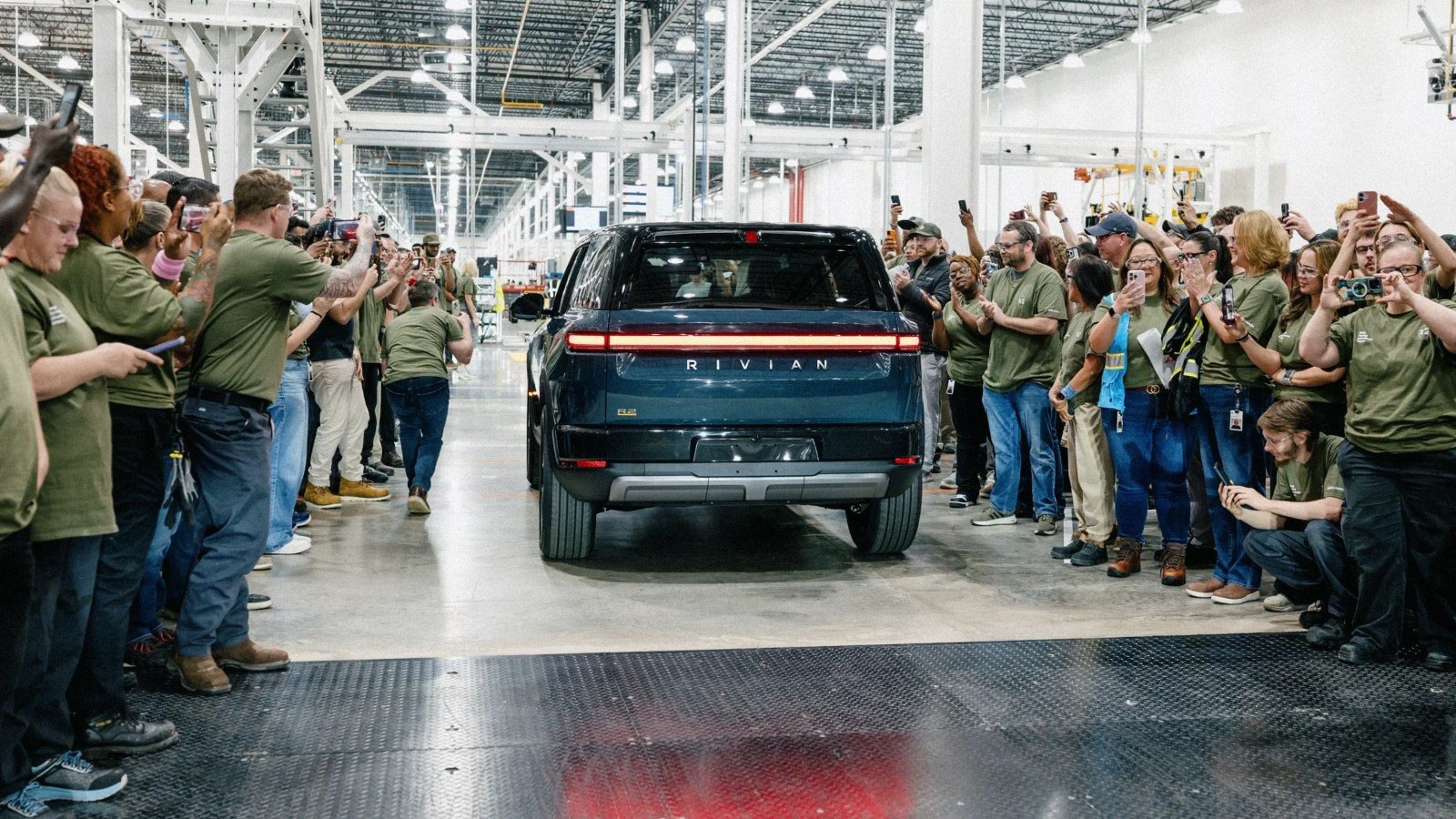

Rivian’s founder and Chief Executive Officer RJ Scaringe said the pace at which the company can build its R2 SUV is being set by its suppliers rather than by its plant, a day after Citi began coverage of the stock at Neutral on the risk of producing the model at scale.
“That isn’t actually what’s constraining our ramp-up,” Scaringe said of the Normal, Illinois factory at Morgan Stanley’s Laguna Conference on Tuesday. “Our ramp-up is gated by or throttled by the rate at which we ramp up our suppliers.”
“Our plant is out pretty far in front of where we are from a supply base point of view,” he said. “We can only ramp as fast as our slowest ramping supplier.”
He said the difficulty sits below Rivian’s direct suppliers. “It’s often not the Tier 1s,” he said. “It’s the Tier 2s and Tier 3s that can be the most challenging.”
Rivian has several hundred direct suppliers, he said, each with about ten of their own, and each of those with five to ten more, “many thousands of companies.”
A Prediction
Scaringe said none of this was a surprise. “If you’d ask me this question a year ago, I would have said, I think the throttle for a ramp and what defines the ramp curve will be our suppliers, and that is, in fact, the case.”
He was asked a year ago, at the same conference.
On September 11, 2025, at Morgan Stanley’s 13th Laguna Conference, he said: “The constraint for us in ramping, as we look at 2026, is going to be a few of our suppliers that are being asked to jump up pretty quickly in volume. We are very cognizant that we know exactly which suppliers are going to throttle production in 2026.”
He told Axios at the Aspen Ideas festival in July that the biggest risk to the R2 was on the supply side, naming semiconductors. “By far my biggest worry about ramping R2 isn’t demand,” he said. “It’s, you know, can we get enough parts to build cars? We’re quite nervous about global supply.”
What It Is Costing
The constraint has a price.
Rivian’s second-quarter results included about $100 million of incremental R2 ramp costs, covering expedited freight, temporary supplier premiums and unabsorbed expenses, according to the earnings call on July 30.
Scaringe said on Tuesday that Rivian knows which supplier is slowest, what the problems are, and has staff on site.
Asked whether the ramp was running to plan, he said the company had given full-year guidance, made “a slight tweak” to it earlier this year, and had been “pretty consistent.”
That guidance is 65,000 to 70,000 deliveries, raised in July from 62,000 to 67,000, within which Rivian has said it expects 20,000 to 25,000 R2s.
The guidance is demanding. Rivian delivered 22,559 vehicles in the first half, 10,365 in the first quarter and 12,194 in the second, so the range requires between 42,441 and 47,441 in the second half, or roughly 7,100 to 7,900 a month across the R1, R2 and commercial vans.
Rivian does not publish an R2-only figure. Owner-tracked VIN assignments, which run ahead of built cars, had passed 11,400 by September 10.
He said the second shift at Normal, planned for the end of this month, remains on track but must be timed to parts. “Bringing a second shift on to then not be busy because you don’t have parts is also a challenge,” he said.
Chief Operating Officer Javier Varela said in July that the shift would contribute no material volume until the fourth quarter.
A Day After Citi
Citi’s Michael Ward initiated Rivian at Neutral with an $18 target on Monday, writing that the company’s outlook depends on producing the R2 at scale across two manufacturing facilities and citing its history of difficulty with high-volume production.
Scaringe located the problem elsewhere. “When we saw Tesla go through this similar inflection point with Model 3, in their case, their constraint was initially in the plant,” he said. “In our case, our plant is out pretty far in front.”
The two positions are not in conflict.
Ward’s second facility is the Georgia plant, under construction and not expected to produce until 2028. Scaringe was describing a parts problem in 2026.
Normal is rated at 215,000 vehicles a year on three shifts, of which up to 155,000 can be R2s, after an expansion that cost about $1.5 billion, and a single shift uses a fraction of that.
Scaringe said trade conditions at the second and third tiers had been “so dynamic” that managing them had required particular care.