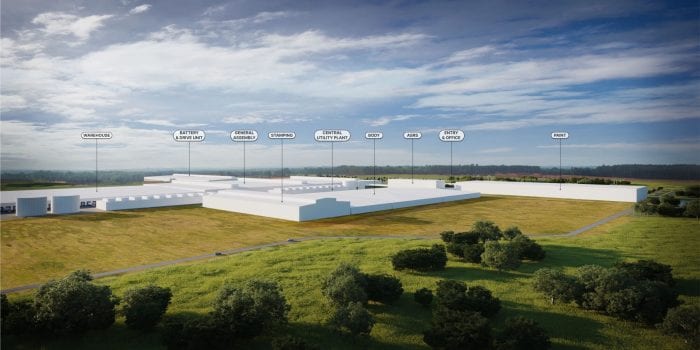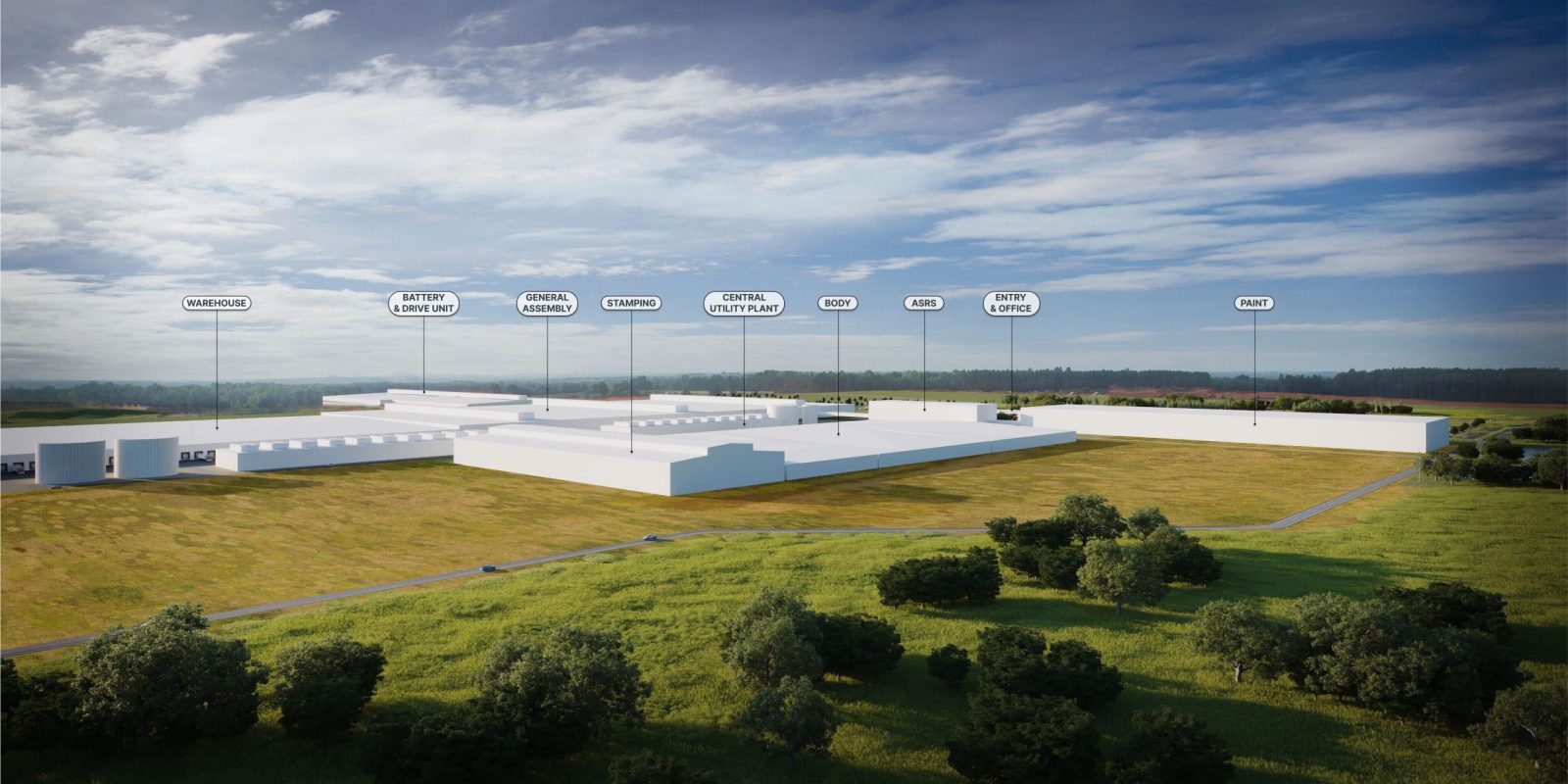

Drone footage of Rivian‘s Georgia plant site shows two large excavations that local officials identified as the beginnings of stamping pits, the foundations for the presses that will form the vehicles’ body panels.
The video was recorded on September 21 by the Development Authority of Walton County and shown the next day to the Joint Development Authority of Jasper, Morgan, Newton and Walton counties, The Walton Tribune reported.
Shane Short, President and Chief Executive Officer of the Walton County authority, told members the two areas were the start of the pits that will hold the plant’s stamping presses.
The excavations appeared in the video as two large holes covered in metallic material, the newspaper said.
Stamping pits are deep, reinforced concrete foundations set below the factory floor to house the presses that shape sheet metal into body panels.
Cranes have been positioned beside the excavations, Short said.
That indicates Rivian is “getting ready to bring in some heavy equipment for construction”, he told the authority, according to the newspaper.
The footage also showed two graded building pads, road grading and the site’s electrical substation.
The count of two matches an earlier account from the plant’s architect.
As of August, work was under way on the foundations for two stamping presses within one of the buildings, Skidmore, Owings & Merrill told Engineering News-Record.
Rivian itself has not published the number of presses the plant will have.
Rivian’s Own Account
The footage is consistent with what Rivian told investors a week later.
Rivian is “currently working on the stamping press foundation and working on the foundations in Georgia”, VP of Investor Relations Chip Newcom said on September 29 at an Evercore ISI conference, where he also said the plant could one day supply Europe.
The stamping press area is “one of the most capital-intensive and technically demanding projects within the plant from a construction perspective”, Rivian said in a statement carried by Engineering News-Record.
Accounts differ on how far the project has advanced beyond foundations.
Dodge Construction Network listed the plant as the largest nonresidential building project to break ground in the US in May, and Engineering News-Record reported that vertical construction began that month.
The Walton Tribune wrote that Rivian had previously announced vertical construction would begin by the end of this year.
The footage, as described, shows foundations and graded pads and no building frames.
The primary factory buildings are expected to be enclosed in 2027, Engineering News-Record reported.
Monthly Flights
The Walton County authority has recently begun flying a drone over the site each month.
Video from future flights will be shared with members of the four-county authority at its request, the newspaper said.
The Joint Development Authority is also awaiting a public safety study it commissioned for the wider Stanton Springs development, with the report expected in October.
The September footage follows a pick-up in activity over the summer.
In July, an authority member said there were more people at the site than he had seen in a year, with crews grading roads and installing water and sewer lines.
The Plan for Georgia
The plant sits on a site of nearly 2,000 acres at Stanton Springs North, near Social Circle and about 45 miles east of Atlanta.
Rivian paused the project in March 2024 to save cash and held a groundbreaking ceremony in September 2025.
On April 30, the company raised the plant’s first-phase capacity to 300,000 vehicles a year from 200,000.
It said at the same time that its Department of Energy loan for the project had been reset at up to $4.5 billion, down from $6.57 billion.
The new amount consists of $4,006 million of principal and $494 million of capitalised interest.
Rivian expects to draw on the loan by early 2027, subject to conditions.
Vehicle production is targeted for late 2028.
The plant will build Rivian’s midsize platform, including the R2 SUV and the R3, along with up to 50,000 robotaxis for Uber.
The Uber deal is expected to enable Uber, or its fleet partners, to purchase 10,000 fully autonomous R2 robotaxis, with the option to purchase up to 40,000 more in 2030, Rivian said in its first-quarter results.
The full first phase will be built on the site’s upper pad, leaving the lower pad as greenfield for later expansion, Chief Financial Officer Claire McDonough said on the first-quarter earnings call.
Together with the plant in Normal, Illinois, Georgia would give Rivian 515,000 units of annual capacity, which McDonough said provides “a path to free cash flow positive once fully ramped”.
Site plans also show a visitor campus with a museum, cabins and a test track, to be built in phases.
State Commitments
Rivian has committed to invest at least $5 billion and create 7,500 jobs at the plant under an agreement with Georgia that carries about $1.5 billion in state and local incentives.
A September 2023 amendment to the agreement moved the deadline for meeting those commitments to December 31, 2030, from December 31, 2028.
The jobs must then be maintained through 2047, according to the state’s summary of the agreement. Falling below 80% of the targets would trigger proportional repayment of incentives, the summary says.
Production is due to start in late 2028, about two years before that deadline.