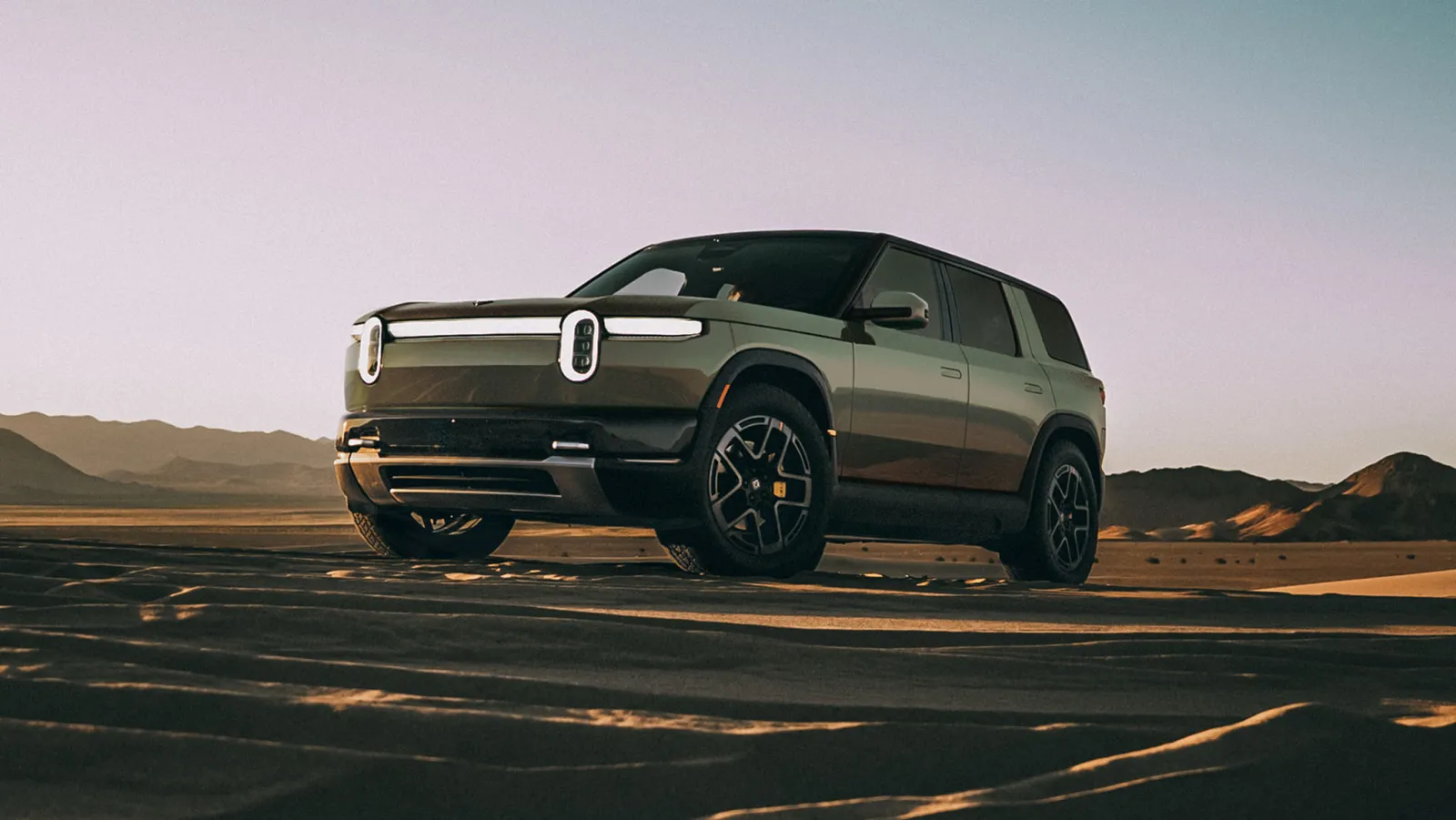
Rivian is the top pick among EV makers at Seaport Global Securities, which started coverage of the stock on Tuesday with a ‘Buy’ rating and an $18 price target and called the R2 “a killer product with upside to 2027 expectations.”
The target from analyst Ron Jewsikow is 60.4% above Rivian’s closing price of $11.22 on Monday, the largest upside implied among the five carmakers Seaport began covering on the day.
Jewsikow based the call on “an attractive catalyst path, confidence in the R2 launch through 2027, and unique value creation levers beyond the current slated vehicle lineup,” according to the note.
Price Target, a sister publication of EV, archives Wall Street analysts’ research on the electric vehicle, artificial intelligence and semiconductor sectors.
He called Rivian “our top pick within our EV coverage” and acknowledged that the price would be contested. “We expect considerable pushback from investors around valuation, which does require a non-automotive lens,” he wrote.
Seaport also started Tesla, General Motors and Ford at ‘Buy’ and Lucid at ‘Sell’ with a $1 target.
The R2 Case
Jewsikow’s first argument is the midsize SUV that Rivian began delivering in June.
He said the R2 “can command a strong 2nd place in the US EV market behind the Tesla Model Y.”
“Smart design choices (traditional SUV shape), RIVN’s strong software and tech leadership, expanding brand awareness and strong backlog will support meaningful delivery upside in 2027,” he wrote.
He added that Rivian has “a strong track record of going head-to-head against Tesla with the R1S outselling the Tesla Model X.”
Production of the R2 is still being added. Rivian started a second shift at its Illinois plant before the end of September, and Founder and CEO RJ Scaringe has said a third will follow in 2027.
The R2 launched with the $57,990 Launch Edition. Rivian has said the $53,990 Premium will become available in late 2026 and a $48,490 Standard version in the first half of 2027.
Rivian delivered a record 19,248 vehicles in the third quarter and raised its 2026 forecast to between 67,000 and 70,000.
Margins
Jewsikow said he is “highly confident” in Rivian “delivering on R2 demand and margins.”
The vehicle business is not yet profitable. Rivian reported an automotive gross loss of $80 million for the third quarter, wider than the $36 million loss in the second, after absorbing about $120 million of R2 ramp costs.
“We expect that R2 will help us achieve a positive automotive gross margin exit rate for the year,” Interim Chief Financial Officer Derek Mulvey said on the earnings call. Asked whether that meant a positive fourth quarter, he said, “I would not expect the full quarter.”
Chief Operations Officer Javier Varela said this week that the R2’s bill of materials is half the R1’s.
Autonomy in ‘Four Forms’
The second argument is autonomy, which Jewsikow said can create value for Rivian in four ways.
The first is the Autonomy+ driver-assistance package. High attach rates “could augment R2 platform level gross margins by ~500bps assuming no pricing changes,” he wrote.
Rivian began charging for Autonomy+ in April. It costs $2,500 as a one-time purchase on the 2027 R1, or $49.99 a month.
The second is demand. Point to point navigation could draw buyers, Jewsikow said, citing Tesla Chief Executive Officer Elon Musk’s suggestion that “consumers are no longer shopping for a vehicle, they are shopping for an autonomy system.”
Rivian plans a limited release of its Point to Point hands-free feature this year and a general release to Autonomy+ subscribers in 2027. It has opened an early access program for owners.
The third is ride-hailing. “Robotaxi operations provide a potential recurring revenue stream,” Jewsikow wrote.
Uber agreed in March to invest up to $1.25 billion in Rivian in stages, with a commitment for 10,000 R2 robotaxis and an option to negotiate 40,000 more from 2030.
Rivian’s VP of Investor Relations, Chip Newcom, said in September that the company will also earn software licensing fees on those cars, because “it is going to be Rivian’s driver that is going to be driving around.” He said Rivian had not quantified the fee.
The fourth is licensing to other companies. “A relatively small subset of companies have the requisite funding and technical teams to solve for L4 and beyond,” Jewsikow wrote, using the industry term for driving without human supervision in defined areas.
Two Rivian job listings describe a remote assistance platform meant to keep “fully autonomous vehicles operational.”
Rivian holds its Autonomy & AI Day in Palo Alto, California, on December 9.
A Smaller Pie
Jewsikow’s third argument is that Rivian’s competitors are stepping back.
“Legacy OEM pullback from EVs makes underwriting future market share easier,” he wrote. Established carmakers “now need to develop, at least, 4 distinct powertrain offerings (ICE, Hybrid, EREV and BEV),” he said, referring to combustion, hybrid, range-extender and battery-electric vehicles.
“While the pie is smaller near term, RIVN should take a larger share of it,” he wrote.
He also listed robotics among “other positive sources of optionality.” Scaringe said this month that Mind Robotics, the company he founded, plans to put its first robots in a Rivian plant in the middle of 2027.
The ‘Non-Automotive Lens’
The valuation objection Jewsikow expects rests on a company that still burns cash.
Rivian’s free cash flow was negative $1.124 billion in the third quarter, and its net loss attributable to shareholders was $913 million.
It ended September with $5.502 billion in cash and short-term investments and put its liquidity at $7.095 billion on a pro forma basis, including a $1 billion loan from Volkswagen Group funded in October and $593 million available under a credit line.
At Monday’s close, the company was worth about $16.4 billion, based on the 1.46 billion shares outstanding at the end of September.
The gross profit Rivian reports comes from outside the car business. Its software and services segment, which includes its joint venture with Volkswagen, posted a gross profit of $256 million in the quarter on revenue of $605 million, more than the company’s total gross profit.
Scaringe told CNBC this month that “2027 is really an inflection year for us.”
Where Seaport Sits
Seaport’s $18 equals the median among 13 firms tracked by Price Target, whose targets run from $10 at Mizuho to $23 at Baird.
Evercore ISI repeated an $18 target and an ‘Outperform’ rating on the same day. Analyst Chris McNally put the stock’s near-term upside at $13 to $15 and its downside at $8 to $10, and wrote that “which way RIVN inflects is yet to be decided.”
Other firms have backed the stock since the results. UBS upgraded Rivian to ‘Buy’ on November 2 with a $17 target, calling the selloff “a buying opportunity ahead of an inflection in R2 ramp and gross margins.”
Stifel kept a ‘Buy’ and a $22 target on November 12, saying the R2 “seems to be off to a great start” in its note.
Rivian last closed at or above $18 on July 9.
Seaport’s Other Calls
Jewsikow’s four other ratings turn on different questions.
On Tesla, rated ‘Buy’ with a $475 target, he said the energy and automotive businesses “appear overvalued” and that Robotaxi is “the only business within Tesla that is likely to justify the current valuation over the next 3-5 years.” He called it “a legitimate multi-trillion dollar opportunity.”
He rated General Motors ‘Buy’ with a $106 target, citing its “industry leading shareholder yield,” while warning of “terminal value risks for autos as a whole driven by autonomous vehicle development.”
His ‘Buy’ on Ford, with a $14 target, assigns “$0 value” to the Model e electric vehicle division.
Lucid drew the only ‘Sell.’ Jewsikow said the company “likely needs to raise as much capital as the current market cap, if not more, over the next 12-18 months” and that its robotaxi timeline with Nuro and Uber appears to be slipping. “While we love the product and the tech, we don’t love the stock,” he wrote.
Based on Monday’s closing prices, the targets imply gains of 29.8% for GM, 23.2% for Tesla and 20.2% for Ford, and a 61.7% decline for Lucid.
The Stock
Rivian shares were down 0.9% at $11.12 at 11:04 a.m. in New York on Tuesday, Nasdaq data showed.
They rose 8.6% on Monday after falling to $10.33 on Friday, their lowest close since November 22, 2024. At Monday’s close, the stock was down 43.1% this year and 44.3% below its 2026 closing high of $20.14, set on July 6.
Late that day, Rivian announced a share offering that eventually totaled 86.25 million shares at $15.50 each.
Short interest stood at 173.6 million shares on October 30, about 11.9% of shares outstanding and the highest in the 12 months of data Nasdaq lists.
Institutional investors held a record 828.5 million Rivian shares at the end of September, regulatory filings show. Volkswagen is the largest shareholder, with 15.9%.
Tesla was down 1.6% at $379.22, GM down 0.8% at $81.03 and Ford up 0.6% at $11.72. Lucid rose 2.1% to $2.665.