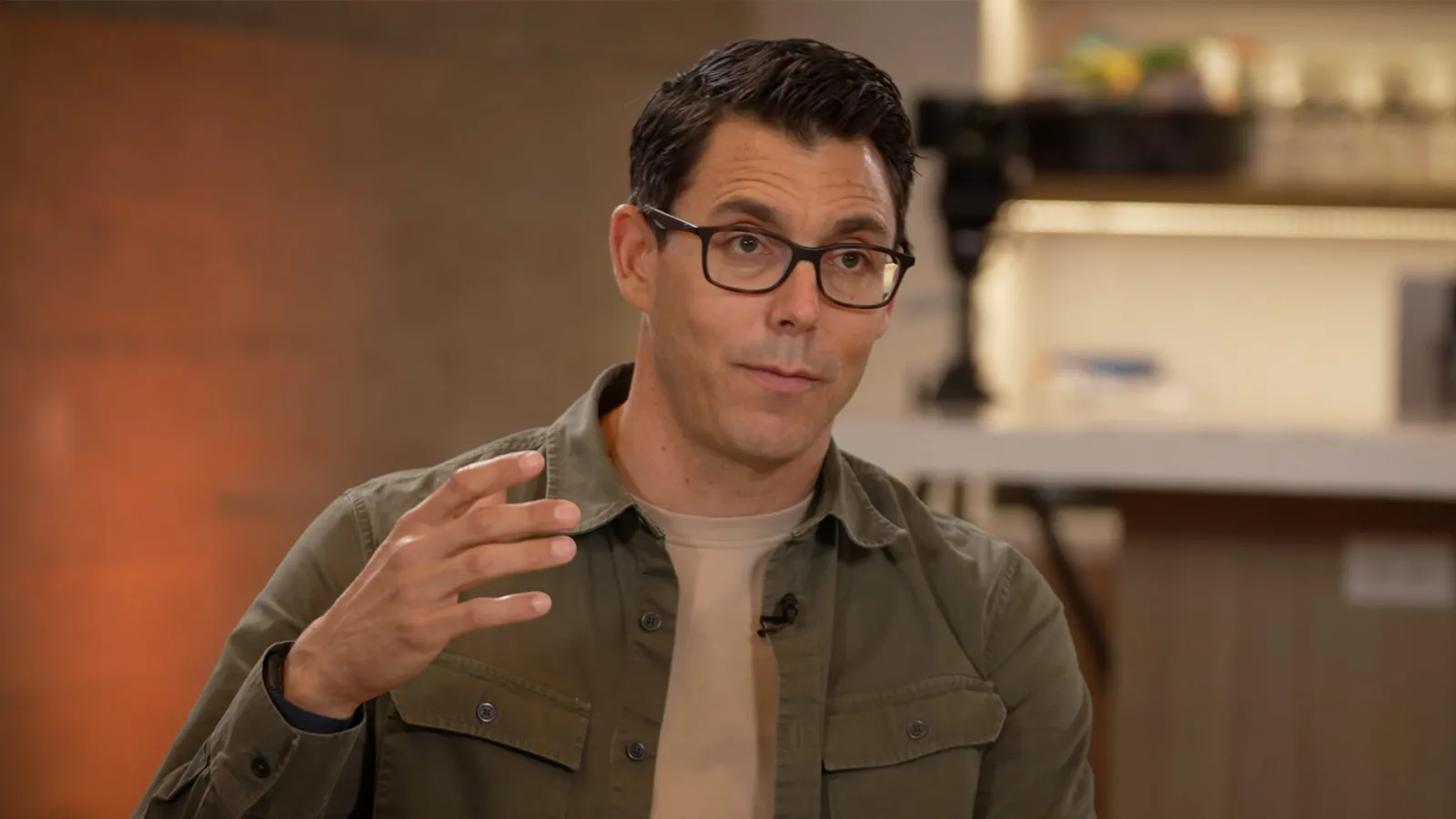
Rivian Founder and Chief Executive Officer RJ Scaringe said Mind Robotics, the robotics company he founded, plans to put its first robots in a Rivian plant in the middle of 2027, where they will initially be able to handle about a fifth of the tasks.
Mind, which is based in Palo Alto, California, is on “really aggressive product timelines,” including “putting the first robots in a Rivian plant middle of next year,” Scaringe said in a conversation published by venture capital firm Kleiner Perkins on Monday.
Kleiner Perkins led a $400 million funding round for Mind in May.
“In the beginning we’re going to be able to do … 20% of the tasks in the plant, but over time we want to grow that to 80%,” he said.
The date is more specific than the timelines he has given before.
Earlier Timelines
In March, The Wall Street Journal reported after an interview with Scaringe that the startup would have a large number of robots deployed by the end of the year.
In June, at the media launch of the R2 in Utah, he was asked when Mind would be ready to show its work. “Less than a year,” he said, according to The Detroit News, adding that “we’re going to be deploying inside Rivian’s production plant.”
Mind’s website said by September that “our first robots are learning on the job” with Rivian as its first manufacturing partner, training on active vehicle lines. That describes data collection and training, not the production work Scaringe now dates to mid-2027.
The company’s job postings point the same way. A Forward Deployed Engineer role based “onsite at a key customer in Normal, IL” starts with data collection devices “and then transition into robot deployment support.” Rivian builds its vehicles in Normal, Illinois.
A supply chain posting describes a plan to move from prototype builds in the tens of units to “initial production runs” of hundreds to thousands.
“That’s exactly what Mind needs as we deploy robots into real factories and beyond,” Scaringe said when Field was named. He gave no date in the video for deploying robots outside Rivian.
From 20% of Tasks to 80%
Scaringe said Mind filmed thousands of different plant tasks, rated each for the dexterity and reasoning it requires, and then judged whether its launch robot could do them.
The hardware is fixed at launch, he said, while the software improves. “The model gets smarter over time.”
The first jobs are the simplest ones, which he described as pick and place: taking a part off a rack and putting it into a fixture, where a conventional robot can then pick it up. He said such work can make up half the labor in some parts of a plant, and that these jobs tend to have the highest attrition.
An industrial setting also asks less of the model than a home, he said, because a robot can be tuned to a single station after performing the task a handful of times.
On cost, he spoke as a customer. “We are happy to spend tens of thousands of dollars per year per robot to do the types of tasks that today only a human can do,” Scaringe said of Rivian.
He was more specific last month, asking in an interview with Big Technology whether a manufacturer would pay $50,000 a year for a robot working three shifts.
Data Without an Internet
Scaringe said robotics lacks the ready-made training data that language models found online. “We don’t have the internet as a starting point,” he said.
Mind’s answer is what he called a data collection machine, built on Rivian and, eventually, on partners and suppliers. He described “a wearable hat for egocentric data” and cameras “watching how manufacturing’s being done.” Collecting its own data lets Mind decide details such as whether to synchronize the video with tactile gloves, he said.
“We’ll both buy data, but we’ll also build our own,” he said.
In-House Except Simulation
Scaringe said Mind develops nearly everything itself. It has gone through “everything with the exception of fully building our own sim platform,” he said, and works with partners on simulation.
He said the inference platform developed within Rivian is also being used in Mind’s robots, and described the company’s software as “world action models.”
He expects the field to shrink. “I think in robotics, there’s probably too many companies across the stack today, and we’re going to see consolidation,” he said, comparing component makers that serve robot startups to the suppliers behind the EV startups of the last decade, most of which have disappeared.
Scaringe also repeated his case against copying the human body, calling the focus on human biomechanics “a lazy way to think about it.” A spine’s degrees of freedom are “unnecessary for most manufacturing,” he said.
Mind’s own hiring language is less clear-cut. A Safety Engineer posting refers to “our humanoid platform” and to “a bipedal, dynamically balancing, multi-DOF system.”
Rivian’s Stake
Rivian established Mind in November 2025 and held 53.5% at the end of that year, according to its filings. Its stake fell to 37.6% in March, when it stopped consolidating the company and booked a $506 million gain, to 32.1% in June and to 31.2% at September 30.
Outside investors, primarily Eclipse Ventures, put in about $112 million when Mind was formed, according to Rivian’s annual report.
A $500 million Series A followed in March, co-led by Accel and Andreessen Horowitz, and Kleiner Perkins led the $400 million round in May. The Wall Street Journal reported valuations of $2 billion in March and $3.4 billion in May.
The latest quarterly report says Mind issued Series A-1 preferred shares to third parties “in May and July 2026.” Mind announced the May round, which took its funding above $1 billion. Mind has not announced a July issuance.
Rivian calls itself “a key customer and launch partner, providing a live, high-volume manufacturing environment for model training and deployment” in its third-quarter presentation. The quarterly report says transactions with Mind were not material through September 30.
Scaringe chairs Mind’s board and holds a profits interest of up to 10% in the company, according to Rivian’s proxy statement. Doug Field oversees its product, engineering and operations.
In the same conversation, Scaringe said he still visits suppliers in Mexico to keep pressure on parts makers as the brand prioritises ramping up production of its cheapest SUV, the R2.