
Aftermarket infotainment maker EV Play announced plans to build a version of its Max unit compatible with the Rivian R2, which extends Apple CarPlay and Android Auto to the automaker’s newest and most affordable model.
Rivian does not support either platform on any of its vehicles — a deliberate decision founder and CEO RJ Scaringe has defended as essential to delivering what he calls a “seamless digital experience” throughout its software.
The vehicles’ own operating system could do it. Both the R1 and R2 run Android Automotive OS, which supports CarPlay and Android Auto natively. Rivian chooses not to enable them.
The absence has made CarPlay one of the most persistent feature requests in the Rivian owner community, with aftermarket solutions like EV Play emerging to fill the gap.
Rivian’s own research suggests the constituency has shrunk but not disappeared.
Chief software officer Wassym Bensaid told The Verge‘s Decoder podcast in May that more than 70% of customers requested CarPlay when the R1T and R1S launched around five years ago, and that a recent internal survey put the figure below 25%.
Rivian owner and X user Chris Hilbert shared EV Play‘s newsletter with his followers on Sunday, writing that CarPlay is “coming to R2 with EV Play Max.”
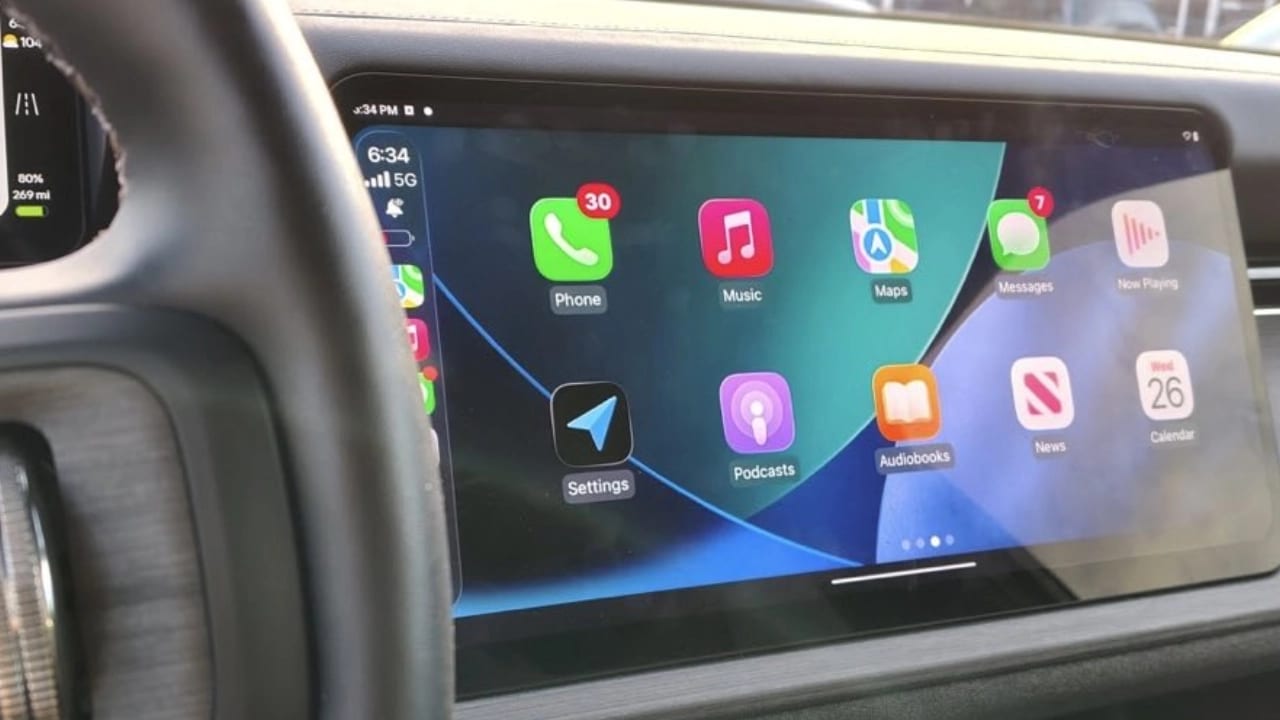
The email included an image of Apple CarPlay running on an R2 center screen and a link to an interest form asking prospective buyers which Rivian model they own — R1 Gen 1, R1 Gen 2, or R2.
The developers asked whether users planned to use the device for CarPlay, Android Auto, or both.
A separate question gauged willingness to pay a yearly subscription on top of the hardware cost, with one option set at under $3 per month or $36 annually.
No such charge exists today: EV Play’s product page lists the Rivian unit at $425 plus tax and shipping, with no subscription of any kind.
Alex, the founder of EV Play and signer of the newsletter, said he spent time with the R2 and confirmed that a Max unit covering both the R1 and R2 is in development.
“I spent last week with the Rivian R2 (side note: what a great job Rivian did) and am excited to announce that we will be building a Max unit that is compatible with both the R1 and R2,” he wrote.
Pricing and timing for the launch were not disclosed.
“I will provide additional updates, including pricing & timing, in the next week or so,” the newsletter added.
The existing R1 unit is listed as out of stock on EV Play’s site, with buyers directed to a waiting list — which is what the interest form is sizing.
What EV Play Max Does
EV Play Max is the flagship product from Amprocity — a small California-based startup that began developing the device in the summer of 2024.
The hardware is an Android-based mini-computer that taps into a Rivian’s center-screen video feed and CAN bus.
Owners can switch between the factory Rivian interface and a full Android tablet-like environment using a small wireless button.
The R1-compatible version currently available retails for $425, with an optional $36-per-year subscription for ongoing software updates.
Core features include wired and wireless Apple CarPlay and Android Auto, access to the Google Play Store for apps such as Netflix, Hulu, Disney+, YouTube, Spotify, Waze, Google Maps, ABRP, and Zoom, and HDMI input and output for consoles, laptops, or streaming sticks.
The system automatically reverts to the native Rivian interface — including backup cameras — when the driver shifts into reverse. USB ports, Bluetooth, and Wi-Fi via an included dongle round out the hardware.
The device is already compatible with Gen 1 and Gen 2 R1S and R1T models. EV Play’s own FAQ still lists only those vehicles; the R2 exists as a newsletter announcement rather than a purchasable product.
EV Play also sells a separate, simpler product called Auto-Mate for $65 — a USB-C adapter paired with a phone app that automates touchscreen sequences based on speed, GPS location, or entry and exit events.
The company is not a Rivian specialist. It sells a $199 LT unit and a $425 Max for Chevrolet, GMC and Cadillac electric vehicles, alongside a $49.95 camera product for the same brands — a business built on several manufacturers making the same decision.
Owner Feedback
Community discussion around EV Play is concentrated on Rivian Forums and the r/Rivian subreddit.
Sentiment from owners who have installed the R1 version is generally positive, with recurring descriptions such as “game changer” and “favorite accessory,” with owners praising the native Android experience on the large center screen, particularly for streaming during charging sessions.
Several posts have highlighted CarPlay and Siri work even when the Rivian factory interface is displayed.
However, not all feedback is favorable. Occasional glitches — unexpected interface reversions, Android Auto requiring resets, and weaker Wi-Fi signal after panel reassembly — surface in forum threads.
On the EV Play community forum, user ‘anderson’ reported that after an initially successful install, the EV Play UI would play video for only about eight seconds before unexpectedly reverting to the native Rivian interface while the truck sat parked.
Later, an update froze the screen entirely and required pulling power for 15 minutes to recover.
On RivianForums, thread starter ‘Gurule92’ wrote that “the Android Auto reset function was needed a few times.”
Overall, both owners and the developer treat the software as an aftermarket solution coming from a “small team” rather than a polished, factory experience.
R2 Timing
EV Play did not specify whether the R2-compatible Max unit would carry the same $425 price as the R1 version or require a different installation method.
Installation on the R1 takes about 45 minutes and requires removing the passenger-side footwell panel to reach the infotainment control unit.
The interest form suggests the company is still gauging demand across R1 Gen 1, R1 Gen 2, and R2 owners before finalizing production details.
Rivian began external deliveries of the R2 mid-size SUV in June, as it began sending out order invited for its Performance Launch Edition — priced at $57,990.
The EV maker is preparing to roll out its 2026.31 software update, which will, for the first time, ship OS 2.0 to both R1 models.
Rivian on Infotainment
Rivian executives have articulated their opposition to CarPlay and Android Auto in multiple occasions.
In an interview with Stratechery in December 2025, the company’s founder and CEO stated that supporting Apple CarPlay would create “two different UIs playing out,” resulting in a “poor user experience.”
Scaringe argued that most drivers demand CarPlay only because competing automakers offer subpar infotainment systems.
“They’re in cars that have such bad UI that the life raft to escape the horrible UI that is embedded in the car is CarPlay,” the CEO stated.
Bensaid has made the same argument in hardware terms. “The challenge with screen mirroring solutions is that they take over every single pixel in the car,” he told Decoder, adding that deep artificial intelligence integration would eventually render the debate “completely obsolete.”
Rivian shares the approach with Tesla, which also builds a proprietary infotainment platform and does not offer CarPlay or Android Auto.
Both companies selectively integrate third-party services — Rivian recently announced Waze police and speed camera alerts for its in-vehicle navigation.
The R2 launched with iHeart Digital Radio and plans to integrate apps like Amazon Music and YouTube Music in future updates — while keeping the core interface in-house.