Three customers have filed a class-action lawsuit against Rivian, claiming the company misled buyers by advertising its first-generation R1T and R1S vehicles as being capable of hands-free, Level 3 self-driving.
The lawsuit — filed on Wednesday in the US District Court for the Central District of California — argues that the EV maker “unquestionably knew that its Gen 1 Vehicles would never be capable of Level 3 autonomy or ‘true hands-free driving’.”
According to the complaint, however, the company “continued to tout the supposed capabilities of its vehicles to induce consumers to purchase them.”
The plaintiffs seek a nationwide class certification on behalf of purchasers and lessees of model year 2022–2024 R1T and R1S vehicles equipped with the company’s ‘Driver+’ platform.
5 Years of Alleged Misrepresentations
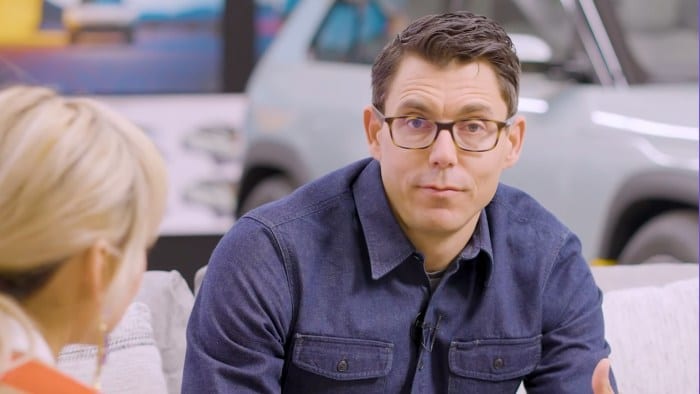
The filing traces the alleged marketing scheme back to November 2018 — when Rivian founder and CEO RJ Scaringe unveiled prototypes of the R1T and R1S at the Los Angeles Auto Show.
According to the filing, Scaringe stated during the presentation that the vehicles would integrate cameras, radar, high-precision GPS, and two front-facing LiDAR sensors to deliver a level of on-road and off-road self-driving capability not previously seen in the market.
From late 2018 through at least October 2020, Rivian‘s website stated that Level 3 autonomy would be available on every Rivian vehicle, the complaint alleges.
The company’s website marketed to prospective buyers they would be able to take their hands off the wheel and their eyes off the road.
In November 2020, Rivian branded its driver-assistance system ‘Driver+’ and described it as delivering “true hands-free driving assistance” standard on every vehicle the company builds, with all enhancements provided over-the-air at no expense.
The lawsuit further alleges that Rivian‘s sales staff reinforced those claims at in-person events.
Beginning in August 2021, the company held a series of regional “First Mile Event Tours” at its Normal, Illinois manufacturing facility and in New York, San Francisco, and Los Angeles for customers who had placed preorders.
During those events, Rivian representatives allegedly told attendees their vehicles would possess Level 3 autonomous driving capabilities through future software updates, according to the complaint.
One named plaintiff, Michael J. Fritz, attended a First Mile Event in January 2023, where a Rivian representative told him the company’s self-driving capabilities were “parallel to, if not better than” Tesla‘s Full Self-Driving system, the filing states.
Rivian‘s filings from its initial public offering (IPO) also form part of the case.
In the Form S-1 Registration Statement filed with the US Securities and Exchange Commission on October 1, 2021, Rivian stated that it expected its platform’s architecture would enable it to expand its ‘Driver+’ offerings to support SAE Level 3 autonomy.
Gen 1 Hardware Described as a ‘Dead End’
The core of the lawsuit rests on the allegation that Rivian manufactured its Gen 1 vehicles without the hardware, cameras, sensors, and computing power necessary for hands-free driving or Level 3 autonomous operation — and that the company knew this from the start.
The complaint asserts that no software update, regardless of sophistication, will enable the Gen 1 vehicles to perform as advertised.
Level 3 autonomy requires high-resolution cameras, radar sensors, lidar systems, high-performance onboard computing, and redundant safety systems — hardware that must be designed into a vehicle at the time of manufacture, not retrofitted through software, the filing states.
The plaintiffs point to a Wired Magazine interview in which Scaringe acknowledged that Rivian had determined the technology underpinning the Driver+ system was a “dead end” around the same time the Gen 1 vehicles launched.
“R1 Gen 1 launched end of 2021. The architecture was (…) primarily a Mobileye-based system. We realized as we were launching that it was the wrong approach,” the Rivian founder told the outlet last week.
Scaringe told the publication that the company “completely reset” and recruited a new team to design a system built around a data flywheel approach, trained with accumulated miles — a system that launched on second-generation vehicles in late 2024.
Rivian‘s inaugural Autonomy & AI Day on December 11, 2025 marked the first time the company publicly acknowledged that the Gen 1 vehicles were manufactured without sufficient hardware or compute for hands-free driving.
At the event, the EV maker unveiled its custom RAP1 5nm processor and its new ‘Autonomy+’ platform, which is available on Gen 2 Rivians and will form the basis for the system in the forthcoming Gen 3 R2 models.
The ‘Autonomy+’ system is not compatible with Gen 1 vehicles — as those models lack the necessary sensors, cameras, and computing infrastructure.
Three Plaintiffs Across Three States
The lawsuit names three plaintiffs from California, Michigan, and Wisconsin — each of whom purchased a Gen 1 R1S during the class period, which begins October 1, 2021.
Fritz, the California plaintiff, paid approximately $97,000 for a 2023 R1S and maintains a ‘Connect+’ subscription at $14.99 per month.
According to the complaint, Level 3 hands-free driving was a prerequisite for his purchase.
Jason M. Cornellier, in Michigan, preordered a Gen 1 R1S in 2019 after livestreaming the November 2018 Rivian Unveiling Presentation.
He purchased a 2023 R1S in February 2023 for more than $81,000.
Dean A. Sweberg, of Wisconsin, preordered a Gen 1 R1S in 2020 after watching Scaringe’s 2018 presentation and reviewing Rivian‘s website.
He purchased a 2022 R1S in December of that year for more than $83,000.
All three plaintiffs formally opted out of the arbitration agreement and class-action waiver contained in Rivian‘s standard purchase agreement, preserving their ability to file suit in federal court.
Nine Counts Filed, Jury Trial Demanded
Wednesday’s complaint brings nine counts against Rivian, spanning common law and state consumer protection claims.
The first three counts apply to all classes: fraudulent concealment, negligent misrepresentation, and unjust enrichment.
Fritz brings three additional claims under California law: violations of the Unfair Competition Law, the False Advertising Law, and the Consumer Legal Remedies Act.
Cornellier asserts a claim under the Michigan Consumer Protection Act, while Sweberg brings a claim under the Wisconsin Deceptive Trade Practices Act.
A ninth count alleges violations of consumer protection statutes across more than a dozen additional states.
The plaintiffs are seeking injunctive relief, compensatory and punitive damages, restitution, disgorgement of profits, and attorneys’ fees.
The firms representing the Rivian owners have demanded a jury trial.
Gen 2 Now Offers Hands-Free Driving
The lawsuit draws a sharp distinction between Rivian‘s first- and second-generation vehicles.
The Gen 1 R1T and R1S do not offer hands-free driving. The second-generation models, overhauled in 2024, do.
The Gen 2 vehicles were equipped with the Rivian Autonomy Platform, which comes standard and includes 11 cameras, five radar sensors, and a computer the company has described as 10 times more powerful than the previous system.
Last year, Rivian rolled out Universal Hands-Free driving via a software update pushed to Gen 2 R1 vehicles.
The feature allows drivers to take their hands off the wheel on more than 3.5 million miles of roads in the United States and Canada, including a mix of highways and surface streets, as long as there are visible lane lines.
Rivian has since began charging for ‘Autonomy+‘ at $49.99 per month or $2,500 as a one-time purchase — after extending its free trial three times.
The company started delivering its R2 midsize SUV last week, beginning with the $57,990 Performance Launch Edition.
The R2 ships with the ‘Autonomy+’ system and is expected to receive the company’s third-generation autonomy hardware — including a LiDAR version and the in-house RAP1 processor — in late 2026.
Misleading Statements
The lawsuit adds to a growing list of legal disputes for the Irvine, California-headquartered automaker.
Last year, Rivian agreed to pay $250 million to settle a class-action shareholder lawsuit filed after the company hiked prices on the R1T and R1S in 2022.
That case, filed in 2022, alleged Rivian made materially misleading statements about vehicle production costs leading up to its November 2021 IPO.
In December, the company faced another shareholder lawsuit from an investor making similar allegations about the IPO disclosures.
Tesla’s Case
Rivian is not the only EV maker to face legal challenges over autonomous driving promises.
Tesla owners have sued over the failure to deliver autonomous driving capabilities through its Full Self-Driving (FSD) software — including in China, where the system was partially approved last year.
Earlier this year, the California Department of Motor Vehicles (DMV) filed accusations alleging Tesla violated state law by deceptively marketing Autopilot and FSD.
A judge ruled in the DMV’s favour, but the agency decided in February not to suspend Tesla’s sales and manufacturing licences after the company stopped using the term ‘Autopilot’ in its California marketing.
Upon launching FSD in the Netherlands recently, the company said it is limited to vehicles equipped with its Hardware 4 (HW4) computer.
Owners of older Hardware 3 cars in the Netherlands are not eligible to activate FSD Supervised, even if they have previously purchased or subscribed to the software.
The situation mirrors the United States, where HW3 vehicles have been left behind by the FSD v14 generation entirely.
Tesla executives said in a previous earnings call last year that a ‘Lite’ version of FSD 14 was being developed specifically for HW3 cars, with a release targeted for the second quarter of 2026.
Whether — and when — that Lite version will be approved for use in the Netherlands is unclear.
CEO Elon Musk admitted in late 2024 that HW3 vehicles are not powerful enough to run the current FSD software and committed to free computer retrofits for owners who purchased the FSD package outright.