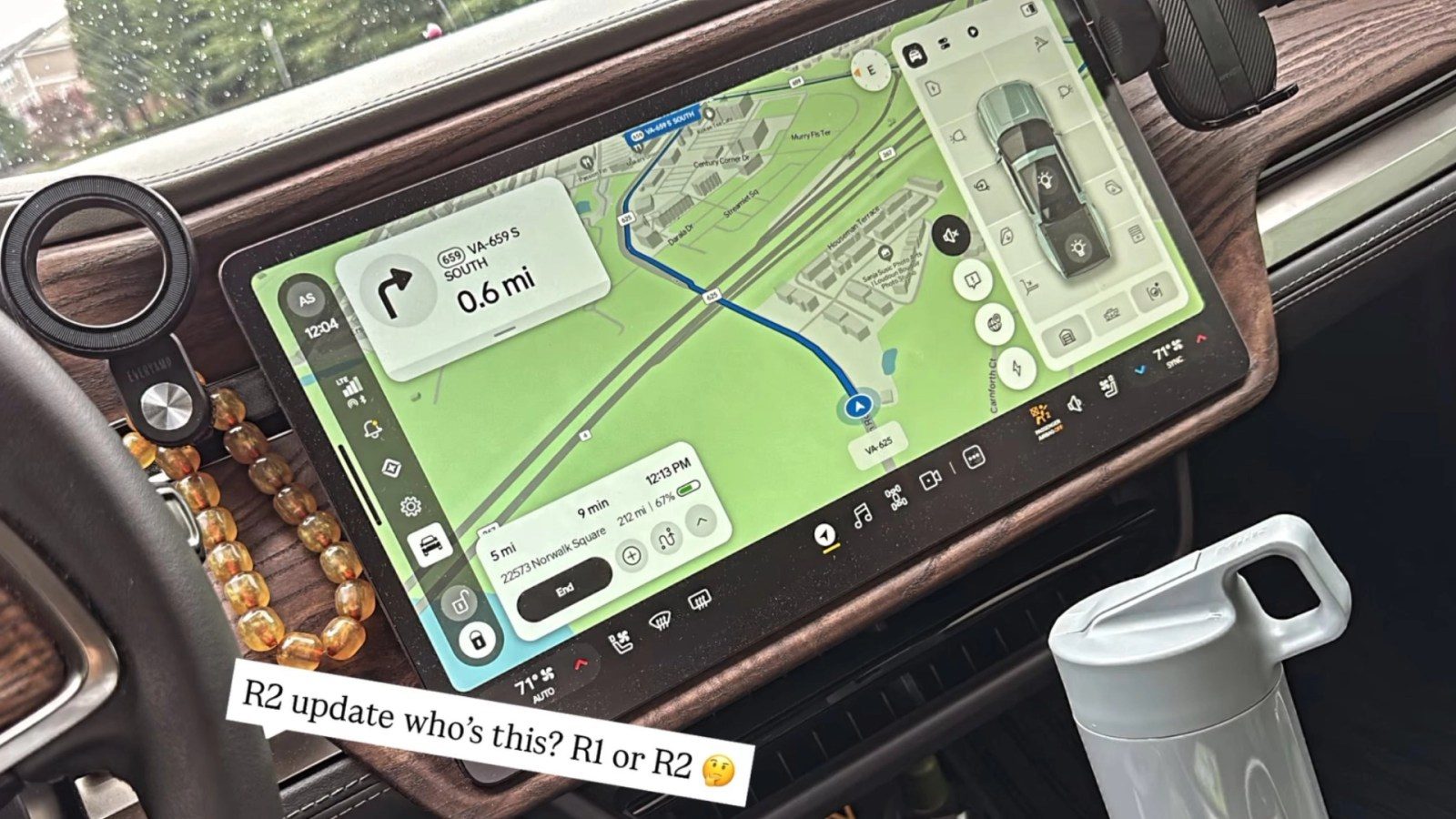

An image shared on X on Monday suggests Rivian may be testing the unified operating system that Chief Software Officer Wassym Bensaid promised would come to the R1 by year-end.
After a recent software update, an R2 owner noticed that the vehicle avatar displayed in the top-right corner of the navigation view carried the boxier profile of an R1 rather than the R2’s more compact, rounded silhouette.
The image, shared by user ‘Kanundrum17’, shows the R2’s infotainment screen mid-route along VA-659 South.
A text overlay on the image reads “R2 update who’s this? R1 or R2,” calling attention to the mismatch.
The rendering discrepancy — an R1 vehicle model surfacing inside R2 software — suggests Rivian may have already started merging code and visual assets between the two platforms.
Chief Software Officer Wassym Bensaid had told owners in May that the company’s next-generation operating system would be unified across the R1 and R2 by year-end.
What Bensaid Promised
The vehicle model glitch surfaces nearly three months after Bensaid announced during a Reddit AMA session in the r/RivianR2 subreddit that Rivian intended to run one core operating system across its entire vehicle lineup.
Bensaid told owners at the time that RivianOS 2.0 would debut on the R2 at launch and roll out to existing R1 vehicles “later this year.”
The executive described the goal as creating “a core software Operating System that provides a unified brand experience irrespective of the hardware that may differ between vehicle platforms.”
The question of whether Rivian could sustain two parallel software stacks had been a recurring concern within the owner community, particularly as the R2 introduced a different infotainment architecture and more powerful onboard compute.
RivianOS 2.0 replaced the R1’s horizontal navigation bar with a vertical sidebar and introduced multi-panel layering — design changes that currently exist only in the R2 software branch.
The same architecture underpins the $5.8 billion software joint venture between Rivian and Volkswagen Group, where Bensaid serves as co-CEO alongside Volkswagen‘s Carsten Helbing.
The Scalable Systems Platform developed through that venture is expected to be deployed across Volkswagen, Audi and Scout Motors vehicles starting with the VW ID.1 in 2027.
Unified Codebase
A unified codebase would consolidate vehicle-specific assets — including 3D models, UI layouts and feature flags — into a shared software layer that adapts to the hardware platform at runtime.
An R1 vehicle model rendering on an R2 screen is consistent with that kind of architecture: shared rendering code pulling from a combined asset library, with the vehicle-detection logic selecting the wrong model.
The engineering challenge, however, varies dramatically depending on which R1 generation is involved.
Rivian currently maintains three distinct hardware tiers across its lineup, each with a different compute foundation.
First-generation R1 vehicles — built through model year 2024 — run a domain-based architecture with 17 separate electronic control units, each dedicated to a single function.
ADAS on Gen 1 relies on Mobileye’s off-the-shelf system, which limits those vehicles to the basic Driver+ suite and excludes them from every Autonomy+ feature Rivian has shipped since the platform split.
Those features run on Nvidia’s Drive AGX Orin processors, fitted only to Gen 2 hardware.
Rivian’s update cadence for the R1 has already slowed this year. The company shipped four R1 feature versions in 2026 through mid-August — 2026.03 in January, 2026.07 in April, 2026.15 in May and 2026.23 in August — against 11 over-the-air updates across all of 2025, a figure Bensaid cited during the AMA.
Rivian has not publicly announced a specific date for the unified OS rollout to R1 owners beyond Bensaid’s year-end commitment.
The R2, meanwhile, shares the Gen 2 R1’s seven-ECU zonal layout but adds a separate 200 sparse TOPS of Edge AI compute dedicated to the cabin experience — the layer that powers the Rivian Assistant, the Unreal Engine 5 interface and the on-device large language model.
RivianOS 2.0 was designed around that compute headroom.
Rivian‘s update cadence for the R1 has already slowed this year.
As of early August, the company had pushed seven R1 releases in 2026 against 11 across all of 2025, according to community version trackers.
Rivian has not publicly announced a specific date for the unified OS rollout to R1 owners beyond Bensaid’s year-end commitment.
The Two Branches Are Converging
Since Bensaid’s May comments, Rivian has pushed updates to both the R2 and R1 on separate version series — but the most recent releases point toward the merge rather than away from it.
On the R2 side, Rivian began rolling out 2026.24.40 on 15 July, the first major over-the-air release for the midsize SUV roughly five weeks after deliveries commenced.
Bensaid confirmed the release himself, which added Launch Mode, Pet Comfort, Gear Guard, garage-door pairing and an in-vehicle WiFi hotspot, alongside fixes spanning an Adaptive High Beams bug, Spotify freezing on load and Apple Music login failures.
Then both platforms updated on the same day.
R1 version 2026.23 and R2 version 2026.24.41 each entered public release on 6 August, and their release notes carry the same two headline features in near-identical wording: Lane Change on Command extended beyond freeways, and traffic lights and cones rendered in the Autonomy view on the driver display. The R2’s notes add stop signs; the R1’s do not.
On the R1, the lane-change expansion is restricted to second-generation vehicles running Universal Hands-Free, across the more than 3.5 million miles of US and Canadian roads the system covers.
Rivian Assistant gained memory, conversational charger search and voice-drafted service requests on both R1 generations.
The version numbering still shows two branches — the R1 sits on 2026.23 while the R2 is already on 2026.24 — and the R2 reached the higher number three weeks earlier.