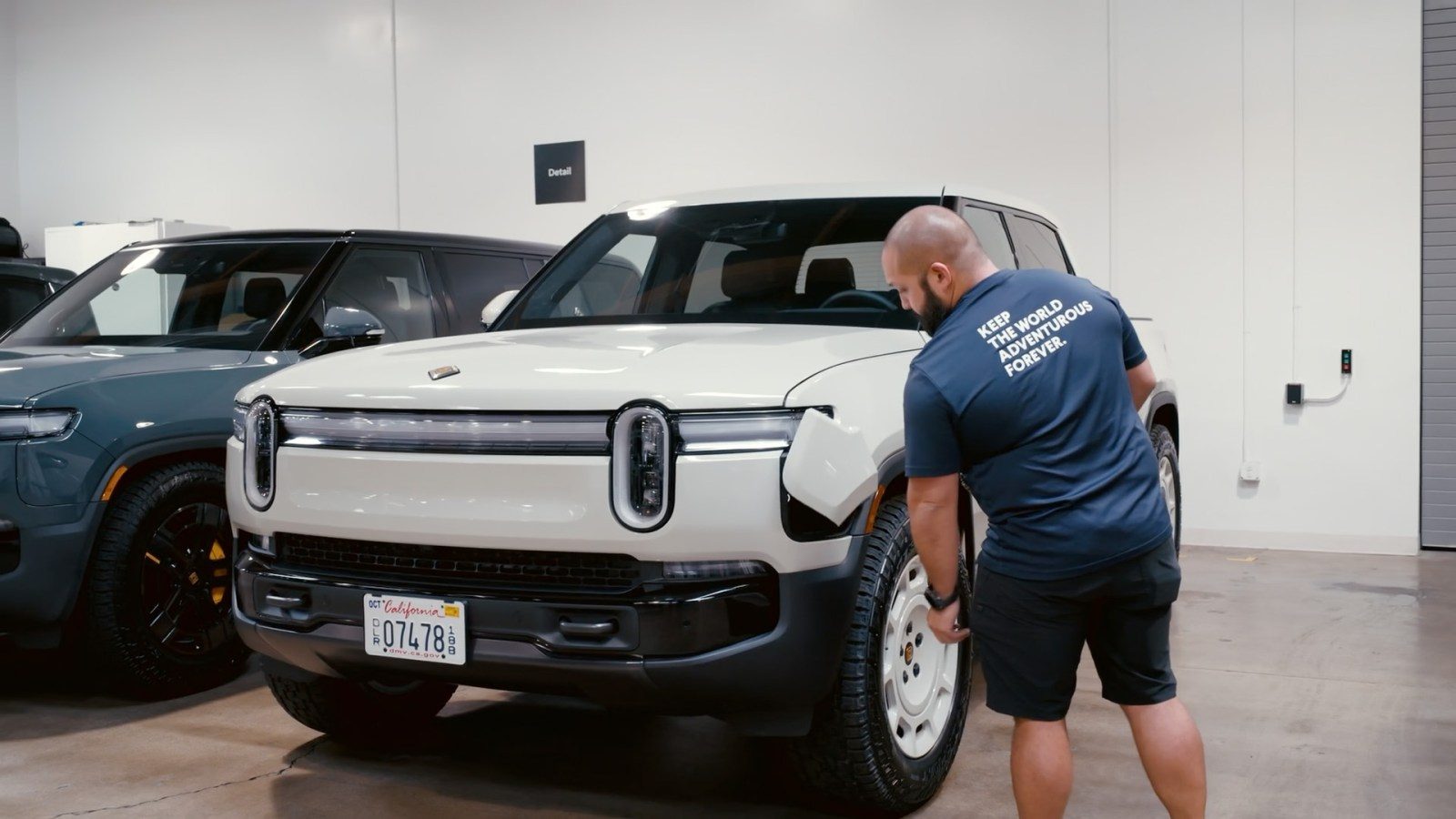

Rivian owners continue to report premature 12-volt battery failures on first-generation R1 vehicles — a recurring problem the EV maker has acknowledged through proactive replacement campaigns since late 2024.
The latest complaint came from X user ‘Firetrade0129’ on Sunday, who said his R1T is about to receive its third 12-volt battery in just over two years.
The user shared a screenshot of a “Replace 12V battery” alert from the Rivian mobile app.
“This will be my 3rd 12V battery … 3 12 volt batteries in 2 yrs 3 months of ownership,” the owner wrote, adding that his truck had just 13,000 miles on the odometer — placing the replacement rate at approximately one 12-volt battery every 4,200 miles.
In a follow-up exchange, the owner said he has been told by Rivian on the previous two occasions that the replacement battery would last two years.
“I think that’s what they said last time,” he wrote. “At this rate I’m going through 12 volt batteries every 9 months … annoying to say the least.”
The owner noted he is leasing the vehicle and that all replacements have fallen within the warranty period.
Community Poll
Chris Hilbert, a well-known Rivian owner and content creator on X under the user ‘Hilbe,’ posted a poll last week asking owners how many times Rivian had replaced their 12-volt batteries.
The poll, published on June 25, drew 182 votes.
Of those who responded, 68.1% said Rivian had replaced their 12-volt battery once.
Another 15.9% reported two replacements, 4.9% reported three, and 11% said four or more times.
The results, while drawn from a self-selecting sample of owners who had already experienced at least one failure, suggest that repeat replacements are far from isolated.
Nearly a third of respondents — 31.8% — reported needing two or more battery replacements.
12V Battery Functions
Rivian‘s first-generation R1T and R1S vehicles use small lead-acid 12-volt batteries to power auxiliary systems — door locks, contactors, infotainment, sensors and the onboard computers that manage the vehicle’s sleep and wake cycles.
The high-voltage battery keeps the 12-volt system charged through a DC-DC converter, but not as a continuous feed.
While the vehicle sleeps, standby services draw from the 12-volt battery; when voltage drops low enough, controllers partially wake, close the high-voltage contactors, top up the 12-volt cell, and return to sleep.
This repeated micro-cycling wears out the small lead-acid cells far faster than in a conventional vehicle, where the 12-volt battery is charged continuously while the engine runs.
Multiple owners and trade outlets have described the failure timeline at roughly 12 to 18 months for the single-battery configuration.
Early Gen-1 vehicles shipped with two 12-volt batteries for redundancy, however, Rivian replaced one with a capacitor in June 2023 to reduce costs.
Vehicles with the single-battery setup are widely reported to fail sooner.
A dead 12-volt battery also creates what owners describe as a catch-22: closing the high-voltage contactors requires a charged 12-volt system, but the 12-volt battery can only recharge from the high-voltage pack once those contactors are closed.
A fully depleted 12-volt cell leaves the vehicle stranded — unable to unlock, unable to start and unable to charge — until an external 12-volt source is applied.
According to Rivian‘s own support documentation, owners who receive a low-voltage alert can expect increased range loss until the battery is replaced.
The company advises keeping the vehicle plugged in when parked and warns that the battery may require replacement within hours of the notification appearing.
Proactive Campaign
Rivian has been running a proactive, no-cost replacement programme since at least late 2024, contacting owners by phone and text to schedule preemptive battery substitutions.
Mobile service technicians perform many of the replacements at owners’ homes, frequently bundling the work with other service bulletins such as wheel-hub bolt torquing and HVAC drain-plug inspections.
Original-equipment 12-volt batteries carry a three-year or 36,000-mile limited warranty, whichever comes first, according to Rivian‘s support page. Defective units are replaced at no cost during that window.
Out-of-warranty replacements are a different matter.
YouTuber Zack Nelson, known as JerryRigEverything to his nearly 10 million subscribers, shared an invoice in October 2025 showing Rivian charged $775.04 to replace two 12-volt batteries — $511.30 in parts and $231 in labour plus taxes.
Nelson’s post went viral, drawing more than 1.6 million views and reigniting debate over Rivian‘s right-to-repair posture.
The company uses a proprietary battery format with non-standard terminal positions, and Nelson said Rivian refused to sell him loose batteries for self-installation while warning that off-the-shelf alternatives could void the warranty.
Promised Fix Still Pending
Rivian‘s Chief Software Officer Wassym Bensaid responded publicly to the backlash in October 2025, writing on X that there was “nothing intentional behind it” and that replacing the battery required a diagnostic tool to clear error codes.
Bensaid said Rivian was “working on an in-vehicle Service menu that will make similar repairs possible by our owners in the future.”
More than eight months later, that service menu has not appeared in a production software release.
Rivian‘s 2026.07 update, which began its public rollout in April 2026, included “12V battery management improvements” and “better 12V diagnostics” for Gen-1 vehicles, but did not deliver the owner-replaceable workflow Bensaid described.
Some owners have found they can clear 12-volt warnings through the existing RiDE diagnostic menu, but multiple forum posts indicate the alerts return within days on affected vehicles.
Broader Battery Issues
Premature 12-volt failures sit alongside several other battery-related problems Rivian has faced.
A separate defect on second-generation (model year 2025) R1S and R1T vehicles involved a corroding aluminium bracket that held the 12-volt battery in place.
Rivian has also been dealing with a battery state-of-charge calibration issue on Gen-2 vehicles equipped with LFP high-voltage packs, where a software update corrupted the range-estimation algorithm and caused sudden range collapses.
In those strandings, the 12-volt battery also died once the main pack fully depleted — a related symptom with a different root cause.
The company also issued an actual NHTSA safety recall in August 2025 for an improperly tightened ground connection in the high-voltage distribution box on certain 2025 vehicles, an unrelated defect that could cause sudden loss of drive power.
No Sign of Chemistry Change
Owners have repeatedly asked why Rivian continues to use lead-acid 12-volt batteries when competitors have moved on.
Tesla switched to lithium-ion 12-volt cells across its lineup, a chemistry that tolerates deep discharge cycles far better than lead-acid and holds a steady voltage even when nearly depleted.
Rivian does not officially support non-OEM 12-volt batteries.
The company’s 12-volt battery carries a three-year, 36,000-mile limited warranty, per its support page.