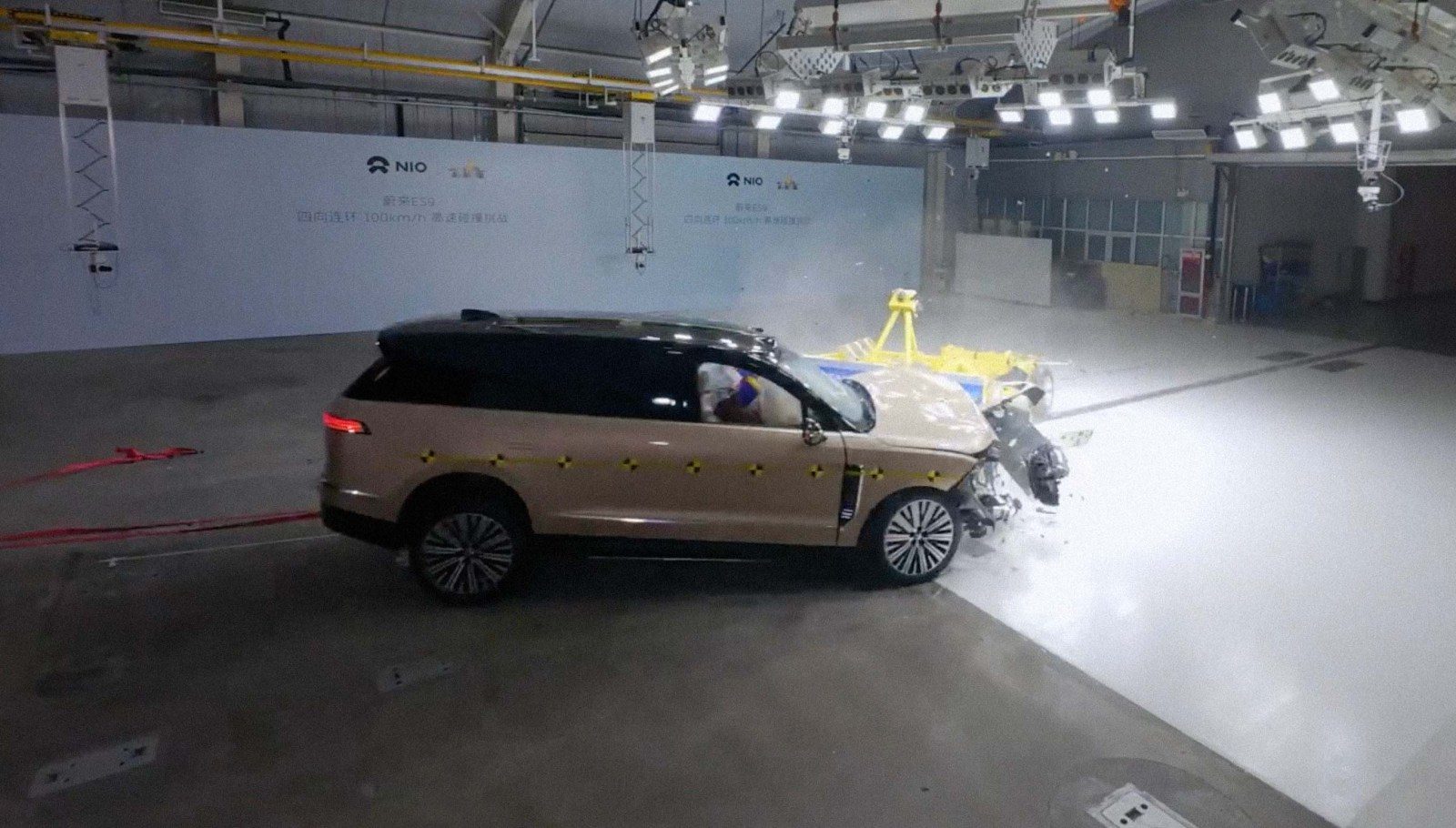

Nio will put its new flagship ES9 through a televised safety showcase on Tuesday, a day before the model goes on sale, as the company leans on technology, performance, and safety to sell its most expensive SUV yet.
China’s state broadcaster CCTV said its program “Top Lab” will air on Tuesday, May 26, testing new-energy vehicles against extreme safety scenarios, including high-speed multi-car collisions and nighttime pedestrian “ghost darting-out” situations, where a person emerges suddenly from a blind spot.
A teaser video posted by CCTV on the Chinese social media platform Weibo shows a crash test of the Nio ES9 and, separately, the company’s founder and chief executive, William Li, speaking in front of two ES9s.
What the Event Covers
CCTV’s own post frames the program around the safety of Chinese new-energy vehicles broadly and does not name Nio.
The link to Nio and the ES9 comes from the broadcaster’s video, which shows the crash test and Li. CCTV’s livestream is set for 7:30 p.m. Beijing time.
The framing appears to resolve an earlier hint. A screenshot circulating on Weibo on Monday showed Ma Lin, Nio‘s assistant vice president for branding and communications, previewing the event in a private group chat.
Ma said the ES9 had two more events scheduled, one on Tuesday night and one on May 27.
Earlier on Monday, Ma Lin described Tuesday’s as “very hardcore,” said it was “not yet announced” and still in preparation, and called it “a single-topic” segment.
What Nio Claims on Safety
The safety event plays to a message Nio already makes for the new flagship SUV.
On its official ES9 page, the company says the SUV “brings together NIO’s cutting-edge safety technologies to create a smart safety system that integrates active and passive safety across all time domains and driving scenarios.”
The ES9 comes with 12 airbags as standard, with a total volume of 525 liters, and a Smart Restraint System 2.0 that adds dedicated second-row collision sensors, according to Nio.
The body uses an ultrahigh-strength cage structure with 2,000-megapascal hot-formed steel in critical areas, and high-strength steel and the company’s own integral aluminum die castings make up more than 91% of the body, Nio says.
On the active side, the ES9 carries 31 sensors, including roof-mounted and fender LiDAR, 4D imaging radar, cameras and ultrasonic sensors, and runs Nio‘s in-house Shenji NX9031 chip with its Nio World Model assisted-driving software.
May 27 Launch Event
The safety showcase runs one day before the ES9 formally goes on sale.
Nio said the ES9 officially launches on Wednesday, May 27, at 7:30 p.m. Beijing time, with an online livestream of the event.
The company is offering a pre-launch deposit of 5,000 yuan that counts as 10,000 yuan off the purchase price, an incentive it said closes before the launch event. The deposit is refundable.
The ES9 is Nio‘s new full-size flagship SUV, built on its NT3.0 platform with a 900-volt architecture and the company’s SkyRide intelligent chassis.
Pre-sale pricing starts at 528,000 yuan with the battery included, or 420,000 yuan under Nio‘s Battery-as-a-Service rental model, with a Signature Edition at 588,000 yuan.
Li’s Video Appearance
In the video, Li speaks at the Nio House in Hefei’s NeoPark, the largest of the company’s flagship showrooms anywhere in the world.
The facility, which opened in August 2023, spans more than 4,000 square meters and was Nio‘s 134th Nio House globally and its first zero-carbon one.
It has a feature no other Nio House shares: a second-floor corridor that leads directly into the company’s F2 factory, the plant in NeoPark that began production in September 2022 and now builds models including the ES8.
A Sales Push Behind the Flagship
The two-day sequence underscores how central the ES9 is to Nio‘s second-quarter sales drive.
Founder William Li said on last week’s first-quarter earnings call that ES9 test drives, which opened May 11, had lifted demand for the existing ES8 rather than cannibalizing it, with ES8 order intake rising 30% week-over-week after drives began.
Nio expects to deliver between 110,000 and 115,000 vehicles across its three brands in the second quarter, a target that depends heavily on a June production ramp and the conversion of ES9 orders.