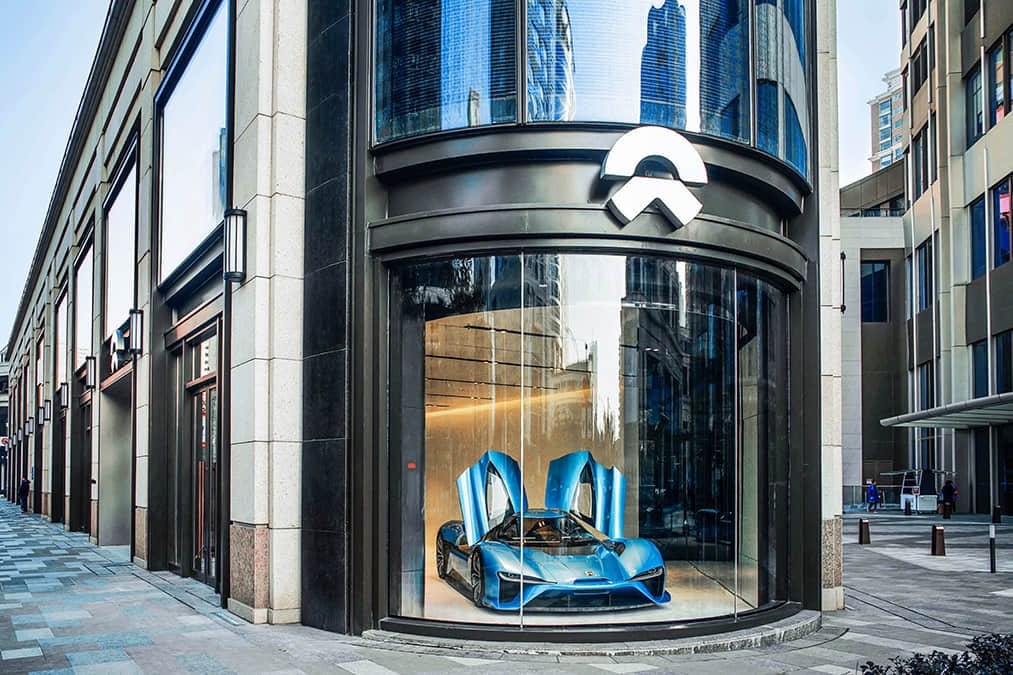

Nio will close its NIO House at Shanghai’s HKRI Taikoo Hui on the last day of August, shutting a flagship in the company’s home city that founder and CEO William Li once had demolished and rebuilt because the finish did not satisfy him.
The company does not disclose individual closures and has not published a monthly store update since June 2025. Instead, the premium brand discloses the total number of retail showrooms on a quarterly basis.
A Building That Took 495 Days
Nio confirmed the West Nanjing Road site in January 2017.
On September 14 that year, Li visited for the first time and ordered the work to start again from nothing after judging the art installations, lighting, materials and design short of the standard he wanted, with the money already spent.
“For user experience, our standard is the ultimate,” he said at the time, according to local media reports. Nio would spend whatever time and money it took rather than accept a single unmet requirement.
The Gallery opened that December.
The full house opened on May 26, 2018, 495 days after the site was chosen. The delay cost Shanghai the distinction of being the first NIO House. The one in Beijing opened first.
The Chinese outlet Guancha first reported the closure on Tuesday.
The Count Has Fallen
Nio’s annual report puts the global NIO House count at 173 at the end of 2025, against 180 a year earlier — the first annual decline since the format began. NIO Spaces, the smaller sales-focused stores, fell to 393 from 433.
The decline has continued into this year. On the first-quarter earnings call, Li said the company operated 168 NIO Houses and 389 NIO Spaces. Shanghai takes the first figure to 167.
Each disclosure since the middle of last year has been lower than the one before it: 187 in June 2025, the last month Nio published a store update and the highest figure it has reported; 176 at the third-quarter call in September; 173 at year end; 168 in the spring.
That is a fall of 19 houses, or 10.2%, from the peak.
The same network now carries more work.
The 2024 annual report described NIO Houses and Spaces as Nio’s channels. The 2025 report describes them as channels for the Nio and Firefly brands after the cheaper sub-brand was launched in China.
Onvo’s separate network has moved the other way, reaching 430 stores by the first-quarter call from 419 at the end of 2025 and 300 a year before that — growth of 43% in fifteen months.
Alongside the retail sites, Li counted 408 service centres and 90 delivery centres.
Malls Are the Expensive Part
Wang Tai, Nio’s Guangzhou regional general manager, told the Chinese outlet Blue Whale News this month that “some automakers are withdrawing from shopping malls primarily due to financial considerations,” adding that mall costs are usually higher.
In a separate interview, Nio executives said the company would close some smaller stores this year because they no longer reflect the brand’s current state, and would open formats that do.
Entry into new markets, they said, now requires a comprehensively reasonable financial model.
Estimates circulating in Chinese coverage put the annual cost of running a first-tier-city NIO House above 20 million yuan ($2.98 million), about three times a traditional dealership.
Nio has never confirmed a figure, and the number should be treated as an industry estimate rather than a disclosure.
The company similarly never confirmed reported rents of about 80 million yuan a year at Beijing’s Oriental Plaza.
Local media have reported sharply higher retail sales at the mall where the Nio House is located following the 2025 installation of Louis Vuitton’s ship-shaped store, with the landlord concentrating higher-end luxury tenants.
Chinese reporting has identified earlier closures at Hohhot in May 2025, and at Guangzhou’s Zhujiang New Town and Meihuayuan and Jinan’s Kuanhouli in September.
Nio has confirmed none of them individually.
The Sky Store Replacement
Li presented the network as expanding, not contracting.
Nio was optimising its sales and service layout through what he called the highly coordinated three-brand Sky store model, he said on the first-quarter call, expanding market coverage while increasing the depth and density of its channels.
The Sky store puts Nio, Onvo and Firefly under one roof, and combines pre-sales, after-sales service and vehicle delivery at a single address.
Nio announced the format in January, for markets where all three brands sell, and it is the structure absorbing the closures.
Co-founder Qin Lihong said last month that more than 40 were open, with new-standard sites concentrated in the third quarter and about 120 planned for 2026.
Reaching that figure requires roughly 80 more in the second half, or about 13 a month — trebling the format in six months.
Shared stores let Nio into smaller cities that could not support three separate networks. The second is space.
Qin said the format also compensates for insufficient display area at existing stores in major cities — which is the problem a landmark house on West Nanjing Road does not solve.
A NIO House is a clubhouse with a showroom attached. A Sky store is three brands’ inventory in cheaper square metres.
Nio, Onvo and Firefly each ran separate stores until this year, with building and staffing costs high enough to block expansion into lower-tier cities and to make it inconvenient for customers to compare the brands.
Qin’s line on the merged format was that once a buyer is through the door, whichever car they choose makes them a Nio customer.
Onvo’s own network reached 430 stores by the first-quarter call, from 419 at the end of 2025 and 300 a year earlier — growth of 43% in fifteen months, against a 10.2% fall in NIO Houses from their peak.
The Cost Discipline Behind It
Nio recorded its first quarterly profit in the fourth quarter of 2025 and has made a full year of profit its 2026 objective.
Research and development spending fell to 10.6 billion yuan last year from 13.0 billion in 2024. The annual net loss narrowed to 14.9 billion yuan from 22.4 billion.
The pressure has not eased. Li said in July that chips, plastics, aluminium, copper and lithium carbonate had all risen, adding nearly 20,000 yuan to the cost of building an ES8 — a figure that would require a 30,000-yuan price increase to hold gross profit steady.
He framed the second half as selling cars steadily and serving users, rather than launching them.
In Europe, the company confirmed the closure of its Hamburg house in July — the first there — only after a German outlet approached it, citing market conditions and construction outside the building.