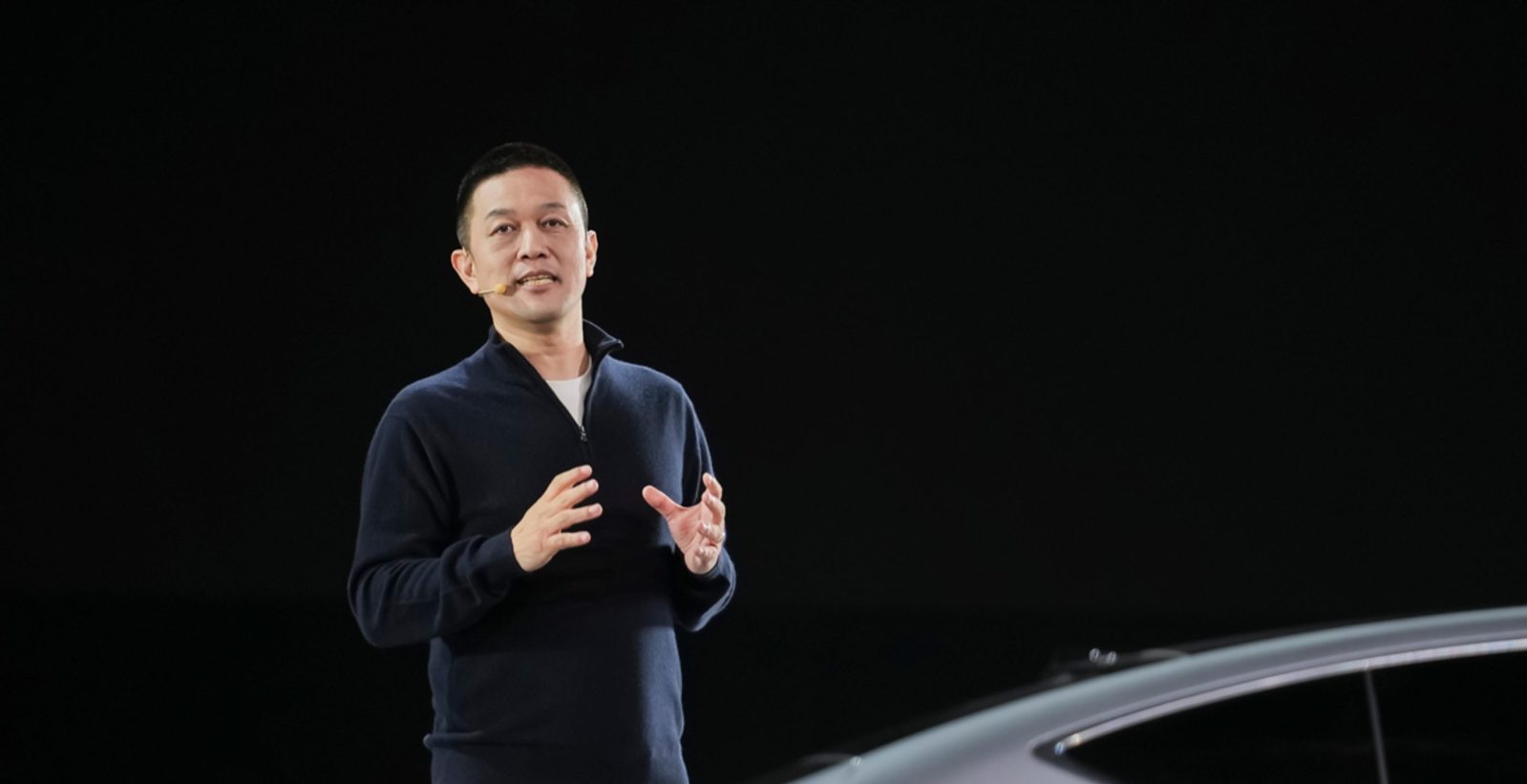

Nio founder and CEO William Li said investors and employees exert pressure on the company and that the EV maker may impose pressure on itself, risking the loss of its determination.
Li made the remarks at a science and innovation forum in Shanghai on Saturday, ten days before the company reports second-quarter results on September 1.
Nio‘s chief said the company sometimes faces temptations and setbacks, that “investors and employees will exert pressure,” and that Nio may impose pressure on itself and risk losing its determination.
“Investors and employees will exert pressure, and we may even impose pressure on ourselves, and risk losing our determination,” the founder said, according to Yicai Global, which reported his remarks in English translation.
Nio‘s US-listed shares are down 24.0% over the last twelve months and 93.1% from the all-time high reached in January 2021.
The comments came ten days before the company reports second-quarter results, which it said on August 20 would be published on Tuesday, September 1, before the open of US markets, with a management call at 8:00am US Eastern time.
Li also told the forum that profitability should be the ultimate measure of a technology-driven company’s value.
He then said Nio‘s biggest milestone last year was not profitability, but its services and community revenue passing 10 billion yuan ($1.49 billion) for the first time.
Nio Inc. is targeting between 456,000 and 489,000 deliveries in 2026, a range Li has framed as roughly 40% to 50% growth on the 326,028 vehicles delivered last year.
The group delivered 227,057 vehicles in the seven months to July 31, up 68.0% year on year, leaving it at 49.8% of the lower bound and 46.4% of the upper with five months remaining.
The Financial Record
Nio posted the first quarterly net profit in its history in the fourth quarter of 2025, at 282.7 million yuan, on record deliveries of 124,807 vehicles and revenue of 34.65 billion yuan.
The company slipped back to a net loss of 332.1 million yuan in the first quarter of 2026, while remaining profitable on an adjusted basis at 43.5 million yuan excluding share-based compensation.
Adjusted profit from operations was 66.8 million yuan, down from 1.25 billion yuan in the fourth quarter.
First-quarter revenue rose 112.2% to 25.53 billion yuan on deliveries of 83,465 vehicles, up 98.3%. Gross margin reached 19.0%, a four-year high, against 7.6% a year earlier.
Research and development (R&D) spending fell 40.7% to 1.9 billion yuan and selling, general and administrative expenses fell 20.5% to 3.5 billion yuan.
Cash and equivalents stood at 48.2 billion yuan at the end of March, and net current assets turned positive.
Second-quarter deliveries reached 107,658 vehicles, up 49.4% year on year, taking first-half deliveries to 191,123, an increase of 67.4%. The third-generation ES8 accounted for 33,474 of the quarter’s total and the ES9, launched on May 28, for 11,703.
The distinction between the two profitability measures is the context for Li’s remark. Nio has recorded one GAAP profit in its history and two consecutive adjusted-profit quarters.
Services Revenue
Nio‘s services and community segment covers after-sales work, battery swapping, charging and upgrades, Nio Life merchandise, used-car operations, insurance, financing and technology exports.
The segment grew 41% in 2025 to 10.6 billion yuan and reached full-year profitability.
Other sales margin reached 20.6% in the first quarter, a four-year high, which management attributed to services and community businesses scaling without one-off effects.
Li said that within the automotive value chain, vehicle sales are only one segment, and that the returns available across the full chain are larger than many expect.
Four Stages
In remarks reviewed by EV from a recording of the event and translated from Mandarin, Li set out four stages he said the industry is entering this year.
The first he called the cruellest stage of the finals, saying the final players in the car industry will largely be settled over the next three to five years, and that the coming one to two years will determine who keeps up and who is left behind.
The second is accelerating fully electric adoption. The third is a shift from a chaotic phase for brands to a mature one, in which buyers choose a brand before choosing a model, rather than comparing specifications until products become indistinguishable.
The fourth is a move from single-point competition to systems competition spanning research, supply chain, manufacturing, quality, sales, service and the capital markets.
Winning on one strength is no longer possible in an industry like this, Li said.
He described the contest as a marathon on a muddy road and said the next two years would show who can hold on.
Norway as the Endgame
Li pointed to Norway as the clearest indication of where the industry ends up.
New energy vehicle penetration in Norway is close to 98% and above 97%, he said, and 98% of that is pure electric.
In China, he said, only battery-electric is growing this year, with plug-in hybrids, extended-range and combustion all falling sharply and combustion retail down 40% in recent months.
Li said he had called China’s EV inflection point a year ago and that the subsequent data had borne it out.
Nio‘s own Norwegian position differs from the market Li describes.
The company’s Norwegian inventory page lists 106 vehicle configurations, and Elbilstatistikk records 211 Nio Inc. registrations in the country this year, of which 23 came in August to the 23rd.
Of those, 121 units are Nio brand vehicles, while the remaining units represent the cheaper sub-brand Firefly.
Its Norwegian unit said in June that 105 cars built for the market would arrive in July.
Across its three directly operated European Union markets, the company lists fifteen configurations, of which six are described as available.
Nio told European owners in May that no model updates would arrive until late 2027, according to an attendee at the meeting told EV. Its Norwegian unit said in June that media coverage had given an unnuanced picture of its European operations.