
Nio founder William Li told the company’s staff on Tuesday that its task for the next three years is “focus on the core business, focus on the premium segment, focus on core markets,” that Nio will stay out of humanoid robotics except as an investor, and that a “heavyweight new car” is coming next year, in an internal address reported by Leiphone on Wednesday.
The speech, delivered on the afternoon of September 8 to all employees, came a week after second-quarter results that missed Nio’s own guidance and set off a run of analyst cuts that took the shares to their lowest of the year.
Li did not mention the results, the third-quarter outlook or the share price.
Nio’s US-listed shares were trading at $3.81 as of publication time, near the 13-month low. Since its all-time high reached in early 2021 at $66.99, the stock price has plummeted 94.3%.
He spoke instead about a market in “the most brutal stage of the final round,” a company he said is growing against it, and a battery-electric transition he expects to accelerate.
“The room we have to grow is still enormous,” Li said.
Robotics Push
Asked in the question-and-answer session about carmakers moving into embodied AI, as XPeng and Xiaomi have, Li said Nio would take part “only through strategic investment” for a fairly long time and would not make robotics a main business.
“There are a great many start-ups in this industry,” he said. “We are willing to explore it by working with start-ups.”
NIO Capital, the investment firm in which Li is a managing partner, led an angel round in Acorn Robot in August and invested in Dexmal and LimX Dynamics in 2025.
On product cadence, Li said the launch rhythm “no longer bunches many cars together as before” and is “now better paced,” and that a heavyweight model would arrive in 2027. He gave no name or segment.
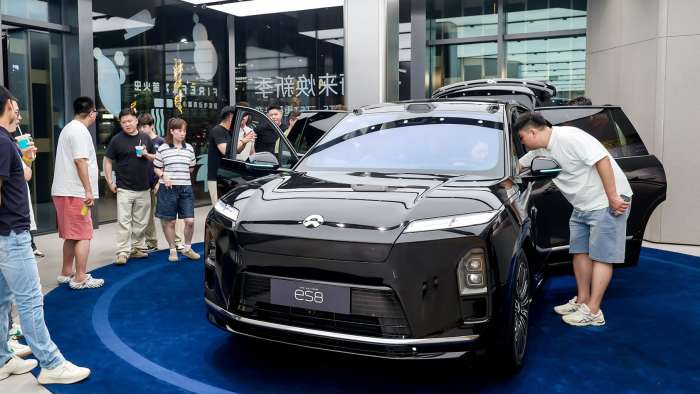
Nio’s 2026 launches have been the ES9 in May, the five-seat ES8 in July and the Onvo L80 and L90.
The Numbers
Li put Nio’s January–August deliveries at 262,893, up 57.9%, against a Chinese passenger-car market down 20.5% over the same months and, he said, widening its decline in August. “Our counter-trend growth came from everyone’s all-out effort.”
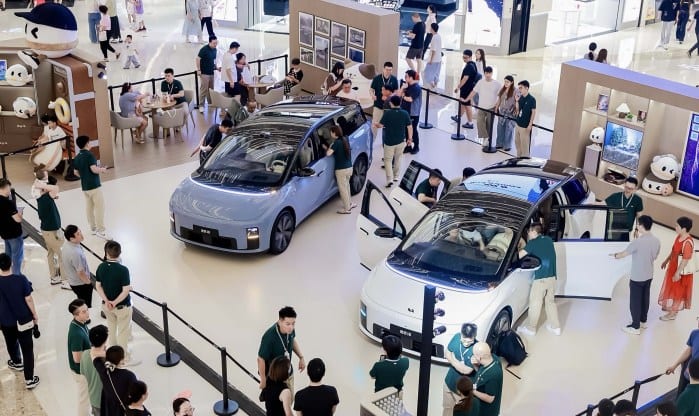
On pricing, he said the Nio brand was “consistently No. 1 in the market above 400,000 yuan” in the first half, with an average selling price above 430,000 yuan in July, “close to 440,000.” Onvo’s average, he said, is 240,000 yuan, “just 20,000 less than Audi and higher than Cadillac.”
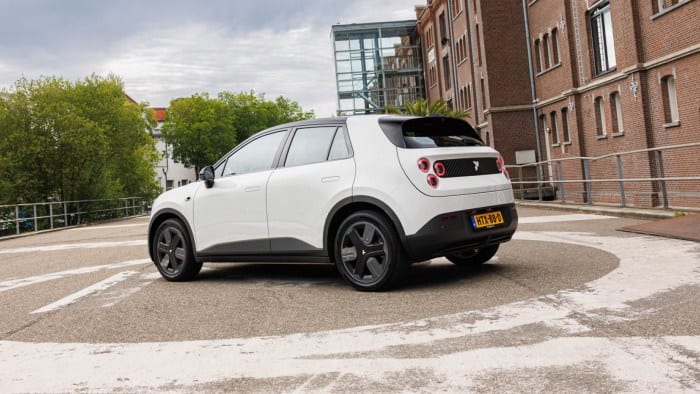
Firefly “holds close to 70% of the premium small-car market. MINI and smart combined have only half our share.”
On profitability, Li cited “three consecutive profitable quarters” since the fourth quarter of 2025, a vehicle gross margin “around 18.5%” despite raw-material costs that “have risen sharply this year,” and a service and community business with a gross margin of 17 to 18%, “exceeding 20% in some quarters,” whose profit “can now cover our investment in charging and swapping infrastructure.”
Nio’s profitability claim rests on adjusted operating profit, 206.9 million yuan in the second quarter. On a GAAP basis the company lost 528 million yuan in the quarter.
On the flagships, Li said the ES8 “is expected to deliver more than 150,000 units in a year, at an average price of 400,000-plus yuan,” and that the ES9 order book “still has a three-month wait.” He said the Onvo L90 and L80 “are also among the top few in market share in their segments.”
The BEV Argument
Li built the speech’s central claim on the CPCA’s August data. NEV penetration reached 65.2% and battery-electric penetration 45.3%, “the only powertrain still growing,” with pure combustion sales down 45% and extended-range and plug-in hybrids also falling.
“In August BEV sales were 8.6 times EREV sales,” he said, and swap-capable BEVs “grew fastest, up nearly 60% year on year.”
He restated the thesis he set out at the ES8 launch on August 21, 2025, that “the golden age of the EREV large three-row SUV is over, and the era of the BEV large three-row SUV is arriving,” and argued that “the experience gains BEVs bring users now far outweigh the experience losses from inconvenient charging and swapping.”
Li cited more than 4,000 Nio swap stations, over 5 million public chargers and 25 million including private ones. “Once the trend takes hold it is irreversible,” he stated.
On forecasts, Nio’s founder said NEV penetration “could very likely break 70%” in the fourth quarter, monthly BEV penetration “has a chance to keep setting new highs, and exceeding 50% is possible” before year-end.
By 2030, he expects “90% of new car sales will be NEVs, and 90% of NEVs will be BEVs,” possibly earlier.
The CPCA’s own August review describes the record NEV penetration as the product of a collapsing combustion market rather than growing NEV volume: NEV retail fell 10.1% in August while combustion retail fell 40%.
Li’s figures are the same data read from the BEV side, where the CPCA’s wholesale split shows BEVs up 25.9% year on year at 68.3% of NEVs while plug-in hybrids gained 3.1% and extended-range vehicles fell 10.9%.
Brand and System
Li argued that the NEV market is moving from “a period of brand chaos” to one in which brand decides purchases, citing a McKinsey survey in which brand rose from the fifth factor to the second for NEV buyers this year.
“BBA owners are the main source of ES8 and ES9 sales this year,” he said, referring to BMW, Mercedes-Benz and Audi. Onvo, he said, draws buyers of “high-end Toyota and Volkswagen products,” and Firefly is “the safest small car,” first in China’s C-IASI and the latest European crash tests.
“The car I drive to take my child to school in the morning is a Firefly,” he revealed.
The speech closed on discipline. “The auto industry is a marathon on a muddy road,” Li said.
“Save the money that should be saved, spend the money that should be spent, and keep careful accounts,” and “keep deepening the CBU mechanism,” the cost-accounting system under which each department answers for its spending.
What He Did Not Address
Nio guided third-quarter deliveries to 108,000 to 111,000 against 107,658 in the second, a forecast Goldman Sachs found 12% below its own and that prompted JPMorgan’s downgrade to Neutral with a $4.50 target and cuts from Citi, Bank of America, Bernstein, Freedom Broker, Macquarie and Goldman in four days.
Li’s full-year target of 456,000 to 489,000 deliveries now requires 48,277 a month for four months, above the group’s best month ever.
Onvo delivered 8,810 in August against 11,743 in June, and Bernstein and Goldman both named the brand’s weakness in their notes. Exports were 181 in August, a 2026 high but below 2025 levels. None of those appeared in the speech.
Li had addressed the investor side four days earlier. “It is difficult to convince investors,” he said on September 4, as EV reported. “Many people simply lack imagination about the business we are in.”