
Gartner’s 2026 Digital Automaker Index ranked Tesla and four Chinese automakers in the top five for a second consecutive year, reinforcing a divide between software-driven companies and legacy manufacturers struggling to keep pace.
US EV startups Rivian and Lucid ranked sixth and seventh, respectively.
The research firm called the findings “a wake-up call” for traditional manufacturers, which fell further behind digital-native rivals despite heavy technology spending, according to Automotive News.
No legacy automaker cracked the top three in any of the index’s nine scoring categories, and no European legacy automaker placed in the top 10.
The index, now in its fourth year, assesses 24 global automakers on their preparedness to maximize the business benefit of their vehicle technology across categories including connectivity, vehicle architecture, electrification, autonomy, talent, and — for the first time this year — artificial intelligence.
Tesla led the ranking at 82.7%, up from 79.3% in 2025.
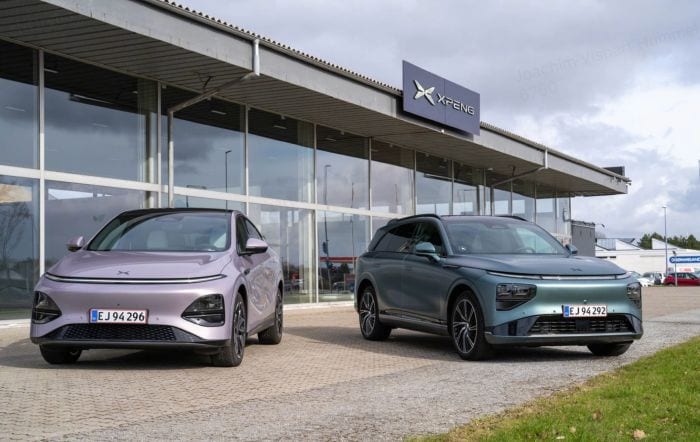
The Elon Musk-led company was followed by four Chinese brands: EV makers Nio and Xiaomi held second and third place at 73.1% and 69.2%, respectively, while carmakers XPeng and Li Auto ranked 57.7% and 57.0%.
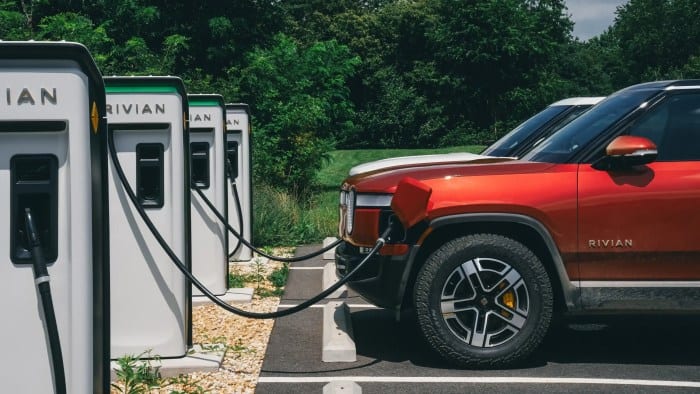
Rivian rounded out the top six at 55.5%.
Below 50%, but still in the top 10, US EV maker Lucid ranked seventh at 45.3%, BYD eighth at 43.6%, Geely ninth at 41.1% and Hyundai–Kia 10th at 37.5%.
Mercedes-Benz, the highest-scoring European automaker, placed 11th at 35.8%.
Under the tougher 2026 criteria, however, its score fell to 35.8% from 37.0% in 2025 — a 47-point gap behind Tesla and a 37-point gap behind Nio.
Volkswagen dropped to 16th at 29.5%. BMW fell to 14th at 30.9%. Stellantis tumbled five positions to 22nd at 23.0%.
Legacy Automakers Absence
The gap between digital natives and traditional manufacturers is stark across all nine dimensions.
None of the legacy automakers ranked in the top three in any individual category, according to Gartner’s category-level breakdown.
Gartner deliberately raised the bar for its 2026 evaluation, adding AI as a standalone scoring category and replacing several binary checks — whether an automaker had a given technology — with measures of how broadly that technology is deployed across model lines and markets.
The methodological shift drove down scores for nearly every automaker evaluated, but it widened the gap between digital-native companies and legacy players rather than narrowing it.
“Moreover, the DAI is also more focused on AI, precisely because it has become a main competitive battleground for OEMs,” Gartner’s VP of Research Pedro Pacheco wrote on his LinkedIn. “As part of this focus, DAI now has a new category that ranks automakers on their level of AI focus.”
Zonal architecture, 5G connectivity and over-the-air update capability no longer distinguish leaders from the rest of the pack. What matters now is the depth of deployment across an automaker’s full portfolio.
BMW, for example, dropped one position to 14th place despite unveiling its ‘Neue Klasse’ platform — an 800-volt, EV-only architecture with a redesigned digital cockpit — because the index measures how broadly advanced technology penetrates an automaker’s model lineup, not whether a single flagship demonstrates it.
Categories Rankings
Tesla led outright in five of nine categories: overall, culture and leadership, talent, electrification, and AI.
Rivian tied with Tesla for first in vehicle electrical and electronic architecture and took top marks in both tech experience and online presence.
Nio placed second in overall score, culture and leadership, connected vehicle, and tech experience.
XPeng ranked second in both talent and vehicle E/E architecture, and third in AI.
Xiaomi placed second in AI and autonomy, and third in overall score, culture and leadership, electrification, and connected vehicle. Li Auto ranked second in autonomy.
The results reflect years of software-first investment by these companies.
Nio operates its proprietary SkyOS full-vehicle operating system — an AI-oriented platform that integrates cockpit, vehicle control, autonomous driving, digital services, connectivity and platform management across its entire product range, including the Onvo and Firefly sub-brands.
XPeng has built its second-generation Vision-Language-Action autonomous driving architecture in-house, with VLA 2.0 representing what the company calls the first physical-AI system with foundational Level 4 capabilities.
Rivian recently confirmed plans to unify its software stack across its R1 and R2 platforms under RivianOS 2.0, and its software architecture underpins the $5.8 billion joint venture with Volkswagen Group.
AI as a Key Differentiator
The addition of AI as a scoring category highlights what Gartner sees as the next frontier.
Tesla led the AI category, followed by Xiaomi and XPeng.
The category rewards automakers that build AI capabilities internally and reuse them across vehicles, autonomy systems, robotics and potentially other product lines, Pacheco said.
The index also evaluates whether an automaker’s AI leadership exercises real technical expertise and executive authority, rather than simply holding a title.
Off-the-shelf technology tends toward parity among competitors, Pacheco noted, because any rival can buy the same solution from the same supplier.
“When you buy technology from a vendor then any of your competitors can do the same,” he told the outlet, “but if you develop the technology in-house you have the chance of being better than the competition and differentiating yourself from the competition.”
Tesla and XPeng hold a competitive advantage in this regard, according to the research expert, as both develop foundation models in-house for ADAS.