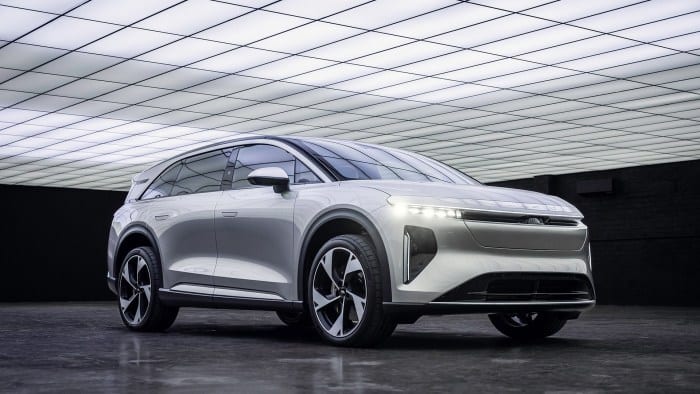
Chinese automaker XPeng unveiled and opened pre-orders on Wednesday for its flagship six-seat model, the GX — the brand’s first luxury SUV and the most expensive model in its lineup.
Available as both a battery electric vehicle (BEV) and an extended-range electric vehicle (EREV), both variants have a pre-sale price of 399,800 yuan — equivalent to $58,600.
The launch price comes in below the 400,000-to-500,000-yuan range that industry observers had estimated when the model was first unveiled in February.
The extended-range variant pairs a 1.5-liter range extender with a dual-motor setup, delivering 430 km of electric range and 1,585 km combined on the CLTC cycle.
The pure-electric variant uses an 800V silicon-carbide platform, supports 5C ultra-fast charging, and offers up to 750 km of CLTC range.
The model is built at XPeng‘s Guangzhou plant, where it entered series production last month.
Display vehicles will gradually arrive at dealerships nationwide starting next Saturday (April 18), the company announced.
Buyers who place a 1,000-yuan refundable deposit before the official on-sale date are eligible for limited-time benefits.
The deposit includes the deposit being credited as 5,000 yuan off the final price, complimentary Canyon Gray exterior paint valued at 6,000 yuan, and a complimentary Misty Forest Purple interior valued at 3,000 yuan.
SEPA 3.0
The GX is built on the brand’s latest SEPA (Smart Electric Platform Architecture) 3.0 physical AI vehicle architecture.
The most recently launched X9 MPV, the new P7+ sedan, and the G7 mid-sized SUV were still built under SEPA 2.0.
Founder and CEO He Xiaopeng said earlier this year that the GX was developed to resolve what he described as the “impossible triangle” of three-row SUVs — the trade-off between comfort, space, and handling.
The Chief Executive previously said that the model would be the first under XPeng to support L4-level hardware and software capabilities.
Specs
The GX measures 5,265 mm in length, 1,999 mm in width, and 1,800 mm in height, with a 3,115 mm wheelbase.
Five exterior colors are offered, including Everest White, Polar Black, Canyon Gray, Danxia Red, and Cloud Desert Gold in matte finish.
Customers can also pick from Platinum Brown, Dawn White, and Misty Forest Purple for the interior.
The brand has collaborated with Huawei to add DLP projection headlights that support interactive ground projection — similar to what Nio did with the ES9 SUV.
The system extends the XPeng-Huawei partnership that previously produced the “Light Chaser Panorama” AR-HUD launched on the G7 last year.
Display hardware includes an 88-inch AR-HUD — likely an evolution from the co-developed 87-inch system —, a 17.3-inch 3K central touchscreen running at 120 Hz, and a 21.4-inch 3K ceiling-mounted screen.
The cabin uses a 2+2+2 six-seat layout. Front and second-row passengers get zero-gravity seats.
The third row reclines from 0° to 180° and folds electrically, expanding cargo capacity from 673 L to 1,748 L. The pure-electric version also adds a 109 L front trunk.
Smart Driving, AI and Safety
XPeng said the GX is designed to L4 autonomous driving standards, powered by four in-house Turing chips delivering 3,000 TOPS of computing power.
The system is vision-only, with no LiDAR, and runs the company’s VLA and VLM large models — the same software stack that, according to an internal memo cited in February, Volkswagen Group will adopt for its own vehicles.
Active safety functions include AEB operating up to 150 km/h and AES emergency steering up to 130 km/h, with snow-and-ice AES support.
A driver-incapacitation system can identify an unresponsive driver in highway-assist scenarios and autonomously navigate to an emergency parking zone to call for help.
The GX uses a 16,000-ton integrated die-cast body structure and carries 11 airbags, including full-length side curtains.
XPeng describes the safety package as “aviation-grade six-fold redundancy,” covering steering, braking, drive, communication, power supply, and door unlocking.
Market Position
The GX enters one of the most competitive segments in the Chinese new-energy vehicle market, going up against the new-generation Nio ES8 and the larger Nio ES9 — which was unveiled late last week.
The ES9 — currently China’s largest fully electric SUV, at 5,365 mm in length — opened pre-sales with three trims, with prices beginning at 528,000 yuan ($77,200).
The price lowers to 420,000 yuan ($61,600) under Nio‘s Battery as a Service scheme.
All three variants share a 520 kW dual-motor powertrain, a 900V architecture, and a 102 kWh CATL battery delivering up to 620 km of CLTC range.
Other rivals include the Onvo L90, the Tesla Model Y L, and the Zeekr 9X and 8X SUVs.
XPeng is counting on the GX to help it hit its 2026 delivery target of between 550,000 and 600,000 vehicles — a 28.1% to 39.7% increase from the 429,445 vehicles delivered last year — after a softer-than-expected start to the year.
The Guangzhou-based automaker delivered 62,682 vehicles in the first quarter, a 33.3% plunge from the same period in 2025 and the first year-over-year quarterly decline since the second quarter of 2023.
The figures landed within the company’s previously issued guidance range of 61,000 to 66,000 units, but represent just 10.4% to 11.4% of the full-year target.
Reduced incentives in China and a longer-than-usual Chinese New Year holiday weighed on the broader industry, with February deliveries of 15,256 marking XPeng‘s lowest result since August 2024.
The results prompted Barclays and Macquarie to cut their price targets on the company’s US-listed shares in March.
Outlook
In its latest earnings call, the company laid out a 2026 roadmap built around seven new model launches, a doubling of overseas deliveries, and AI R&D spending rising to 7 billion yuan from 4.5 billion yuan last year.
XPeng reported its first-ever quarterly net profit in the fourth quarter of 2025, with gross margin reaching a record 21.3%.
The company is also targeting 1 million annual overseas sales by 2030 and preparing to launch three robotaxi models — a 5-, 6- and 7-seater — with manned pilot operations starting in the second half of the year and fully driverless operation targeted for early 2027.
Chinese media outlet Gasgoo reported last week that the Robotaxi version of the GX has secured a road testing license for intelligent connected vehicles in Guangzhou.