
China’s main state broadcaster reported over the weekend how heavy and wide the country’s cars have become, in a report that landed as Beijing enforces its first mandatory limits on electric-vehicle energy use.
China Central Television (CCTV) said on June 7 that the average passenger car now weighs far more than a decade ago, that many models have outgrown the parking spaces built for them, and that bigger batteries and a race to add features are largely to blame.
CCTV is China’s main state broadcaster, and the report aired with the new energy rules already in force.
Cars That Gained a Third of Their Weight
The average passenger car in China weighed 1,704 kilograms in 2024, up from 1,312 kilograms in 2012 — a gain of 392 kilograms, CCTV said.
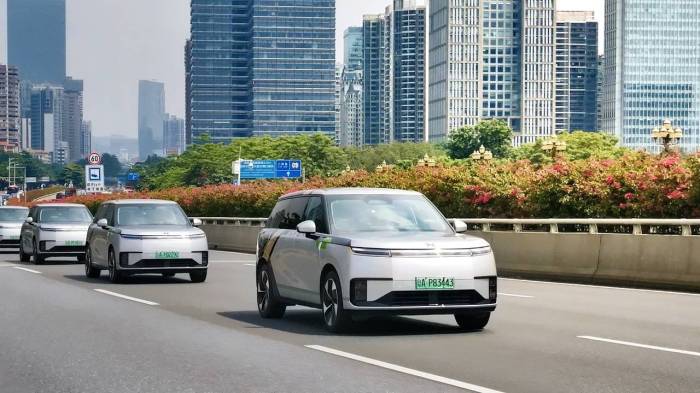
Cars have also grown wider, the broadcaster said, with many popular sport utility vehicles and multipurpose vehicles now approaching or exceeding two metres across.
The trend is straining infrastructure built for smaller cars. CCTV measured one model at nearly 2.3 metres wide, against a standard parking-space width of 2.4 metres.
Technology outlet IT之家 illustrated the shift with the Xiaomi SU7, which at 1,963 millimetres is wider than a Mercedes-Benz S-Class or Maybach S.
A sedan priced around 200,000 yuan now out-measures cars worth several times as much, breaking the old link between size and price.
China’s parking codes set a perpendicular reverse-in space at 2.4 metres wide and parallel spaces at 2.1 metres, dimensions drawn up for a smaller generation of cars.
New Launches Run Past 5.2 Metres
The growth has carried into this year. Three new models longer than 5.2 metres — about 205 inches, or 17 feet — have gone on sale in China over the last few months.
The Leapmotor D19 went on sale on April 16. The SGMW Huajing S, sold as the Wuling or Baojun Xingguang L, followed on May 8 at 5,235 millimetres, or 206 inches.
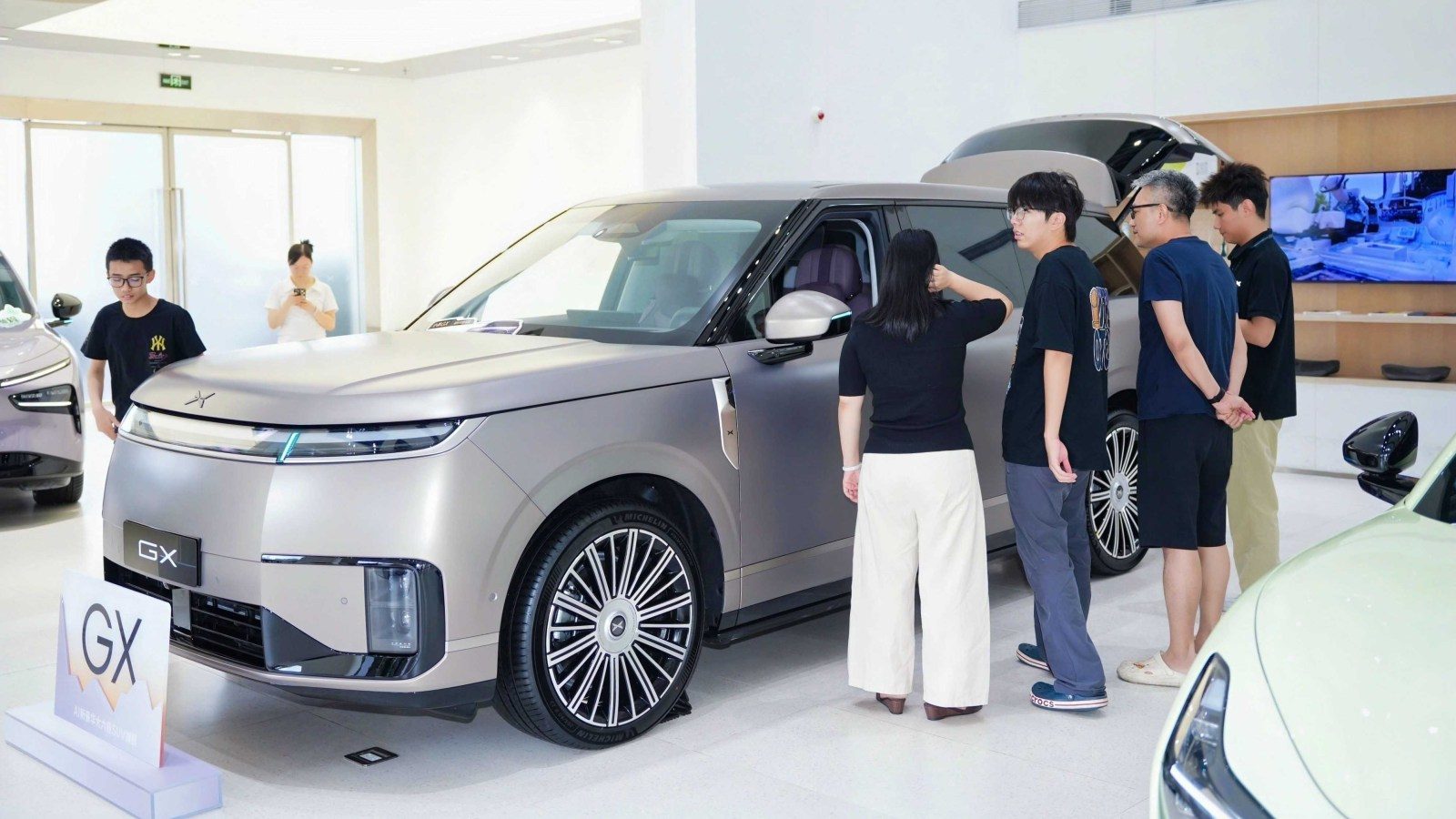
The XPeng GX arrived on May 20 at 5,265 millimetres (207 inches) while China’s largest fully electric SUV ES9 was launched by the Shanghai-headquartered brand Nio.
A fourth, BYD’s Datang at more than 5.26 metres, or 207 inches, opened pre-sales in April but is not due to go on sale until mid-June, leaving it off the market as of June 8.
The Battery Arms Race
The added weight starts with the battery, according to the report.
Some manufacturers fit packs that push single-charge range toward 1,000 kilometres, and those packs can weigh as much as 800 kilograms, experts cited by CCTV said.
Pan Helin, a member of the Ministry of Industry and Information Technology’s expert committee, attributed most of the gain to the limited energy density of current lithium iron phosphate and ternary lithium cells, which forces automakers to add mass to secure range.
Mainstream family electric vehicles carry packs of 500 to 650 kilograms, rising to 700 to 800 kilograms on long-range versions, before the weight of motors, power electronics and underbody battery protection.
CCTV said automakers have added comfort and lifestyle features to stand out in a crowded market, with some models marketed as mobile living spaces for working, watching video, drinking coffee and resting, and a few fitted with in-car toilets.
A Mandatory Standard Already in Force
Beijing has already moved to curb the trend.
China enforced GB 36980.1-2025 on the first day of 2026, the world’s first mandatory energy-consumption standard for electric cars, barring new battery-electric passenger models that miss the limits from being produced, sold or registered.
The rule caps a car of about two tonnes at 15.1 kilowatt-hours per 100 kilometres on the domestic CLTC cycle, about 11% tighter than the recommended framework it replaced.
It applies to M1 battery-electric cars with a maximum design mass up to 3,500 kilograms and excludes plug-in hybrids and extended-range models.
The standard sets limits by curb weight, with the inflection points moved from the previous 750 and 2,510 kilograms to 1,090 and 2,710 kilograms.
A separate purchase-tax rule works the same way.
Battery-electric cars above 2,710 kilograms must hold consumption under 19.1 kilowatt-hours per 100 kilometres to keep the half-rate tax break.
Most new models already comply. A tally by Auto Business Review found nearly all of 30 mainstream electric vehicles launched this year met the limits.
The exceptions, by that count, were the 2024 Tesla Model 3 Performance all-wheel drive and the 2024 Lotus Eletre L+.
Existing approved models have until the 25th month after the rule took effect to comply, with about 10% of laggards expected to be phased out.
State Media and the Scale at Stake
CCTV cited industry estimates that cutting 100 kilograms of mass lowers electricity consumption by about 7.5% per 100 kilometres, alongside lighter wear on tyres and brakes and less road damage.
The China Society of Automotive Engineers forecast on June 3 that new-energy vehicles will exceed 70% of new passenger-car sales by 2030, which would place the efficiency limits over most of the market.
Hou Fushen, the society’s Vice Chairman and Secretary-General, described the next five years as a shift from scale expansion to high-quality development.
Former Ministry of Industry and Information Technology Vice-Minister Su Bo has made a similar forecast, expecting domestic new-energy penetration above 70% by 2030.
China also plans to extend the standards as separate energy-consumption limits for light and heavy commercial battery-electric vehicles are due under the same GB 36980 series.