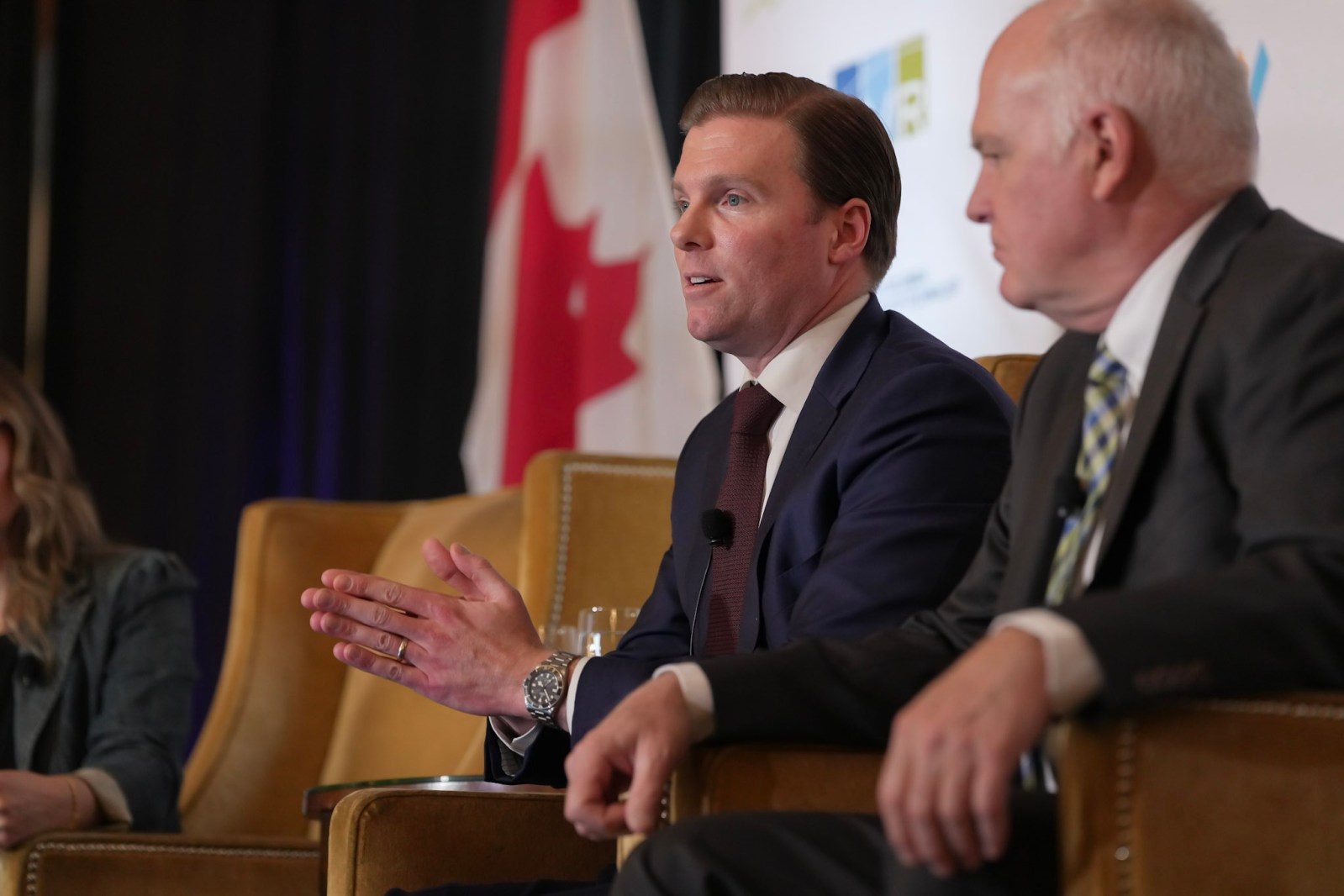

The Canadian Vehicle Manufacturers’ Association (CVMA) President Brian Kingston warned this week that Chinese automakers benefit from “weak or non-existent labour rights” that suppress wages and distort global competition.
The President’s testimony centered on the January agreement that reversed the 100% surtax on Chinese-made EVs and replaced it with a 6.1% tariff on an annual quota of 49,000 vehicles.
Kingston delivered testimony that framed the Canada-China EV trade deal as a threat to the country’s auto sector on four fronts — from unfair competition and security risks to regulatory contradictions and US misalignment.
The auto lobby representative spoke before the House of Commons’ Standing Committee on Science and Research, in a session focused on the ‘Implications of the Canada-China Preliminary Joint Arrangement on Canada’s Electric Vehicle Sector.’
“The CVMA is concerned with the Canada-China agreement that reversed the China surtax order and allows 49,000 Chinese vehicles into the market,” Kingston said. “That’s equivalent to 30% of the total number of EVs sold in Canada last year, a significant number.”
The association represents Ford, General Motors and Stellantis in Canada.
Kingston described its members as “the largest employers, investors, and innovators in the auto manufacturing sector in Canada,” noting they have built over 100 million vehicles since 1945.
Level Playing Field
Kingston’s sharpest language targeted Chinese labor standards, which he described as a structural cost advantage distorting global competition.
“Chinese manufacturers have a cost advantage due to weak or non-existent labour rights that have suppressed wages and artificially lower the cost of production,” he said.
He cited Reuters‘ analysis estimating that the hourly wage at 30 Chinese auto companies ranges between 14 yuan ($1.93) and 31 yuan ($4.50).
By comparison, CVMA members pay unionized production assemblers an average hourly wage of C$44.52 ($32.51), plus pensions and benefits.
The wage disparity has been a recurring theme in the global EV debate.
BYD paid an average of approximately $21,400 per employee in total compensation in 2025, a figure roughly two to six times lower than entry-level pay at Rivian, Tesla and Lucid plants in the United States.
CVMA’s President also pointed to what he called China’s state-directed industrial policy, which he said had delivered subsidies totaling $230 billion between 2009 and 2023.
BYD alone received 12.5 billion yuan in government subsidies in 2025, according to its annual report.
“Today, domestic EV manufacturing capacity exceeds demand by three times, with the surplus product exported and in many instances dumped in markets abroad,” Kingston said.
He added that Chinese vehicle exports grew from one million units in 2020 to six million in 2024 and are on track to reach nine million by 2030.
The labor argument carries additional weight in Canada following recent forced labor allegations against BYD at its factory construction sites in Brazil and Hungary.
Earlier this month, Kingston called those reports “deeply concerning” and said they reinforced the case against Chinese automaker entry into Canada.
Subsidy Question
Not all industry voices share the CVMA’s framing of the subsidy question.
Daniel Breton, representing Electric Mobility Canada, pushed back on the premise that Chinese state support is uniquely distortive.
“What I find concerning is when some people say that the Chinese manufacturers have been subsidizing significantly their auto manufacturing facilities and their capacities,” Breton said. “If you go back years ago, Japan was subsidizing significantly the auto manufacturing to help them come into Canada, the US.”
He also noted that the US “has been subsidizing significantly their auto industry for decades.”
“When I see a country like China subsidizing significantly their auto industry, to me, this is just– they’re doing what the Japanese, the Europeans, the South Koreans and the Americans have done,” he added.
When pressed by a committee member on whether Chinese and Canadian manufacturers are competing on a level playing field given the wage and benefits gap, Breton shifted the focus to structural changes already reshaping Canada’s auto sector.
“The truth is that the future of the industry is not going to be so much on wages, and we are losing jobs in Canada and it has nothing to do with Chinese cars or Chinese manufacturing,” he said.
Breton pointed to legacy automakers’ own production decisions as the primary driver of job losses.
He said GM and Stellantis have reduced their Canadian manufacturing by 80% over the past 20 years — well before Chinese EVs entered the picture.
“Within the EV industry, while we have been losing jobs in the legacy auto industry, we’ve been creating tens of thousands of jobs in the past 15 years,” Breton said. “This is a shift from traditional jobs to new jobs and infrastructure upstream and downstream.”
Security and Connected Vehicles
Kingston also raised national security concerns, pointing to Canada’s 2024 commitment to banning Chinese connected vehicle software and hardware.
“The Canada-China agreement is incompatible with this commitment,” he said. “Clarity is needed on the federal government’s position on the risks posed by Chinese connected vehicles to Canadian drivers.”
The US has maintained its ban on Chinese-linked software and hardware in connected vehicles.
US Trade Representative Jamieson Greer said earlier this month that those rules are “effective” and the Trump administration does not intend to soften them.
Data security concerns have also surfaced among Canadian consumers.
An AutoTrader survey of 1,761 Canadians found that 50% of those interested in Chinese EVs had reservations about how data is collected and stored.
EV Mandate and Compliance Credits
Kingston also flagged what he described as a regulatory contradiction between the China deal and the federal government’s handling of its EV mandate.
“The federal government announced three months ago that the EV mandate would be repealed,” the CMVA President said.
“In September of last year, the federal government announced that the 2026 model year targets would be paused,” he said, adding that “despite these announcements, nothing has happened. The mandate remains in place today.”
Prime Minister Mark Carney announced in February that the government would scrap the Electric Vehicle Availability Standard, replacing it with emissions standards and a C$2.3 billion EV Affordability Program.
Kingston warned that as long as the mandate technically remains in force, Chinese OEMs could exploit it.
“Under the EV mandate, Chinese OEMs could earn up to $980 million per year selling compliance credits,” he said. “This is an incomprehensible outcome at a time when manufacturers are already under significant pressure from US tariffs.”
US Alignment and CUSMA
The CVMA’s final argument centered on Canada’s relationship with its largest trading partner — the United States.
“The CVMA strongly supported the federal government’s China Surtax order that levied that 100% tariff on Chinese manufactured EVs because we must align ourselves with the US approach to China,” he said.
The CVMA had backed the Conservative Party’s auto pact, which proposed scrapping the Chinese EV quota, banning Chinese-connected vehicle software and aligning tariffs with the US.
That plan was rejected in the House of Commons last month.
Kingston warned that the stakes extend beyond the auto sector, as the July review of the CUSMA trade agreement approaches.
The process that will determine whether the deal is extended, renegotiated or allowed to expire.
“We cannot be out of step with our largest trading partner on China as we approach a very sensitive time with respect to the review of our CUSMA agreement,” Kingston said.
“There is simply too much at stake for the auto industry and the broader Canadian economy if we are perceived by Washington as being out of step and misaligned on how to deal with China,” he added.
His testimony came days after Canada’s International Trade Minister Maninder Sidhu met with BYD, XPeng and GAC executives in Guangzhou — a visit Sidhu described as part of Canada’s effort to work with “global partners” on affordable EVs.