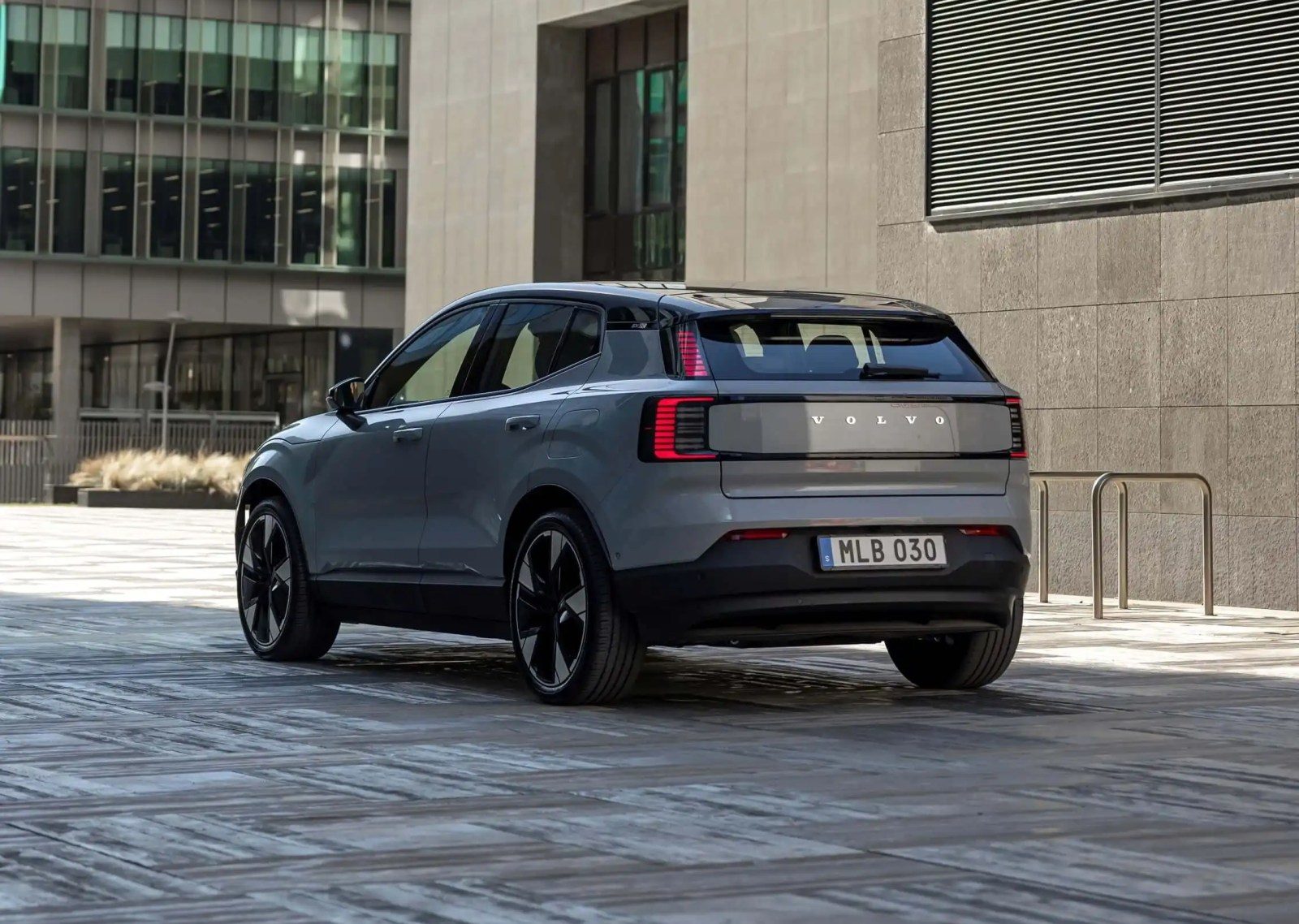

Volvo has begun rolling out an over-the-air update that lets the EX30 supply electricity from its traction battery to external devices, delivering on the last day of its own timetable a feature it promised in February.
The Geely-backed brand says the free update will reach new and existing EX30 owners over the coming weeks.
Vehicle-to-Load is not available on EX30s in the United States, Canada, Mexico, South Korea, Taiwan or Japan.
The rollout covers markets across Europe, the Middle East and Africa, the Asia-Pacific region and Latin America that use the CCS2 charging standard, and Volvo warns that compatibility can still vary by vehicle configuration.
What It Does
The car can supply up to 3 kW through an adapter fitted to its external charging port. Volvo also gives a 16-amp figure, which is the rating of the socket rather than the output: 16 amps at European mains voltage would be about 3.7 kW, while 3,000 watts draws roughly 13.
That is enough for power tools, a fridge, a coffee machine, camping equipment or an electric bicycle, and it behaves like a domestic socket once connected.
Supply cuts off automatically when the battery falls below 20%, and owners can set a higher floor if they choose.
The flow runs one way. The adapter draws power out of the battery; charging the car still happens through the normal charging cable.
The Catch Is the Adapter
The adapter is sold separately and Volvo has not published a price or a date.
Its release says only that customers should speak to their local market representative or retailer for pricing and availability. Retailer listings circulating since the announcement point to availability later in the third quarter, which ends on September 30, but that is not a company figure and should not be reported as one.
So the software is live while the hardware needed to use it may not yet be on sale.
Late, Not New
The capability was announced on February 25 alongside the refreshed EX30, and Volvo was explicit at the time that it would reach existing cars.
“Several of the features will also be available to current EX30 drivers, free of charge, via over-the-air software updates,” the company said then, adding that V2L and the new interface were “planned to be provided through over-the-air software updates during summer to new and existing EX30 customers.”
The hardware was already fitted. Volvo described the EX30 in February as “hardware-ready to offer Vehicle-to-Load.”
Where 3 kW Sits
Three kilowatts is at the lower end of what the segment offers.
BYD’s Atto 3 supplies 3.3 kW, and the Hyundai Ioniq 5 and Kia EV6 both deliver 3.6 kW on the E-GMP platform. Ford’s F-150 Lightning offers up to 9.6 kW through Pro Power Onboard, though that is a full-size pickup rather than a compact SUV.
The same function is already built into the EX60, and Volvo says more models will follow.
The Rest of the Update
The update also introduces Plug and Charge, which authenticates a charging session automatically at compatible public chargers without an app or a card. That feature is narrower still: Europe only, and only on EX30s from model year 2026 onwards.
Volvo has also redesigned the settings interface, adding a side panel to group setting categories and a contextual bar that owners can customise for frequently used functions.
Those changes reach markets where V2L does not, including the United States, where Volvo has said the EX30 will be discontinued after the 2026 model year.
The Model
The EX30 was unveiled in Milan in June 2023.
Volvo does not break the model out in its annual sales tables.
Its 2025 results list the XC60 as the top-selling model at 230,655 cars, followed by the combined XC40 and EX40 at 166,920 and the XC90 at 103,217, from global sales of 710,042, down 7% on the year.
Chief Commercial Officer Erik Severinson named the EX90 and EX30 as the fully electric products behind increased deliveries.
Volvo sold 323,294 fully electric and plug-in hybrid cars in 2025, or 45.5% of its global total.