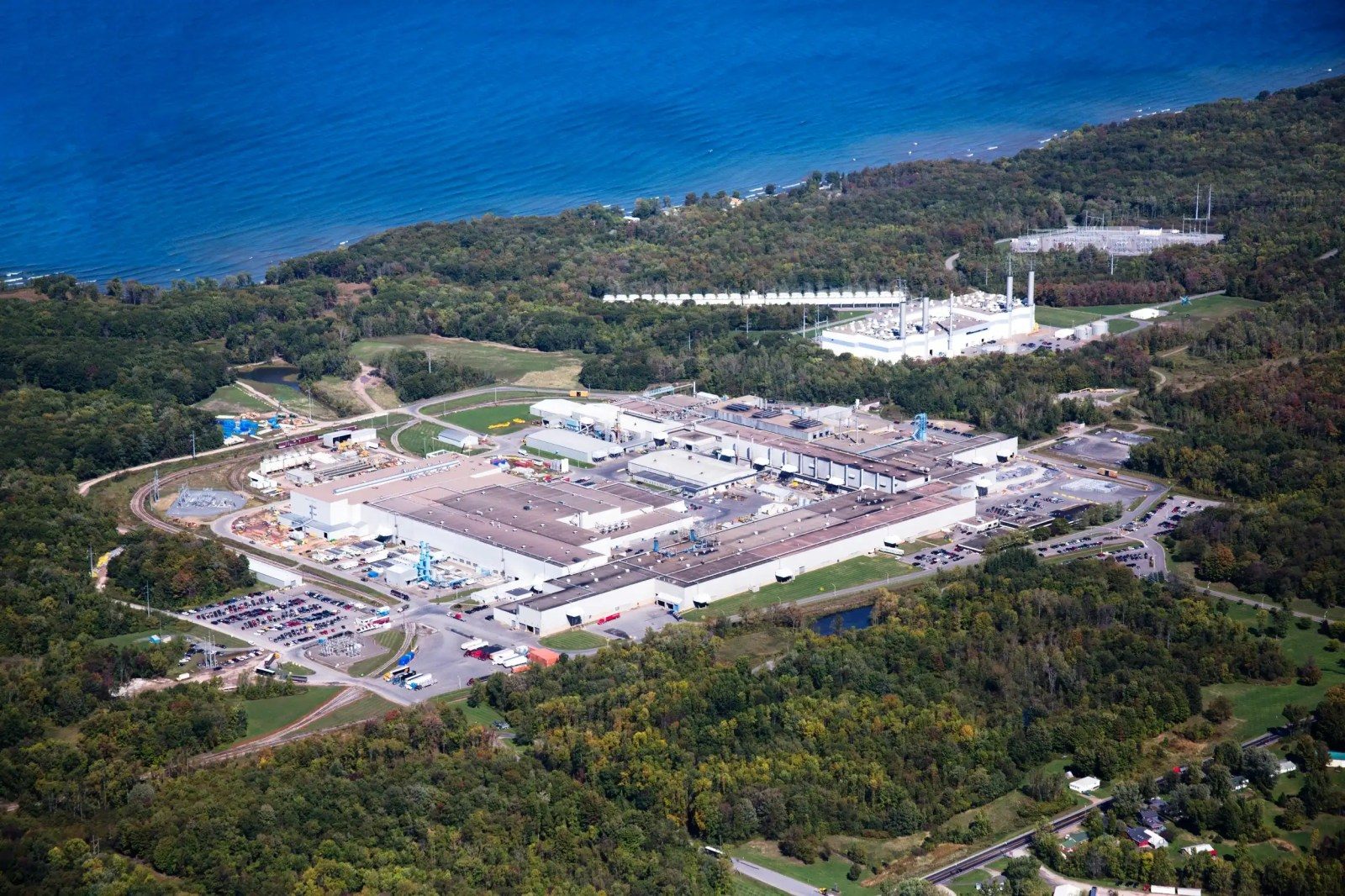

Novelis said on Wednesday that the hot mill at its Oswego, New York, rolling plant is back online, nine months after fires at the facility triggered a supply crisis across the US car industry.
The plant is the largest domestic supplier of aluminum sheet for the US automotive industry, serving about a dozen companies including Lucid, Ford, General Motors and Jeep and Ram parent Stellantis, as well as foreign automakers with US production facilities.
Wednesday’s restart also closes a chapter for Lucid, which told investors in November that “a fire at our aluminum supplier’s plant shut other OEMs down” while the EV maker “was once again able to minimize the impact.”
Lucid has never named the supplier.
However, the Oswego fires were the only major incidents at a US automotive aluminum supplier during that period — and the only ones that shut down other manufacturers — making the Novelis plant the evident subject of the company’s remarks.
Two Fires and a Nine-Month Outage
Flames first broke out on September 16 at the plant’s hot mill, the primary aluminum sheet production area, knocking the facility offline and disrupting supply for automakers across the country.
A second fire followed in November, compounding the damage and stretching the recovery timeline at a site that had supplied roughly 40% of the aluminum sheet used by US automakers, with capacity to produce 1.7 billion pounds per year.
Novelis responded by activating overseas plants in Europe, Brazil and South Korea to supply customers, though the 50% US tariff on imported aluminum added cost to every replacement ton, and industry analysts noted few domestic rolling mills had spare capacity to fill the gap.
Restarting the hot mill is “an important step forward for our operations and, most importantly, for our customers,” President and Chief Executive Officer Steve Fisher said in the statement, thanking customers for their “flexibility and partnership” during the outage.
With the mill operational, Novelis said it is working closely with customers to ramp up supply, while accelerating the implementation of a standardized operating system intended to strengthen supply reliability.
Fisher had signaled the timeline on a May 19 earnings call, saying coils would be coming off the Oswego mill within weeks to meet “pent-up” demand from the automotive and beverage packaging industries.
The Atlanta-based company, a subsidiary of India’s Hindalco Industries, is also commissioning its new $5 billion recycling and rolling plant in Bay Minette, Alabama, later this year, adding up to 600 kilotons of annual capacity.
The Fire in Lucid’s Account of 2025
Lucid‘s fullest description of the episode came at its third-quarter earnings call in November.
“Over the last six months, we have contended with three consecutive industry-wide supply chain crises: magnets, aluminum, chips,” management told investors.
“After we successfully crossed that bridge, a fire at our aluminum supplier’s plant shut other OEMs down, but we were once again able to minimize the impact,” the company said.
The statement establishes two things at once: the burned plant belonged to a Lucid supplier, and the company believes it weathered the outage far better than the manufacturers that halted production.
Then-interim CEO Marc Winterhoff returned to the list at the company’s first Investor Day on March 12, flagging additional tariffs, magnet and chip supply issues and the fires at an aluminum supplier’s plant, as the company said it was reworking its supply chain to become “even more insulated from external shocks.”
“As we all remember, 2025 was probably the worst year for the supply chain,” Winterhoff said at the event, a line he repeated days later at the Bank of America Automotive Summit while citing “fires in aluminum plants” among the year’s setbacks.
The September and November fires at Oswego were the only events matching those descriptions — no other US automotive sheet supplier suffered a comparable incident or shut down other OEMs in that window — which is the basis on which EV identifies Novelis as the supplier in Lucid‘s statements.
Five days after the Investor Day, Chief Financial Officer Taoufiq Boussaid laid out the two scenarios that worry the company, describing the 2026 production target as “conservative” partly because of supplier risk.
“I think that there are two things that we’re closely watching and monitoring,” the finance chief said, naming first “the supply chain disruptions which translate into price increases,” and second the scenario in which “you simply don’t have access to the materials that you need.”
“We simply don’t know what we don’t know. Anything can happen,” Boussaid added.
Lucid also sources aluminum sheet under a three-year supply agreement signed in January 2024 with Ma’aden Rolling Company, a subsidiary of Saudi Arabia’s state mining group, whose majority owner — the Public Investment Fund — is also Lucid‘s controlling shareholder.
A Ramp That Needs Every Ton
The restart arrives with Lucid targeting between 25,000 and 27,000 vehicles this year, up from the 17,840 it produced in 2025 — a figure the company revised down from its preliminary count after determining 538 vehicles had not completed internal validation procedures.
Boussaid has framed the 2026 goal as deliberately cautious, saying the company is “being conservative in [its] assumptions” and did not account for tailwinds such as Tesla‘s phase-out of the Model S and Model X, two direct competitors to the Air and Gravity.
The Casa Grande, Arizona, plant reached a theoretical production run rate of 2,100 units a month in the fourth quarter, against a theoretical annual capacity of 40,000 vehicles — a pace the CFO noted assumes no disruption in the supply chain.
Aluminum sits at the center of that equation. Lucid‘s vehicles use the metal extensively across body panels and structures, a design choice that delivers the low weight behind the Air’s class-leading efficiency but ties the production ramp to sheet supply.
A Year of Supplier Problems
The Novelis recovery removes one entry from what has been a punishing stretch of supplier-related turbulence around Lucid, even where the company says it contained the damage.
Earlier this month, Pomerantz LLP filed a federal securities class action alleging the company and two executives concealed a supplier defect that halted Gravity deliveries for 29 days during the first quarter while publicly touting improved manufacturing capabilities.
Throughout 2025, Lucid cut its annual production target twice amid the succession of industry-wide crises, ending the year at 18,378 units built against an original goal of 20,000, before the validation-related revision trimmed the official figure further — even as management maintained it had minimized the impact of each individual disruption.
In mid-December, Winterhoff said he was “very confident” the company had resolved the shortages that hampered the SUV through its first year.