Ford has agreed to take a minority stake in spacecraft maker Revolution Space and to help it build satellites in volume, the automaker said on Monday, adding space to a list of new businesses it is entering as its EV unit heads for a loss of about $4 billion this year.
The investment will be made through a Ford subsidiary, Industrial Platform LLC. The companies did not disclose the size of the stake or how much Ford is paying.
Ford said the deal is part of a strategy to diversify into businesses with strong growth and returns that are less cyclical than carmaking and where it has a competitive advantage.
It described the investment as “a disciplined and focused bet on a fast-growing market, with limited capital.”
The transaction is subject to customary closing conditions, including regulatory approvals, the Detroit automaker said.
What Ford Brings
Ford’s pitch is manufacturing. Satellite programs are shifting from hand-made builds to repeatable, higher-volume, automated production, the company said, and it can supply the design, engineering, manufacturing and supply chain capabilities Revolution Space needs to scale.
“Ford’s strength is building complex products in large volumes, something today’s growing satellite market requires,” said Marin Gjaja, Ford’s Chief Strategy Officer.
“Becoming a partner to Revolution Space and working to industrialize and scale their advanced technology for space is an exciting opportunity for us to diversify our business in an attractive, high growth market,” he said.
The statement did not say which Ford plants or employees would be involved, how many spacecraft the companies aim to build or when production would begin.
Who Revolution Space Is
Revolution Space is based in Boston. The announcement describes it as a U.S. prime contractor for advanced space systems that draws on its own in-space propulsion technologies.
Its Chairman is Daniel S. Goldin, who ran NASA from April 1992 to November 2001 and is the agency’s longest-serving Administrator. He has chaired Revolution Space since August 2021, according to the company’s website.
Darren Garber has been Chief Executive Officer and Chief Technology Officer since June 2022.
Much of the company’s disclosed work is for the U.S. government. It was one of three companies selected in October 2025 for a program run by DARPA, the Pentagon’s research agency, its website says.
In December 2024, it received an award from the Defense Innovation Unit for an electrospray thruster project and another under a Defense Department program to speed new technology into use.
It signed a Space Act Agreement with NASA in September 2024.
Ford said its investment would increase Revolution Space’s ability to operate from very low Earth orbit to geosynchronous altitude and into the space between the Earth and the Moon.
“We look forward to partnering with the Ford Motor Company to industrialize Revolution Space’s systems to execute on a wide range of missions across all orbit regimes into the future,” Goldin said.
A Return to Satellites
Ford has been in the business before. From the 1960s into the 1970s, it built communications and weather satellites for NASA, the military and NATO, the company said.
Its Philco-Ford unit became the prime contractor for NASA’s Mission Control Center in Houston in 1963.
In 1976, Ford’s aerospace division won a $235 million contract to build seven communications satellites for Intelsat, which Ford said was then the largest single award for a commercial satellite communications system.
Ford also pointed to its record of retooling factories, from bombers, tanks and jeeps in World War II to ventilators and face shields during the COVID-19 pandemic.
The Market Ford Is Chasing
Ford cited a World Economic Forum projection that the global space economy will reach $1.8 trillion by 2035. The Forum put it at $630 billion in 2023 when it published that forecast in April 2024.
The satellite manufacturing market was worth roughly $22 billion to $26 billion in 2025 and is projected to reach $87 billion to $114 billion by 2035, Ford said, citing research firm Future Market Insights.
Beyond Cars and EVs
The deal is the latest step by Ford outside its core business this year.
It launched Ford Energy, which will build battery storage systems for data centers, utilities and commercial customers at a former EV battery plant in Kentucky.
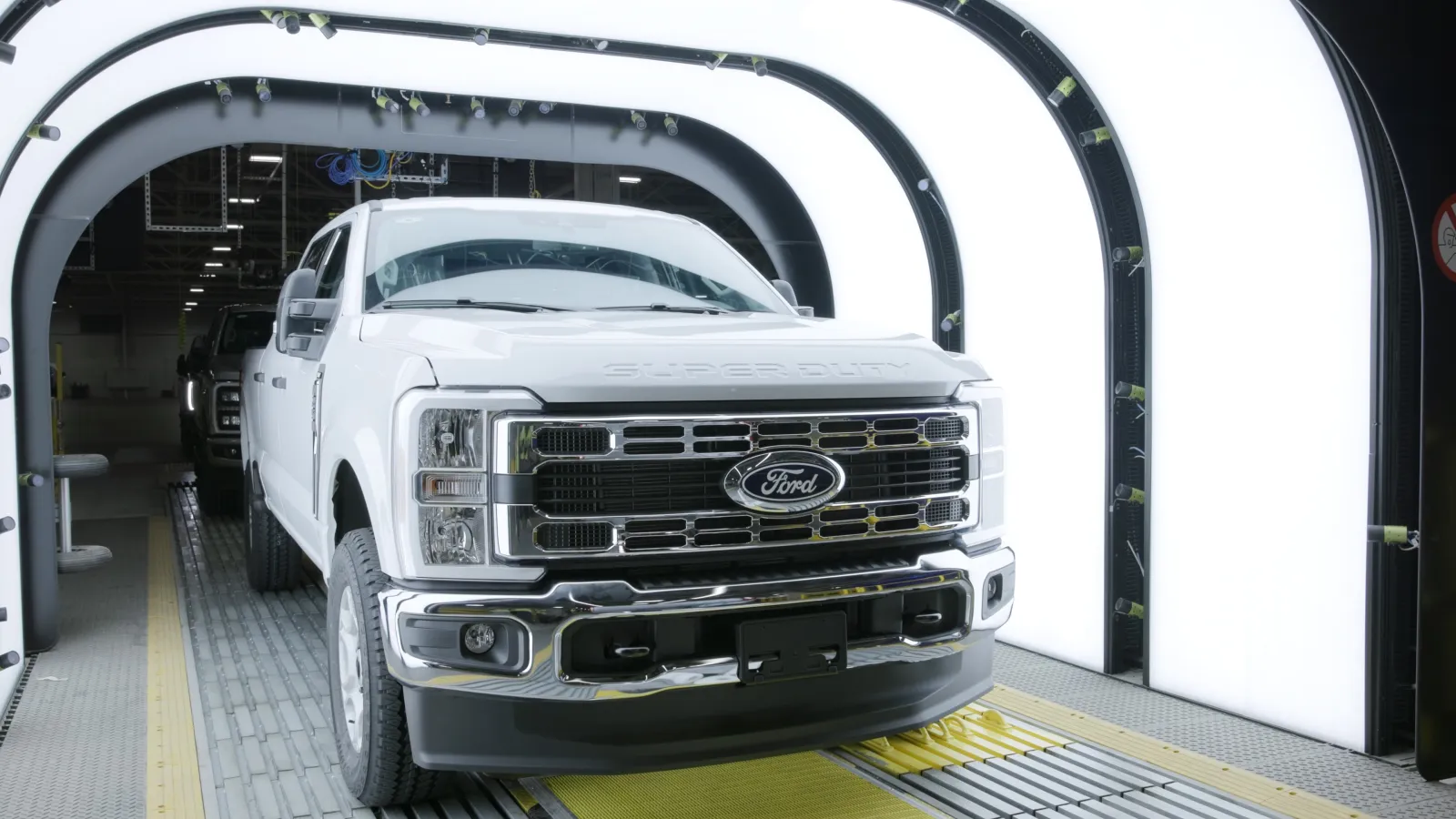
In July, it entered the competition to build the U.S. Army’s next tactical truck and said it would develop three prototypesbased on its Super Duty pickup.
The moves come as Ford’s EV business shrinks. Its Model e division lost $1.06 billion in the third quarter and $2.75 billion in the first nine months, and Ford has kept its forecast for a full-year loss of about $4.0 billion.
Ford has ended production of the F-150 Lightning electric pickup, and its U.S. sales of fully electric vehicles fell 71.2% in October to 1,355.
Last week it said it had finished converting its Oakville, Ontario, plant, once planned as its Canadian EV hub, to build V8-powered Super Duty pickups.
Ford is still preparing a new generation of lower-cost EVs. It has begun shipping battery cells from its Michigan plant for prototypes of the Fathom, a $28,350 electric pickup due in 2027.
Ford shares were up 4.0% at $11.62 at 12:29 p.m. in New York, in a broadly higher market. They are down 11.5% this year.